Egypt scores 7 out of 10 on the Prepared Travel difficulty scale — high, same band as Morocco and Tanzania but for structurally distinct reasons. Tahini (طحينة / tehina) is the invisible sesame vehicle that binds Egyptian cuisine together — drizzled into ful medames, blended into ta’ameya sauce, layered into baba ghanoug, and glossed on every shawarma — and Egyptian kitchens categorize it as ‘sauce’ rather than ‘sesame’ in the allergen sense, which means an English ‘no sesame’ request does not reliably activate the tahini category in a cook’s mind. An Egyptian Arabic card that names طحينة specifically is the bridge that closes that gap. There is no restaurant allergen disclosure law in Egypt — voluntary communication at the point of service is the only channel, which is why the written card matters more here than in regulated markets. Nile cruises compound the problem: ships lock menus at provisioning in Luxor before departure, so the allergen brief must reach the operator’s dietary coordinator 30+ days ahead of booking, not at check-in. In Cairo, severe traffic makes Uber or Careem to a named private hospital the operationally faster emergency pathway than the 123 ambulance line. Egyptian hospitality itself is famously warm — cooks genuinely want to help — but the challenge is matching their warmth to the right vocabulary (tahini, not just sesame) and the right channel (written, pre-arrival, to the kitchen).
🥘 Food & Culture
Egyptian food is the oldest continuously-documented cuisine in the world — bread baked with identifiable ancestors in the Old Kingdom, ful medames prepared in a form recognizable to a 12th-century Cairene. The through-line is bread and legumes: aish baladi (the flat loaf whose name means ‘life’), ful medames (slow-cooked fava beans — the national breakfast), and ta’ameya (Egyptian falafel, made from fava not chickpea, served with tahini sauce). Alexandria’s Mediterranean coast brings seafood and Greek-Egyptian feta; Upper Egyptian and Nubian cooking draws on date groves, dried okra, and Sudanese spice influence. The Nile cruise corridor is where most travelers encounter Egyptian food, and cruise kitchens have evolved a hybrid — European-fine-dining service protocols applied to Egyptian mezze, grilled meats, molokhia, and the compulsory final-night farewell buffet. Everywhere, tahini finds a way in.
Card Languages🇪🇬 EG ArabicMasri card for the cook Create now · MSAMSA card for labels & hospitals Build your card · ENEN card for concierge & Tourist Police Generate now
Core Safety Metrics — hover each for full explanation
Overall Allergy Travel Difficulty
7/10
High — tahini vocabulary gap + no restaurant law + Nile cruise captive dining + Cairo traffic
Egypt scores 7/10 — high difficulty. Tahini (طحينة) is structurally embedded in Egyptian cuisine as a sauce base that kitchens do not mentally categorize as ‘sesame’. No restaurant allergen law. The Nile cruise model creates 3-to-7-night captive dining hundreds of kilometers from any tertiary hospital. Cairo traffic makes Uber or Careem to a private hospital the operationally faster emergency pathway. Moderated by excellent Cairo private hospital infrastructure, upper-band Nile cruise dietary management, and warm Egyptian hospitality culture.
Allergen Labeling Law Strength
3/10
Packaged food only (EOS ES 1-2/2005) — no restaurant law, sesame notably absent
Egyptian Standard ES 1-2/2005 administered by EOS and enforced by the National Food Safety Authority (NFSA, established 2017) requires allergen declaration on pre-packaged foods. FALCPA-style big 8 framework. Sesame is notably absent from the mandatory list despite tahini’s structural role in Egyptian cuisine. No restaurant allergen disclosure law. Imported packaged goods at upscale supermarkets often carry EU or Gulf labels more comprehensive than domestic EOS labels.1
Kitchen Allergen Awareness
4/10
High at luxury tier, minimal at baladi — vocabulary gap is the constraint
Egyptian kitchen allergen awareness is bimodal. At Cairo and Alexandria luxury hotels, upper-band Nile cruises, and Red Sea international resorts, trained kitchens manage dietary requirements with European-standard rigor. At baladi venues (koshari carts, ful stands, Khan el-Khalili kitchens), the concept of food allergy has limited cultural penetration. Tahini specifically is the vocabulary gap — kitchens categorize it as ‘sauce’ rather than ‘sesame,’ and the gap is closed only by naming الطحينة on the card.4
Egyptian hospitality culture is famously warm — ahlan wa sahlan (welcome) is structural. Cooks will go out of their way to accommodate a named allergy when the communication reaches them in Egyptian Arabic. The constraint is structural: Nile cruises lock menus at provisioning, Red Sea resorts operate all-inclusive buffets, and baladi venues prepare single-menu items in batches. The reassurance reflex — ‘ya habibi, mafeesh mushkila’ — is a cultural response that a tourist may misread as factual confirmation of safety. Written card presentation bypasses the reassurance reflex.
Emergency Medical Reliability
5/10
Private Cairo hospitals are excellent — 123 line is traffic-limited
Cairo’s private hospital infrastructure — As-Salam International, Dar Al Fouad, Cleopatra — is internationally-accredited, English-capable, and reliably stocks epinephrine. The 123 ambulance line is operationally limited by Cairo traffic: dispatch may be 30–45 minutes in peak hours, making Uber or Careem to a private hospital the practical faster pathway. The Tourist Police (180) fields English reliably at major tourism destinations. Nile cruise medical events typically use on-board medic response followed by air-ambulance evacuation to Cairo if serious.2
Difficulty in context — how Egypt compares globally7 / 10 High
🇩🇰 Denmark 2🇦🇺 Australia 3🇿🇦 South Africa 6🇪🇬 Egypt 7🇮🇳 India 9
🐪
On the Ground
Egypt’s 7/10 is a map of what to prepare, not a reason to stay home. The primary challenge is vocabulary: ‘sesame’ in English does not reach the Egyptian kitchen concept of طحينة (tahina), and your Egyptian Arabic card must close that gap. The secondary challenge is channel: the hospitality reassurance reflex means verbal exchanges at baladi venues may produce warm answers that do not reflect kitchen reality — the card in writing, handed to the cook, bypasses this. The third challenge is captive dining: Nile cruises, Red Sea all-inclusives, and oasis camps lock menus before the diner arrives, so allergen communication must happen at booking, not at check-in. The paradox: Egypt’s most famous cultural experiences — the Nile cruise, the luxury hotel breakfast with the pyramids in view, the Red Sea reef resort — are often safer than the streetside koshari counter that no international tourist visits anyway. A prepared traveler who hands an Egyptian Arabic card naming tahini to the cruise’s chef de cuisine at boarding, to the hotel breakfast manager at check-in, and to any baladi cook they venture toward can experience Egypt with real confidence.
The Nile is waiting — are your three Arabic allergy cards ready?
Generate your Egypt food allergy cards in Egyptian ArabicMasri card for the cook → Create now, Modern Standard ArabicMSA card for labels & hospitals Build your card, and EnglishEN card for concierge & Tourist Police Generate now — each naming tahini (طحينة), ful (فول), samneh baladi, and your specific allergens in the vocabulary Egyptian kitchens recognize.
Egypt divides into six regional contexts for allergy travel, each with distinct cuisine, medical infrastructure, and operational risk profiles. The Luxor-Aswan Nile cruise corridor is the single most important regional context because that is where most international visitors encounter Egyptian food — and where the captive-dining model reshapes the allergen-communication protocol. Cairo and Alexandria have the strongest medical infrastructure; the Western Desert oases and interior Sinai are the most medically-remote destinations in the country. The regional risk color coding below reflects the combined operational difficulty — not just cuisine density.
Loading region map…
↑ Hover a governorate for region detail
🕌
Cairo & Nile Delta
MODERATE
Egypt’s commercial and culinary capital — densest mezze and baladi food culture, best private hospital infrastructure (As-Salam International, Dar Al Fouad, Cleopatra). Traffic-limited 123 ambulance response makes Uber/Careem to private hospital the practical emergency pathway.
Egypt’s second city and Mediterranean culinary hub — seafood-heavy cuisine (sayadeyya, fried calamari, grilled sea bass) with Greek-Egyptian feta and olive traditions. Alexandria University Hospital and Smouha Medical Center are the regional medical references.
The Nile cruise corridor — where most international visitors encounter Egyptian food. Captive-dining model: menus locked at provisioning in Luxor. Serious events evacuated by air to Cairo. OPERATIONAL PRIORITY: notify cruise operator at booking, not check-in.
↑ Tahini at every cruise breakfast · Ful and ta’ameya daily · Samneh baladi (Upper Egyptian dairy) · Cruise-galley cross-contact
🏖️
Red Sea Riviera
MODERATE
International resort strip — Sharm el-Sheikh, Hurghada, Marsa Alam, El Gouna, Dahab. European-resort logic with high allergen capacity at international 5-star chains (Four Seasons, Kempinski, Rixos). Structural buffet cross-contact at mid-tier all-inclusives. Sharm International and El Gouna Hospital are internationally-accredited references.
↑ Buffet tahini exposure · Red Sea seafood · All-inclusive cross-contact at mid-tier · Dive medicine well-established
⛰️
Sinai — Mount Sinai, St. Catherine, Taba
HIGH
Trekking and monastery-pilgrimage region beyond the Red Sea resort strip. St. Catherine has no tertiary hospital; serious cases evacuated to Sharm or by helicopter to Cairo. Bedouin cuisine (fatta, grilled lamb, dry-desert cooking). Mount Sinai dawn climbs require previous-day dietary planning at the monastery guesthouse.
↑ Bedouin fatta · Grilled lamb · Desert dairy · Tahini in Sinai-style mezze · Remote-medical stack
🏜️
Western Desert Oases
HIGH
Most medically-remote Egyptian destination — Siwa (Berber-influenced, closest to Libya), Bahariya, Farafra, Dakhla, Kharga. Medical evacuation routes to Alexandria (Siwa, 8+ hours) or Cairo. Siwi cuisine has distinct Berber-Saharan influences — dried dates, desert herbs, date palm syrup. No restaurant allergen capacity.
Egypt’s allergen map is defined by one structural through-line — tahini (طحينة / tehina), the ground sesame paste that is drizzled into ful medames, blended into ta’ameya sauce, layered into baba ghanoug, and glossed on every shawarma. Egyptian kitchens categorize tahini as a sauce rather than as sesame, which means ‘no sesame’ in English does not activate the kitchen’s tahini category. The Egyptian Arabic card must name both الطحينة and السمسم distinctly. The secondary structural allergen stack is legumes (fava — فول) in ful and ta’ameya, wheat in aish baladi and koshari, and garlic and onion in virtually every savory preparation. Sesame is notably absent from Egypt’s mandatory packaged-food allergen list despite tahini’s structural role — the single most consequential gap in the Egyptian labeling framework for international travelers. G6PD deficiency favism is a genuine clinical edge case for travelers of Mediterranean or Middle Eastern ancestry — see the Labeling Law section for the full clinical framing. Peanut, by contrast, is materially less structural in Egyptian cuisine than in Tanzanian or West African cuisines — making Egypt safer than expected for peanut-allergic travelers.
Airborne wheat at baladi bakeries: Baladi bakeries (مخابز بلدي) operate with substantial airborne flour — the baker is often working directly with flour in an open-front venue. Travelers with severe respiratory wheat sensitivity should avoid entering baladi bakery spaces directly. The aish baladi itself (sold outside the bakery, in bulk) is a separate question of ingestion, not airborne exposure.
Peanut is meaningfully safer in Egypt than in East or West Africa: Unlike Tanzania (karanga), South Africa (peanut butter and muesli bar additives), or West Africa (peanut oil), Egypt does not use peanut as a cooking oil, and peanut is materially less structural in Egyptian cuisine. The primary Egyptian peanut exposure is roasted ful sudani as a bar snack, and the peanut-variant of dukkah at some hotel breakfasts. For peanut-allergic travelers with no other MENA allergens, Egypt is a high-confidence destination.
Clinical prevalence note: MENA clinical allergen studies consistently rank egg, milk, and sesame as the top three pediatric clinical allergens, with sesame ranking notably higher than in Western cohorts — reflecting the structural role of tahini in the regional diet. Supply prevalence diverges from clinical prevalence: peanut is low-clinical and low-supply in Egypt, while sesame is high-clinical AND high-supply. The traveler’s risk map must follow supply prevalence, not clinical prevalence in their home country.4
Dish Allergen Map
Dish Allergen Map — 13 Egyptian Dishes
This table covers the dishes an international visitor is most likely to encounter across baladi venues, tourist-tier restaurants, Nile cruises, Red Sea resorts, and luxury hotels. The risk level reflects the operational difficulty of modifying the dish for the structural allergens named — not just the presence of the allergen. Five dishes (ful medames, ta’ameya, baba ghanoug, hummus, shawarma) carry tahini as the structural default and must be specifically requested without tahini for sesame-allergic travelers. Kofta mashwi (grilled spiced beef skewer) is the most reliable multi-allergen safe path. Um Ali stacks five allergens and is never a modification candidate — choose an alternative dessert.
Slow-cooked fava beans, national breakfast. Tahini drizzle is the structural default — not an optional garnish. Many cooks initially resist ‘ful without tahini’ as an incomplete dish. Request: ‘من غير طحينة’ (ful min gheir tahina). G6PD clinical edge case — fava unavoidable.
CRITICAL REGIONAL DIVERGENCE: Egyptian ta’ameya is made from fava beans, NOT chickpeas (unlike Levantine falafel). Sesame is both the tahini dipping sauce AND the coating rolled on the patties before frying. Shared-oil fryer risk. Safe path: ‘هل طعمية مغطية بالسمسم؟’
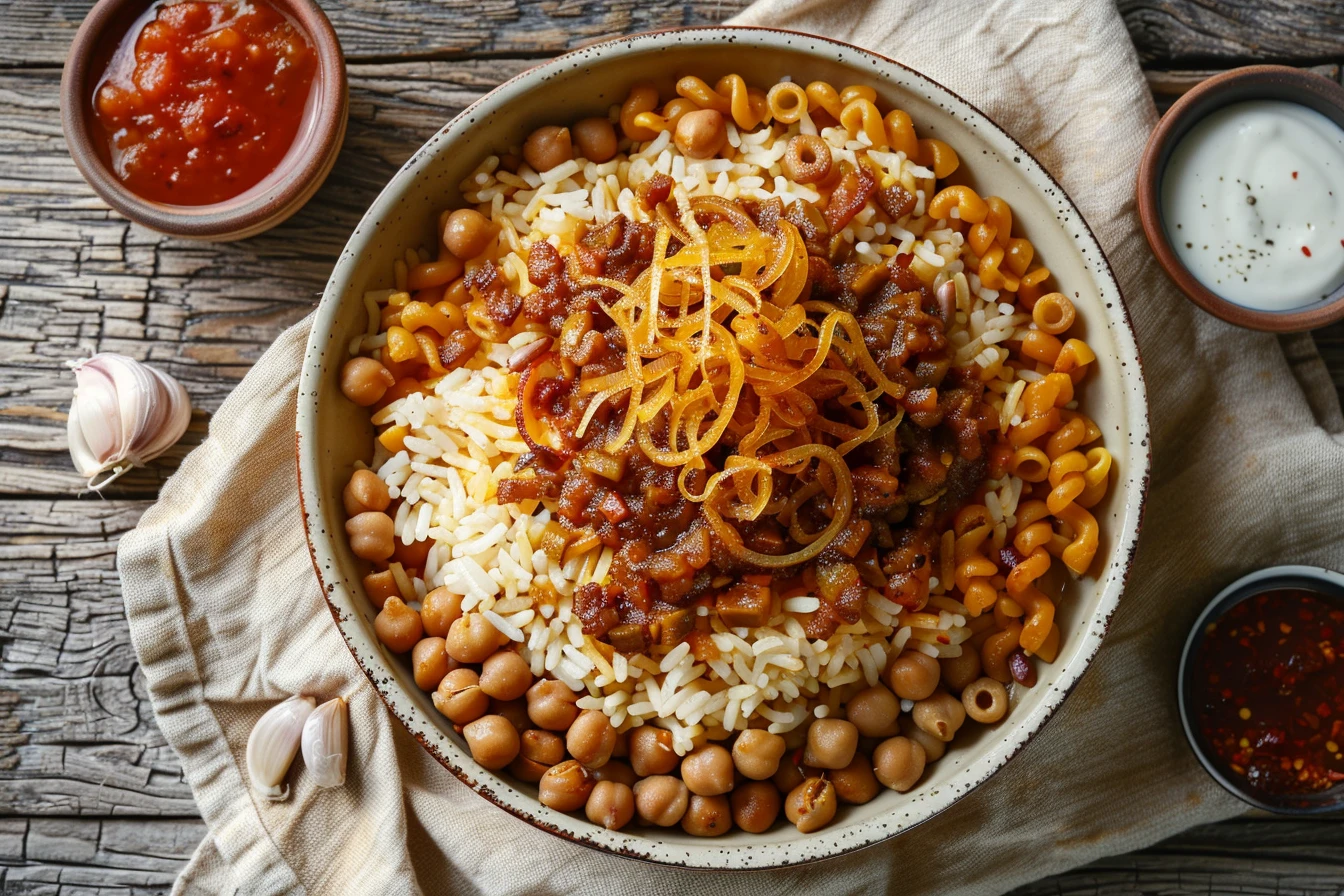
National street-food dish at Abou Tarek, Koshari Ali’s, Tahrir Koshari. Combines wheat pasta, rice, brown lentils, chickpeas, fried onions, tomato sauce, garlic-vinegar dakka, and chili shatta. NOT wheat-free despite being rice-based — pasta is structural, not optional. Not modifiable at service.
Green jute-leaf stew served over rice — naturally wheat-free, dairy-free, sesame-free, legume-free in its plain form. Safe path for most multi-allergen travelers EXCEPT garlic and onion (structural in the taqleya tempering) and coriander-allergic travelers. Request: ‘ملوخية مع روز بس، من غير عيش’.
Meat shaved from a vertical spit, served in aish baladi wrap with tahini-based sauce, pickled vegetables, and tomato. Tahini is the default sauce across Egyptian shawarma. Platter version (‘شاورما في طبق’) without wrap or tahini is the modification path.
Smoky grilled eggplant blended with tahini, garlic, lemon, and olive oil. Tahini is 30-40% of the dish by volume — not a garnish. There is no modification path: baba ghanoug without tahini is a different dish (Egyptian-style mashed grilled eggplant with garlic). For sesame-allergic travelers, avoid entirely.
Chickpea-and-tahini dip at mezze service. Egyptian hummus is less tahini-heavy than Levantine preparations but tahini is still 15-20% of the dish. Avoid for sesame-allergic travelers. Chickpea preparation also means distinct from the fava-based ful.
Vegetables (cabbage leaves, courgettes, peppers, vine leaves, tomato) stuffed with seasoned rice. Regional variants include bulgur in the stuffing and samneh baladi as the braising fat. Ask: ‘هل الحشو فيه برغل ولا سمنة ولا لحمة؟’
Grilled spiced beef skewers — the most reliable multi-allergen safe path in Egyptian cuisine. No structural wheat, dairy, sesame, or nuts in the preparation itself. Structural onion and baharat only. Request plated (‘في طبق’) with rice, no tahini, no bread.
Celebration dish for Eid al-Adha, weddings, and special occasions — layers of toasted aish, rice, and braised beef or lamb with garlic-vinegar dakka. Samneh baladi (aged clarified butter, full dairy allergen) is the traditional braising fat in upper-band preparations. Ask: ‘هل الفتة متعملة بسمنة بلدي ولا بزيت؟’
Alexandrian fish-and-rice pilaf — spiced rice cooked in fish stock with caramelized onions. Naturally wheat-free and dairy-free. Fish varies by daily catch: bolti (tilapia), sea bass, or sardine are common. Ask for the specific species of the day.
Egypt’s signature dessert — and a five-allergen stack. Torn puff-pastry or filo layered with milk, sugar, pistachios, almonds, walnuts, coconut, raisins, and egg-enriched cream; baked until golden. No modification path. Alternative dessert: fresh fruit.
Upper Egyptian clay-pot casserole — slow-braised meat or chicken with vegetables. Samneh baladi (aged clarified butter) is the distinctive Upper Egyptian braising fat — ask specifically: ‘هل الطاجن متعمل بسمنة بلدي ولا بزيت؟’ For Nile cruise travelers, this is the Upper Egypt regional specialty encountered at on-shore lunches.
MODERATE
Safest Egyptian dishes for multi-allergen travelers:Kofta mashwi (grilled spiced beef skewers without tahini drizzle) and plain firakh mashwi (grilled chicken without sauce) are reliable. Molokhia is wheat-free, dairy-free, sesame-free, and legume-free in its plain form (structural garlic only). Plain white rice (روز أبيض), Sayadeyya (Alexandrian fish-and-rice pilaf), and fresh whole fruit (manga, gawafa, inab, battikh) round out the reliable-safe-path repertoire. Critical: every mezze spread arrives with tahini by default. Ask ‘من غير طحينة’ (min gheir tahina) on every order for sesame-allergic travelers — the absence of tahini is the modification; its presence is the default.
Buffet cross-contact at Nile cruise and hotel breakfast: Nile cruise and international hotel breakfast buffets are the highest single risk point at otherwise allergen-aware venues. Shared serving utensils move between adjacent dishes, ful medames with its tahini drizzle sits next to ta’ameya, dukkah-sprinkled dishes sit next to plain items, and kahk-and-halawa sesame sweets sit on the dessert end of the spread. At upper-band cruises (Sanctuary, Oberoi, Viking) and luxury hotels (Four Seasons, Mena House, Winter Palace, Old Cataract), request à la carte breakfast preparation in lieu of the buffet line — upper-band venues accommodate this as standard hospitality practice for a dietary-noted guest.
Where to Eat
Venue Safety Profile
Egyptian venues cluster into eight operational tiers, from baladi ful carts (high risk, no modification capacity, but low cost for the local experience) to upscale Cairo French-Egyptian fine dining (most reliable, brigade kitchens at European standards). The key insight: Egypt’s most-famous tourism experiences — the Nile cruise, the Red Sea resort, the luxury hotel with pyramids in view — are often safer than the streetside ful cart, provided the allergy is disclosed at booking rather than check-in. The Cairo traffic emergency protocol and the Ramadan timing callouts below apply across all venue tiers.
Informal street venues operating in Egyptian Arabic only with no allergen awareness framework. Ful carts, koshari counters (Abou Tarek, Koshari Ali’s), ta’ameya stations, and Khan el-Khalili grills. Vocabulary mismatch is structural — ‘allergy’ in English does not translate into ful-cart operational reality.
Not recommended for severe multi-allergen travelers. If visiting: hand the Egyptian Arabic card directly to the cook (not the order-taker), watch the cook read it, and ask closed-ended questions about tahini. Severity language (ممكن أموت) may be necessary.
HIGH
🍽️Mid-Range Tourist Restaurant (Khan el-Khalili, Luxor tourist strip, Aswan corniche)
Traditional Egyptian restaurants serving mezze, grilled meats, and signature dishes to tourists. English proficiency at the server level, often Arabic-only in the kitchen. Menus are typically bilingual Arabic-English.
Egyptian Arabic card for the kitchen, English card for the server. Order grilled meats (kofta mashwi) with plain rice and plain salad without mezze spread to avoid structural tahini. Request ‘min gheir tahina’ verbally alongside the card for every sauced dish.
MOD
⛵Budget Nile Cruise / 3-Star Dahabiya ($100-200/night)
Lower-tier cruise operators and traditional dahabiya sailing boats with minimal formal dietary protocols. Small kitchens (2-3 cooks, provisioning from small local markets), limited substitution capacity, informal buffet service with no written ingredient disclosure.
Not recommended for severe allergies without extensive pre-negotiation. If booking: written allergy disclosure 30+ days before departure, confirmation that the chef has been briefed, confirmation of substitute ingredient sourcing, and understanding that the operator’s accommodation may be best-effort not guaranteed.
HIGH
🏨Red Sea Mid-Tier All-Inclusive Resort (4-star Hurghada, Sharm, Marsa Alam)
Mid-tier all-inclusive resorts (Steigenberger, Stella, Sunrise, Pickalbatros chains) with buffet-heavy dining model. Allergen awareness varies by property — some chains have formal allergen-intake at check-in, others do not. Structural risk is the all-inclusive buffet format itself.
Request à la carte breakfast preparation at check-in — most mid-tier resorts can accommodate but do not advertise. For dinner, the à la carte restaurants (where available) are safer than the main buffet. Verify tahini presence on every mezze dish. Children’s meal options are often tahini-free simpler preparations.
MOD
🚢Upper-Band Nile Cruise (Sanctuary Sun Boat, Oberoi Philae/Zahra, Viking Osiris, Mövenpick Royal Lily)
Upper-band cruise operators with formal dietary-intake protocols at booking. Chef de cuisine typically briefed before departure; substitute ingredients added to provisioning. À la carte preparation available on request as alternative to buffet.
Notify via operator email at booking — not just on booking form. Request written confirmation that the dietary notice has reached the chef. Reconfirm 72 hours before departure. Hand the Egyptian Arabic card to the chef de cuisine at the first dinner. Reconfirm daily at breakfast with the restaurant manager.
LOWER
🌴Cairo / Alexandria / Luxor / Aswan Luxury Hotel (Four Seasons, Mena House, Winter Palace, Old Cataract, Kempinski)
Upper-band international hotel properties with trained hospitality staff, multilingual kitchen (English + French for upscale chefs), formal allergen-intake documentation, and chef-level oversight of dietary requests. Breakfast can be prepared à la carte in the kitchen; dinner restaurants typically have detailed allergen information.
Disclose allergies at booking via email — not just on arrival. Request a written allergen intake from the hotel F&B team. At breakfast, request à la carte preparation rather than the buffet. Executive chef accessibility is high at this tier.
Upper-band Red Sea resorts with formal allergen-intake, trained chefs, and individual meal preparation as standard. European-hotel operating model fully translated to the Red Sea context.
Standard allergen-intake at check-in applies. Breakfast should be requested à la carte rather than from the buffet. At dinner, the specialty restaurants (Italian, Japanese, French) typically have detailed ingredient lists in English. Dive-medicine coordination is well-established for the Red Sea diving community.
LOWER
🍷Cairo New Cairo / Zamalek French-Egyptian Fine Dining (Pier 88, Sequoia, Zooba, Abou El Sid upscale)
Upper-band Cairo restaurants operating at European-fine-dining standards with trained brigade kitchens, allergen-intake protocols, and executive chef accessibility. The restaurants tourists often discover only through concierge recommendations — some with French kitchen heritage (Cairo’s upper-Zamalek historical French-educated cook tradition).
English or MSA card works here — the Egyptian Arabic card is less critical because the kitchen operates in French/English internally. Allergen-intake happens at reservation; reconfirm with the maître d’ at seating. These venues are the single safest Egyptian dining context for the allergic traveler.
MOST RELIABLE
Cairo Traffic — Uber/Careem to Hospital, Not 123 Ambulance: In Cairo, the operationally faster anaphylaxis response is Uber or Careem to a private hospital (As-Salam International, Dar Al Fouad, Cleopatra) — NOT the 123 national ambulance line. Peak-hour Cairo traffic makes 123 response times 30-45 minutes on the ring road. Brief the driver by hospital name before the emergency: ‘مستشفى السلام الدولي’ or ‘مستشفى دار الفؤاد،’. This is the single most important non-dining safety decision for Cairo travelers.
Ramadan Dining Shifts — Timing and Menu Change: During Ramadan (dates shift annually — 2026 runs approximately February 17 to March 18), most restaurants and cafés close during daylight hours and reopen for iftar (sunset) with ful medames, ta’ameya, harira-style lentil soup, and qamar al-din apricot juice as the standard fast-breaking spread. International hotels and tourist-corridor venues continue daytime service; baladi venues do not. Qamar al-din carries sulfite load. Plan around iftar for severe allergy travelers — the pre-iftar window (5-6pm) at tourist hotels is the thinnest-crowd quietest-kitchen option for à la carte service.
Languages
Languages & Kitchen Reach
Egypt is a diglossic Arabic country — Egyptian Arabic (العامية المصرية / Masri) is the spoken kitchen language universally, while Modern Standard Arabic (الفصحى / MSA) is the written language of packaged food labels, formal menus, and hospital intake. Prepared Travel ships three separate Egypt cards: Egyptian Arabic (for the cook at every venue), MSA (for packaged labels, hospitals, and pharmacies), and English (for concierge, cruise director, and Tourist Police). French reaches a narrow slice of older Alexandrian service staff and some Cairo luxury hotel concierges — context-only, no dedicated card. Nubian and Siwi Berber are cultural-context languages in specific oases; kitchen reach happens via Arabic in both communities.
Language
Kitchen Penetration
Primary Regions
Usage
Egyptian Arabic (Masri) العامية المصرية · 🇪🇬
Egyptian Arabic is the kitchen language at every Egyptian venue — baladi cart, koshari counter, Khan el-Khalili grill, Nile cruise galley, luxury hotel kitchen. The primary safety card must be in Egyptian Arabic; the tahini question reaches the cook through Masri vocabulary (طحينة / tahina), not MSA abstractions.
Nationwide — universal spoken language across all of Egypt, all social classes, all venue tiers. Card language for every in-kitchen communication.
~100%
Modern Standard Arabic الفصحى · 🇪🇬
MSA is the written register across Egypt — every literate Egyptian reads it regardless of their spoken dialect. Packaged food ingredient lists, EOS-compliant allergen declarations, pharmacy labels, hospital intake forms, and formal restaurant menus are all written in MSA, not Egyptian Arabic.
English reaches the concierge, the cruise director, the hotel breakfast manager, the executive chef at upper-band venues, and the Tourist Police hotline (180). Does NOT reach the baladi cook, the koshari counter, or the Khan el-Khalili grill operator — English is the tourism-front-of-house language, not the kitchen language.
Tourism-corridor front-of-house — Cairo luxury hotels, Luxor/Aswan cruise coordinators, Red Sea resort staff, Zamalek/New Cairo business and fine-dining district. Tourist Police (180). English-medium schools and universities.
~35%
French الفرنسية · 🇫🇷
French reaches a narrow slice of older-generation Alexandrian service staff, some Cairo luxury hotel concierge teams with French-curriculum schooling, and the executive chef brigade at historic upper-band Cairo restaurants. Context-only — no dedicated Prepared Travel French card for Egypt.
Historic Alexandria (older generation), Cairo upper-Zamalek and Heliopolis families, some luxury hotel and fine-dining staff.
~3%
Nubian (Nobiin / Kenzi) ⳬⳞⳡ⳧⳧Ⳟ · 🏴
Nubian-speaking communities in Aswan and the Lake Nasser region are bilingual in Nubian and Arabic. Arabic is the kitchen language; Nubian is the community language. No dedicated Nubian card; the Egyptian Arabic card reaches Nubian-community venues.
Aswan, Lake Nasser, Sudanese-border southern Egypt — Nubian cultural communities.
~300k
Siwi (Berber) Jlan n Isiwan · 🏴
Siwa is a Berber-cultural enclave in the Western Desert; the Siwi language is a distinct Berber language, not Arabic. Siwi community members speak Arabic as a second language, often less fluently in older generations. The Egyptian Arabic card functions in Siwa Oasis tourism venues but may require visual confirmation of comprehension.
Siwa Oasis — Western Desert, close to the Libyan border.
~20k
Three cards, three contexts — Egypt’s diglossia is operational, not cosmetic: The Egyptian Arabic card reaches the cook (where the ingredient decision happens). The MSA card reaches packaged food labels, hospital intake, and the literate-Egyptian universal-reach context. The English card reaches concierge, cruise director, and the 180 Tourist Police hotline. Each card is used in a distinct context — not as a ‘backup’ but as the correct tool for a specific channel. Carry all three printed; carry all three in digital wallet. Hand the Egyptian Arabic card to the cook at every baladi and Nile-cruise-galley interaction.
Contextual Intelligence
Nile Cruises & Upper Egypt Touring
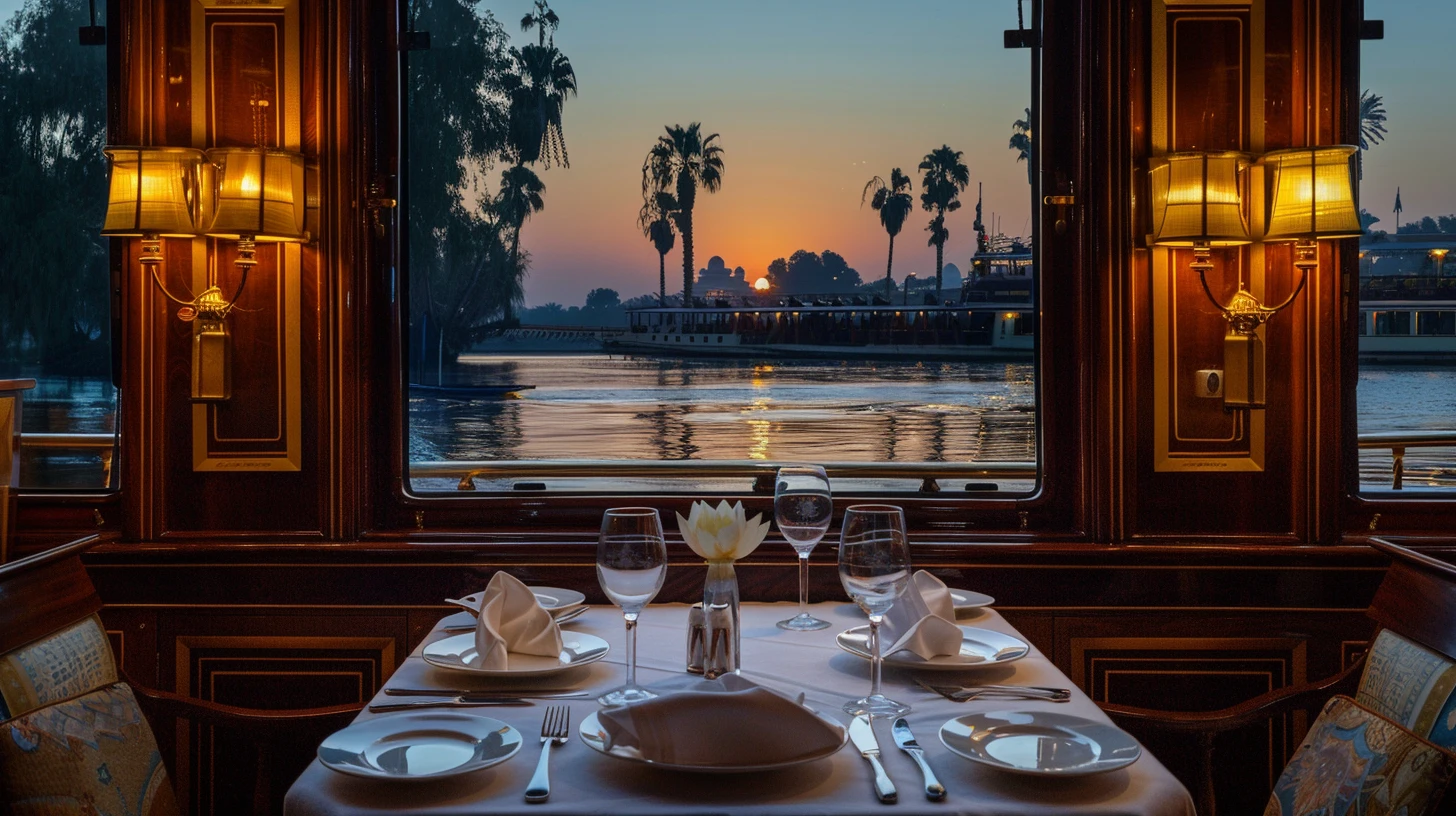
The Luxor-Aswan Nile cruise corridor is where most international visitors encounter Egyptian food — and where the captive-dining model fundamentally reshapes the allergen-communication protocol. Cruise ships load seven days of provisions at Luxor or Aswan before departure and have no meaningful resupply once sailing. For food-allergic travelers, the Nile cruise can be one of the safest Egyptian dining environments (when the operator receives written advance notice 30+ days before departure and briefs the chef de cuisine at booking) or one of the highest-risk (when the allergy is disclosed at boarding and the supply chain has no capacity to respond). The four subsections below are the operational rules.
🚢
You’re on a boat. You must pre-negotiate every meal.
A Nile cruise in October 2026 departs Luxor loaded with seven days of provisions sourced from Luxor and Cairo wholesalers. The chef has received your dietary brief from the operator 30 days ago. Substitute ingredients — sesame-free breakfast options, tahini-free mezze alternatives, non-fava legume substitutes — were added to the provisioning list before the supply truck arrived. The kitchen has planned your meals into the daily rota. This is the structural answer to Egypt’s Nile cruise allergen question. The cruise does not fail at dinner. It fails at booking, when the dietary brief was not written down, or at check-in, when the ship has already departed its provisioning point and the supply chain has no capacity to source substitutes. Your action: written allergy disclosure to the operator’s dietary coordinator at booking. Reconfirm 72 hours before departure. Hand the Egyptian Arabic card to the chef de cuisine at the first dinner.
📦
Supply Chain — Provisioning Happens at Luxor, Before Departure
Nile cruises operate on a single-provisioning model: the ship loads supplies at Luxor (for Luxor-to-Aswan itineraries) or Aswan (for reverse itineraries) before the voyage begins, and there is no meaningful resupply once the ship has sailed. Small supply runs happen at Edfu and Kom Ombo — the intermediate stops where the cruise ties up at the temple visits — but these are for perishables only (fresh produce, bread, sometimes fish) and not for specialty ingredients.
Substitute ingredients for dietary requirements — gluten-free bread, sesame-free breakfast spreads, dairy-free desserts, legume-free mezze alternatives — must be sourced at Luxor/Aswan provisioning. This is why advance notice matters: the window to add your substitutes to the provisioning list is measured in days before departure, not hours.
Operational rule: Upper-band operators coordinate provisioning with a dietary coordinator weeks ahead; budget operators source day-of and cannot adjust.
📅
Advance Notice Protocol — 30+ Days, In Writing, to the Operator
The single most consequential action a Nile cruise traveler with allergies takes is the written allergy disclosure to the cruise operator’s dietary coordinator at booking. Not the booking-form dietary-notes field, which may not reach the ship. A direct email to the operator’s reservations or guest-relations address, 30+ days before departure, stating the allergy profile in English, naming tahini (طحينة) and your specific allergens, and requesting written confirmation that the chef de cuisine has been briefed and that substitute ingredients have been added to the provisioning list.
Upper-band operators (Sanctuary, Oberoi, Viking, Mövenpick, Nile Goddess) treat this as standard hospitality practice; mid-tier cruises accommodate with effort; budget dahabiyas and 3-star cruises may not accommodate at all.
Operational rule: Reconfirm 72 hours before departure. Re-introduce the allergy verbally at boarding, hand the Egyptian Arabic card to the chef de cuisine at the first dinner, and reconfirm daily at breakfast with the restaurant manager.
🌡️
Buffet Cross-Contact & Medical Evacuation Distance
Two structural risks stack at Nile cruises even when the operator has accommodated the allergy: (1) breakfast buffet cross-contact — ful medames station with tahini drizzle sits adjacent to ta’ameya station, shared tongs move across dishes, dukkah condiment bowls sit near the bread basket; (2) medical evacuation distance — from the Nile corridor between Luxor and Aswan, the nearest tertiary hospital is Luxor International Hospital or Aswan University Hospital for stabilization, and any serious case requires air-ambulance evacuation to Cairo (a 60-to-90-minute flight plus ground transit, plus the 2-to-4-hour coordination window to get the aircraft from Cairo).
The combined risk profile means the buffet format must be bypassed (request à la carte breakfast preparation) and that carrying two auto-injectors plus a FRIO wallet is not optional. Upper-band cruises have on-board medics with epinephrine; budget cruises do not.
Operational rule: Confirm on-board medic capability at booking. For cruise travelers, medical-grade travel insurance with air-ambulance coverage (AIG, Allianz, or equivalent) is strongly recommended.
🍽️
À La Carte Substitution — The Safe Path at Upper-Band Cruises
Upper-band Nile cruises — Sanctuary Sun Boat IV, Oberoi Philae and Zahra, Viking Osiris and Aton, Mövenpick Royal Lily, and the upper-tier Mövenpick, Iberotel, and Sonesta vessels — offer à la carte preparation as an alternative to buffet dining for dietary-noted guests. This is the single most effective operational protocol for Nile cruise allergen safety: instead of navigating the buffet cross-contact, your meals are prepared to order in the kitchen, plated individually, and brought to your table.
Request this at check-in; reconfirm at the first breakfast. Most upper-band operators do not advertise this option — it is available on request. Specify your allergens each day, not just once. At dinner, the à la carte Egyptian menu is typically simpler to navigate (grilled meats, plain rice, vegetable sides) than the buffet breakfast.
Operational rule: This protocol converts the Nile cruise from a moderate-risk captive-dining context into one of the genuinely safer Egyptian dining environments — when the operator supports it.
Phrases
Egyptian Arabic Safety Phrases
Eight scenarios covering the communications most likely to matter for an allergic traveler in Egypt. The declaring phrase and the tahini question are the two most important — use them at every venue. The Cairo emergency Uber/Careem phrase and the Tourist Police 180 English script are the two emergency primitives. Egyptian Arabic is the primary register; MSA appears alongside where the formal hospital/pharmacy context warrants it. Written card + verbal phrase is the layered protocol; neither alone is sufficient at severe-allergy levels.
Scenario 01
Declaring your allergy — sesame and tahini
Egyptian ArabicEssential
عندي حساسية شديدة من السمسم والطحينة
‘andi ḥasasiya shadida min al-simsim wa al-tahina
I have a severe allergy to sesame and tahini. Name the vehicle AND the source: al-simsim (sesame seed) and al-tahina (tahini paste) are distinct categories in Egyptian kitchens — name both.
Egyptian ArabicSeverity
ممكن أموت لو أكلت دا
mumkin amout law akalt da
I could die if I eat that. Severity escalation phrase — not hyperbolic in Egyptian medical vocabulary, used when the kitchen has not absorbed the seriousness from the standard declaration.
MSAFormal / Hospital
لدي حساسية شديدة من السمسم ومنتجاته
ladaya ḥasasiya shadida min al-simsim wa muntajatih
I have a severe allergy to sesame and its products. Formal MSA register for hospital intake, pharmacy communication, and written documents.
EnglishConcierge / Cruise Director
I have a severe sesame allergy — this includes tahini, which is in many Egyptian dishes.
For concierge, cruise director, and executive chef at upper-band venues. Specify that tahini falls within the sesame category, because Egyptian kitchens often do not mentally group them together.
Scenario 02
Asking about tahini as a hidden vehicle
Egyptian ArabicCritical question
في طحينة في الأكل دا؟
fi tahina fi al-akl da?
Is there tahini in this food? Primary question to ask for every sauce, mezze dish, ful, and ta’ameya. Egyptian kitchens answer this specifically when the question names tahina, not just ‘sesame.’
Egyptian ArabicBuffet-line question
الصلصة دي عليها طحينة؟ أنهي الأطباق عليها طحينة؟
al-salsa di ‘aleha tahina? anhi al-atbaq ‘aleha tahina?
Does this sauce have tahini on it? Which dishes have tahini on them? Buffet-line question for hotel breakfast and Nile cruise breakfast service — ask the restaurant manager or breakfast chef directly.
Scenario 03
Confirming a dish is safe — double-verification
Egyptian ArabicDouble-check
متأكد إن ده خالي من السمسم والطحينة والفول؟
muta’akkid inn da khali min al-simsim wa al-tahina wa al-ful?
Are you sure this is free from sesame, tahini, and fava? The double-verification phrase after the first confirmation. Egyptian hospitality culture’s reassurance reflex means the first answer may be warmer than factual — ask twice in different phrasing.
Scenario 04
Nile cruise boarding — meeting the chef de cuisine
Egyptian ArabicCruise boarding
مساء الخير. بعت إيميل قبل الرحلة عن الحساسية بتاعتي. ممكن أقابل الشيف؟ عندي الكارت بالعربي.
Good evening. I sent an email before the trip about my allergy. Can I meet the chef? I have the card in Arabic. Use at the first dinner of the cruise — request the introduction through the restaurant manager or cruise director.
Scenario 05
At the hotel breakfast — requesting à la carte
Egyptian ArabicLuxury hotel
ممكن أطلب فطار يتحضر خصوصاً ليا؟ عندي حساسية شديدة — مش هاقدر آكل من البوفيه.
mumkin aṭlub fiṭar yetḥaḍḍar khuṣuṣan liya? ‘andi ḥasasiya shadida — mish ha-a’dar akul min al-buffet.
Can I order a breakfast prepared specifically for me? I have a severe allergy — I won’t be able to eat from the buffet. Use at luxury hotel and upper-band Nile cruise breakfasts.
Scenario 06
Asking about shared oil at informal venues
Egyptian ArabicInformal venues
الزيت دا بتقلوا فيه كمان طعمية أو حاجة فيها سمسم؟
al-zayt da bitiqlu fih kaman ta’ameya aw haga fiha simsim?
Do you also fry ta’ameya or anything with sesame in this oil? Shared-fryer question for koshari counters, ta’ameya stations, and Khan el-Khalili grill stations. Cross-contact via shared oil is a structural risk at informal venues.
Scenario 07
Emergency — anaphylaxis in Cairo traffic
Egyptian ArabicEmergency — Uber/Careem
ودني على طول مستشفى السلام الدولي — أقرب طريق. عندي حالة طوارئ.
Take me directly to As-Salam International Hospital — fastest route. I have an emergency. For Cairo anaphylaxis, Uber or Careem to a named private hospital is typically faster than 123 ambulance dispatch. Substitute the hospital name: Dar Al Fouad (دار الفؤاد) or Cleopatra (كليوباترا) depending on proximity.
Egyptian ArabicEmergency — 123 line
إسعاف! واحد عنده حساسية شديدة — ناخد حقنة الإبينفرين. محتاجين مستشفى دلوقتي.
Ambulance! Someone has a severe allergy — we’ve given the epinephrine injection. We need a hospital now. For 123 dispatcher calls. Not the primary pathway in Cairo traffic — private-hospital via Uber/Careem is typically faster.
Scenario 08
Tourist Police (180) — English-language support
EnglishTourist Police 180
I need urgent medical assistance. I have a severe food allergy and I am at [location]. Please help me reach the nearest private hospital with English-speaking staff.
Tourist Police (180) dispatchers speak English reliably at major tourism destinations — Cairo, Alexandria, Luxor, Aswan, Sharm el-Sheikh, Hurghada, St. Catherine. 180 coordinates translation, routes to private hospitals, and can arrange direct transport. For English-only speakers in Egypt, 180 is the fastest emergency pathway, often faster than the 123 ambulance line.
Pronunciation
Allergen Pronunciation Glossary
How to say and read each allergen in Egyptian Arabic, Modern Standard Arabic, and English. The Egyptian Arabic column is the kitchen register; MSA is the formal packaged-label and hospital register. Always prefer the printed card so staff can read the terms directly — these phonetic cues are verbal-communication supplements, not replacements for the written card.
Arabic script on Egyptian packaged food labels uses Modern Standard Arabic (الفصحى). EOS-compliant packaged food in formal retail (Seoudi, Carrefour Egypt, Metro Markets, Spinneys) displays allergen information in MSA and usually also in English on export-oriented brands. The allergen declaration typically appears at the end of the ingredient list in a “يحتوي على” (yahtawi ‘ala — “contains”) section. Save the characters below to your phone for pattern-matching on labels and menus.
طحينة
TAHINA / TAHINI
Ground sesame paste — the structural sauce base of Egyptian cuisine. Primary through-line allergen. Appears on packaged halawa and tahini jars, and as a named ingredient in ful and mezze descriptions.
سمسم
SIMSIM / SESAME SEED
The allergen category itself. Appears on packaged bread with sesame toppings, on ta’ameya rolled in sesame, and in commercial spice blends.
فول
FUL / FAVA BEANS
Structural Egyptian legume. On menus as ful medames, in ingredient lists as fava base, and as the defining ingredient of ta’ameya. G6PD clinical edge case.
طعمية
TA’AMEYA / EGYPTIAN FALAFEL (FAVA)
Egyptian falafel — fava-based, NOT chickpea-based. Legume-plus-sesame stacked vehicle (often rolled in sesame before frying).
حليب
HALIB / MILK
Standard dairy term on packaged labels. Also لبن (laban — fresh milk/yogurt), زبدة (zibda — butter), جبنة (gibna — cheese).
سمنة
SAMNEH / AGED CLARIFIED BUTTER
Upper Egyptian and baladi dairy vehicle — full milk allergen despite its clarified appearance. Structural in Upper Egyptian tagen and fattah.
بيض
BEID / EGG
Standard egg term. In shakshuka, fiteer meshaltet, basbousa, kahk, and Egyptian breakfast preparations.
قمح
QAMH / WHEAT
Standard wheat term on packaged labels. Also عيش (aish — bread), دقيق (daqiq — flour), سميد (samid — semolina).
سمك
SAMAK / FISH
Standard term. Also species: بلطي (bolti — Nile tilapia), سردين (sardine), تونة (tuna), and fermented فسيخ (fesikh).
قشريات
QISHRIYAT / SHELLFISH
Standard MSA term on packaged labels. Also جمبري (gambari — shrimp, common Egyptian restaurant term), كابوريا (kaboria — crab), calamari, squid.
مكسرات
MUKASSARAT / TREE NUTS
Standard MSA term. Specific nuts: فستق (fustuq — pistachio), لوز (louz — almond), بندق (bunduq — hazelnut), صنوبر (sonobar — pine nut).
يحتوي على
YAHTAWI ‘ALA / “CONTAINS”
Keyword to find on every EOS-compliant label. The allergen declaration phrase. Look for this at the end of the ingredient list — anything after “yahtawi ‘ala” is the allergen summary.
Reading Egyptian packaged food labels: On Egyptian packaged food, the allergen declaration typically appears at the end of the ingredient list in a “يحتوي على” (yahtawi ‘ala / contains) statement. Major export-oriented brands (Halwani Bros, Juhayna, Edita, Domty) also carry parallel English labeling — check both. Formal retail (Seoudi, Carrefour Egypt, Metro Markets, Spinneys) is reliably labeled; baladi-market bulk goods, street-vendor sweets, and informal producers often have no labeling at all. Halawa (sesame confection) and tahini jars carry the clearest sesame labeling — these are typically unambiguously marked.
Reading Egyptian restaurant menus: On restaurant menus, watch for طحينة (tahini — structural in ful, mezze, and shawarma sauces), فول (ful — base of ful medames and ta’ameya), بسبوسة (basbousa — semolina cake with eggs), and أم علي (um ali — tree-nut-and-dairy bread pudding). Menus in English will list ‘tahini,’ ‘fava beans,’ ‘sesame,’ and ‘pistachio’ — the English card reading is more straightforward than the Arabic menu reading for most international travelers. At tourist-tier restaurants, bilingual Arabic-English menus are standard; at baladi venues, Arabic-only menus are the norm and the Egyptian Arabic card is the primary tool.
Etiquette
Cultural & Communication Etiquette
Egyptian hospitality culture runs warm and fast, and the reassurance reflex (‘ya habibi, mafeesh mushkila’) is the single most consequential cultural pattern for allergic travelers to understand: it is an expression of care, not a factual confirmation. Written Egyptian Arabic consistently outperforms verbal English. Direct refusal is culturally uncomfortable in Egypt — accepting an indirect redirect (‘try the other dish’) is often the cook’s honest safety communication. Ramadan timing (February 17 - March 18 in 2026) fundamentally reshapes Egyptian dining rhythms.
📋
Show the card — in Egyptian Arabic — directly to the cook
Written Egyptian Arabic carries more weight than spoken English from a visitor, even at venues where the server speaks English. The card is a physical artifact the cook can hold, read, and refer back to during preparation. At baladi venues, hand the card directly to the person cooking. At restaurants, ask the server to take the card to the kitchen — ‘من فضلك، وديها للطباخ’ (min fadlak, waddeeha lil-tabbakh). At luxury hotels and Nile cruises, request to speak with the chef de cuisine at the first meal and hand the card in person. Baksheesh note: small gratuity to the kitchen through the server or maître d’ is standard Egyptian service culture and can reinforce the kitchen’s attention to your request — this is how service works in Egypt, not corruption.
💬
The ‘ya habibi’ reassurance reflex — cultural, not factual
Egyptian service culture runs fast, loud, and deeply hospitality-oriented. The default response to a guest’s concern is reassurance: ‘ya habibi, mafeesh mushkila’ (dear friend, no problem), ‘khalas, kulu tamam’ (it’s fine, all good), or simply ‘aywa aywa’ (yes yes). These are cultural expressions of care — the Egyptian hospitality instinct that the guest should be reassured, not worried. A tourist reading them as literal factual confirmation of safety has not received the factual answer they thought. The workaround is specific: ask closed-ended questions (‘في طحينة في دا؟’ — yes/no) rather than open-ended (‘is this safe for me?’), and ask the same question twice in slightly different phrasing to surface hesitation the first question did not. The reassurance reflex is real warmth, not deception — but it does not replace factual verification.
✍️
Written wins over verbal — the card removes social pressure
Egyptian kitchen staff are literate in Egyptian Arabic and MSA, and a written card removes the social pressure to reassure that drives the verbal ‘mafeesh mushkila’ reflex. Reading the card gives the cook quiet space to process the actual ingredient constraint without the performative response a spoken question invites. The written presentation also creates a physical artifact the cook can carry back to the kitchen, check against the dish being prepared, and reference when answering a follow-up question. For severe allergies, written + verbal + the card physically on the table during the meal is the layered protocol. For standard-severity allergies, the card handed at order time is sufficient at most tiers.
⚠️
Severity language — ‘حساسية شديدة’ and ‘ممكن أموت’
‘Allergy’ (حساسية / ḥasasiya) as a standalone category has limited cultural weight in everyday Egyptian conversation — allergies are acknowledged but not foregrounded the way they are in American or European clinical vocabulary. The escalation phrase is حساسية شديدة (ḥasasiya shadida — severe allergy), which carries the clinical register the conversation needs. For life-threatening allergy, the phrase ممكن أموت (mumkin amout — ‘I could die’) is not hyperbolic in Egyptian medical vocabulary and may be necessary at venues where ‘allergy’ as a concept has not registered with the kitchen. Use ممكن أموت when the first declaration does not produce kitchen attention — it is culturally comprehensible as direct clinical communication, not dramatic overstatement.
🔄
Accepting indirect decline — when the answer is ‘try the other one’
Egyptian hospitality culture has a low tolerance for direct refusal — saying ‘no’ or ‘we cannot do that’ is socially uncomfortable and is often replaced with indirect signaling: ‘try the other dish instead,’ ‘this one is better for today,’ ‘we have something special for you.’ For an allergic traveler, these indirect refusals are often the cook’s honest answer that they cannot safely prepare the original request — accepting the redirection is the culturally-informed response, not pressing for the original dish. Equally, a server who says ‘let me ask the chef’ and returns with ‘the chef recommends X instead’ is signaling that X is the safer path the kitchen has identified — accept it unless your allergens appear in X. Recognizing indirect refusal as honest safety communication, not as dismissal, is a core Egyptian-dining skill for allergic travelers.
🌙
Ramadan timing — sahur, iftar, and daytime kitchen thinness
During Ramadan (approximately February 17 to March 18 in 2026; dates shift annually), Egypt’s dining rhythm fundamentally changes: most restaurants and cafés close during daylight hours and reopen for iftar (sunset fast-breaking meal) around 6pm, running heavy service until midnight, then a second sahur (pre-dawn meal) service from roughly 2am to 4am. Iftar meals are structurally heavy — ful medames, ta’ameya, harira-style lentil soup, qamar al-din apricot juice (sulfite-heavy), and concentrated dessert spreads (basbousa, kunafa, um ali) — and kitchen attention at iftar is compressed across a rushed 30-60 minute service window. International hotels and tourist-corridor venues continue daytime service but operate at reduced menu capacity because supply chains are thinner. Plan around iftar for severe allergy travelers — the pre-iftar window (5-6pm) at tourist hotels is the thinnest-crowd quietest-kitchen option for à la carte service.
Emergency
Emergency Infrastructure
Egypt’s emergency medical infrastructure is bimodal: excellent private hospitals in Cairo, Alexandria, and the major tourism destinations (Luxor, Aswan, Sharm el-Sheikh, Hurghada), and thin-to-absent infrastructure outside these urban and tourism corridors. The published ambulance number is 123 (Egyptian Ambulance Organization), but in Cairo specifically the operationally faster anaphylaxis pathway is typically Uber or Careem to a named private hospital, not the 123 line. The Tourist Police hotline (180) is the fastest English-language emergency coordination pathway across all major tourism destinations, available 24/7. Outside the major cities, response times extend significantly and medical evacuation to Cairo may be required.2
The published national ambulance line is 123. For tourists, 180 (Tourist Police) is typically faster and reliably English-capable at all major tourism destinations. 122 reaches general police (Arabic-language). 112 from mobile phones connects to a universal emergency dispatcher. In Cairo specifically, Uber or Careem to a named private hospital is often the operationally faster anaphylaxis pathway — see the Cairo traffic callout below.
🚕
Cairo Traffic Emergency Protocol — Uber/Careem to Named Private Hospital
In Cairo, the operationally faster anaphylaxis response is Uber or Careem to a private hospital (As-Salam International, Dar Al Fouad, Cleopatra) — NOT the 123 national ambulance line. Peak-hour Cairo traffic makes 123 response times 30-45 minutes on the ring road. The private-hospital pathway: (1) administer epinephrine auto-injector, (2) call Uber or Careem to the named hospital, (3) brief the driver by hospital name (‘مستشفى السلام الدولي’), (4) call 180 while en route for English-language hospital coordination.
This is specific to Cairo — outside Cairo, the 123 line response is typically adequate.
English-language capability at emergency dispatch: 123 dispatchers operate primarily in Arabic. For tourists, 180 (Tourist Police) reliably fields English across Cairo, Alexandria, Luxor, Aswan, Sharm el-Sheikh, Hurghada, and St. Catherine. For English-only speakers in Egypt, 180 is the primary emergency number. Keep it saved in your phone before arrival.
Public vs. private hospital system: Egypt’s public hospital system (Ministry of Health facilities — including university hospitals like Kasr El-Aini in Cairo and Alexandria University Hospital) provides emergency care universally but with variable English-language capability and variable stocking of specialty medications including epinephrine. For anaphylaxis and allergic emergencies, private hospitals in Cairo (As-Salam International, Dar Al Fouad, Cleopatra), Alexandria (Smouha Medical Center), and major tourism centers (Sharm International, El Gouna, Luxor International) are the operationally reliable choice. Private hospitals require payment at admission — travel insurance with direct-billing is recommended, or be prepared to pay by credit card and reclaim from insurance.
Nile cruise air-ambulance evacuation: From the Nile corridor between Luxor and Aswan, the nearest tertiary hospital is Luxor International or Aswan University for stabilization; any serious case requires air-ambulance evacuation to Cairo (a 60-to-90-minute flight plus 2-to-4-hour coordination window to get the aircraft from Cairo). Upper-band cruises have on-board medics with epinephrine; budget cruises do not. Medical-grade travel insurance with air-ambulance coverage (AIG, Allianz, or equivalent) is strongly recommended for all Nile cruise travelers with severe allergies.
As-Salam International Hospital · مستشفى السلام الدولي
Corniche El Nil, Maadi, Cairo (main) · secondary campus at Mohandessin
Internationally-accredited (JCI) private hospital with English-speaking emergency department. Reliably stocks epinephrine auto-injectors in the ED and pharmacy. Primary recommended private hospital for anaphylaxis response in Cairo. Accepts international insurance with direct billing for major providers.
Cairo · Private · HIGH confidence
Dar Al Fouad Hospital · مستشفى دار الفؤاد
26th of July Corridor, 6th of October City, Cairo
Internationally-accredited private hospital with strong emergency and cardiovascular departments. English-speaking ED staff. Located on the 26th of July Corridor — convenient for Zamalek, New Cairo, and Giza-adjacent travelers. Alternative primary private hospital for Cairo anaphylaxis response.
Cairo · Private · HIGH confidence
Cleopatra Hospital · مستشفى كليوباترا
Abbas el-Akkad Street, Heliopolis, Cairo
Private hospital group with multiple Cairo locations. Heliopolis main campus has English-speaking emergency department. Accessible to Heliopolis, New Cairo airport-adjacent, and northern Cairo travelers. Reliable for allergic emergencies.
Cairo · Private · HIGH confidence
Smouha Medical Center · مركز سموحة الطبي
Smouha, Alexandria
Alexandria’s leading private medical center with English-speaking emergency department. Regional reference for Alexandria and the Mediterranean coast.
Alexandria · Private · MEDIUM confidence
Alexandria University Hospital (Al-Shatby) · مستشفى جامعة الإسكندرية
Al-Shatby, Alexandria
Major public teaching hospital in Alexandria with full emergency capacity. English-language capability at attending-physician level but variable among nursing staff. Alexandria public-sector reference; for English-language priority, Smouha Medical Center is the private-tier alternative.
Alexandria · Public · MEDIUM confidence
Luxor International Hospital · مستشفى الأقصر الدولي
Tayseer Street, East Bank, Luxor
Luxor’s primary emergency reference for international travelers. English-capable. Handles Nile cruise medical events originating in the Luxor-to-Esna segment. Serious cases evacuated by air to Cairo.
Luxor · Tourism corridor · MEDIUM confidence
Aswan University Hospital · مستشفى جامعة أسوان
Downtown Aswan
Aswan’s primary emergency hospital. Handles Nile cruise medical events originating in the Aswan-to-Kom Ombo segment. English-language capability at attending level. Air-evacuation pathway to Cairo for serious cases.
Aswan · Tourism corridor · MEDIUM confidence
Sharm International Hospital · مستشفى شرم الدولي
Na’ama Bay, Sharm el-Sheikh
Red Sea Riviera primary emergency reference. Internationally-accredited with English-speaking staff. Handles Red Sea dive medicine and all Sinai coast emergencies. Reliable for anaphylaxis response.
Sharm el-Sheikh · Resort corridor · MEDIUM confidence
El Gouna Hospital · مستشفى الجونة
El Gouna resort complex, Red Sea Governorate
Red Sea central-coast emergency reference serving Hurghada, El Gouna, Safaga, and Marsa Alam resorts. English-capable. Dive medicine clinic on site. Standard emergency capacity with access to air evacuation if serious.
Hurghada / El Gouna · Resort corridor · MEDIUM confidence
Tourist Police 180 — the English-language emergency primitive: For tourists in Egypt, the Tourist Police hotline 180 is reliably the fastest English-language emergency coordination pathway across all major destinations. Available 24/7 at Cairo, Alexandria, Luxor, Aswan, Sharm el-Sheikh, Hurghada, and St. Catherine. 180 coordinates translation, routes to private hospitals, and can arrange direct transport. For English-only speakers, 180 is the primary emergency number — save it in your phone before arrival alongside the named hospital numbers above.
EpiPen Import
EpiPen & Allergy Medications in Egypt
Epinephrine auto-injectors (EpiPen and equivalents) can be brought into Egypt for personal medical use, regulated by the Egyptian Drug Authority (EDA, established 2019). Personal-use quantities are generally accepted without issue at Cairo International, Hurghada, and Sharm el-Sheikh international airports. Carry the medication in its original packaging with your prescription label, carry a doctor’s letter in English (Arabic translation recommended), and plan for Egypt’s heat — a FRIO wallet is essential for Upper Egypt, Nile cruises, and desert travel where daytime temperatures exceed 35°C. Local replacement is limited to Cairo and Alexandria private hospital pharmacies.3
Permitted with notes: Epinephrine auto-injectors are legal for personal import into Egypt. No Egyptian Drug Authority (EDA) import permit is required for personal-use quantities (typically 2-4 auto-injectors). The practical concerns are documentation (doctor’s letter), temperature management (FRIO wallet for Egypt’s heat), and local replacement availability (Cairo and Alexandria private hospital pharmacies only — not widely stocked at retail pharmacies).
01 📄
Obtain a doctor’s letter in English (Arabic translation recommended for Egypt). Request a letter from your prescribing physician stating your name, allergy diagnosis, prescribed epinephrine auto-injector (include brand name — EpiPen, Auvi-Q, Jext — and generic name — epinephrine / adrenaline), and medical necessity. The letter should be in English on clinic letterhead, dated within 6 months of travel. For Egypt, an Arabic translation (notarized if possible) is recommended as backup in case customs inspection happens in Arabic, though English-only is typically accepted at Cairo International.
02 🧳
Pack in carry-on luggage with FRIO wallet — especially for Upper Egypt and Nile cruises. Epinephrine must travel in your carry-on — never in checked luggage. Use a FRIO wallet or equivalent insulated case to manage temperature. Egypt’s daytime heat regularly exceeds 35°C in Cairo summer and year-round in Upper Egypt (Luxor, Aswan, Western Desert). Activate the FRIO wallet (water-immerse daily) throughout the trip.
03 🛂
Declare at Egyptian customs if asked — otherwise routine entry. Egyptian customs at Cairo International Airport (CAI), Hurghada International (HRG), Sharm el-Sheikh International (SSH), and other entry points typically do not specifically inspect personal medications, but carry your doctor’s letter readily accessible in case of questions. If asked, declare the auto-injector, show the original packaging and prescription label, and present the doctor’s letter. Personal-use quantities are routine and not subject to permit requirements.
04 🌡️
Temperature management throughout the trip — especially Upper Egypt, Nile cruises, and desert. Egypt’s heat is the primary threat to your epinephrine. Keep the insulated case with you at all times — do not leave it in a taxi, a hotel room without climate control, a Nile cruise cabin during shore excursions, or a vehicle dashboard. On Nile cruises, ask the purser if the ship has medication-grade refrigeration for backup storage of an auto-injector. In the Western Desert, where vehicle transport routinely reaches 45°C+ interior temperatures, the FRIO wallet’s cooling envelope is the operational minimum.
05 💉
Local replacement is limited — available only at Cairo and Alexandria private hospital pharmacies. Epinephrine auto-injectors (EpiPen brand) are not widely stocked at Egyptian retail pharmacies. Private hospital pharmacies at As-Salam International, Dar Al Fouad, and Cleopatra in Cairo reliably stock epinephrine and can fill a prescription from an Egyptian physician if needed. In Alexandria, Smouha Medical Center pharmacy. Outside Cairo and Alexandria, replacement is unreliable — carry adequate quantity from home (three or four auto-injectors for trips involving Nile cruises plus Red Sea diving).
Confidence:MEDIUM — Egypt’s Egyptian Drug Authority does not publish comprehensive English-language policy on epinephrine auto-injector import. Information above is derived from Egyptian tourism medicine practitioner reports, Cairo private hospital pharmacy practice, and traveler community experience. Personal-use quantities are consistently reported as accepted at Egyptian international airports with a doctor’s letter; regulations can change, and travelers should confirm current EDA guidance before departure. Consult the Egyptian Drug Authority website or your embassy for authoritative current policy.3
Labeling Law
Egyptian Allergen Labeling Law
Egypt’s food allergen labeling framework covers packaged food only — modeled on a FALCPA-style 8-allergen pattern, narrower than the EU 14. The framework is administered by the Egyptian Organization for Standardization and Quality (EOS) under Egyptian Standard ES 1-2/2005 (General Standard for the Labelling of Prepackaged Foods), with enforcement through the National Food Safety Authority (NFSA, established 2017). The regulatory gap between packaged-food coverage and restaurant-level transparency is wide: restaurants, koshari counters, ful carts, Khan el-Khalili kitchens, Nile cruise kitchens, hotel restaurants, and any prepared-food outlet have no legal obligation to disclose allergens at the point of service. Notably, sesame is NOT on Egypt’s mandatory allergen list despite being the country’s structural hidden vehicle through tahini — a significant regulatory gap for a cuisine built on sesame paste.1
المواصفة المصرية ES 1-2/2005
Egyptian Standard ES 1-2/2005 — General Standard for the Labelling of Prepackaged Foods. The primary regulation covering packaged-food allergen declaration in Egypt. Administered by the Egyptian Organization for Standardization and Quality (EOS).
EOS / NFSA enforcement framework
The Egyptian Organization for Standardization and Quality (EOS) administers the standard; the National Food Safety Authority (NFSA, established 2017) is the primary enforcement body for food safety regulations including allergen labeling compliance on packaged goods. Enforcement is inconsistent by producer tier — major commercial brands comply rigorously; smaller domestic and baladi-market producers are inconsistent.
Mandatory 8 allergens
Mandatory packaged-food allergen declaration covers: wheat, milk, egg, fish, shellfish, peanut, tree nuts, soy. FALCPA-style big 8, narrower than the EU 14 (which adds celery, mustard, lupin, mollusc, sesame, and sulfites).
⚠ Sesame notably absent
SESAME IS ABSENT from Egypt’s mandatory allergen list despite tahini’s structural role in Egyptian cuisine — this is the single most consequential gap in the Egyptian labeling framework for international travelers. The country’s editorial through-line allergen (sesame/tahini) is not required to be declared on packaged food. Major export-oriented brands (Halwani Bros, Imtenan) typically declare sesame voluntarily; smaller producers do not.
Restaurant disclosure requirement
NONE. No Egyptian law requires restaurants, koshari counters, ful carts, shawarma stations, Khan el-Khalili kitchens, Nile cruise kitchens, hotel restaurants, Red Sea resort all-inclusives, or any prepared-food outlet to disclose allergens to diners. Allergen communication at the point of service is entirely voluntary. This is the most consequential gap in Egypt’s food safety framework for allergic travelers — and the gap the Egyptian Arabic allergy card is designed to close.
Imported packaged goods
Imported packaged goods at upscale urban supermarkets (Seoudi, Carrefour Egypt, Metro Markets, Spinneys) often carry EU, Gulf, or Saudi allergen labels that are more comprehensive than domestic ES labels — typically including sesame, sulfites, and other EU-14 additions. For sesame-allergic travelers, imported products with EU labeling are the most reliable packaged-food purchase at Egyptian retail.
Regional product callout — Egyptian tahini and halawa brands: Egyptian commercial tahini and halawa brands have distinctive regional characteristics. Halwani Bros (established 1840, the oldest Egyptian halawa and tahini producer) produces both tahini and halawa across retail tiers with EOS-compliant packaging and export-grade labeling. El Rashidi El Mizan (established 1890) is a heritage halawa producer known for traditional fermentation profiles. Imtenan produces organic tahini with stricter sourcing standards and consistent export-grade labeling. Regional tahini from smaller Nile Delta producers is available in baladi markets without consistent labeling — sesame-allergic travelers should restrict tahini purchases to major labeled brands at formal retail (Seoudi, Carrefour Egypt, Metro Markets, Spinneys).6
⚠ Edge case — G6PD deficiency favism in Egyptian travel: Favism — acute hemolytic anemia triggered by fava bean ingestion in G6PD-deficient individuals — is a genuine clinical risk documented extensively in Egypt and across Mediterranean populations. G6PD deficiency prevalence reaches 2-5% in Mediterranean, Middle Eastern, and North African populations (vs. <1% in Northern European populations). Egypt’s structural reliance on fava beans — ful medames as national breakfast, ta’ameya as structural falafel — creates an essentially unavoidable exposure context for travelers with G6PD deficiency.
The reaction is NOT IgE-mediated allergy but a distinct hematological mechanism: fava bean glycosides (vicine and convicine) cause oxidative damage to G6PD-deficient red blood cells, resulting in acute hemolytic anemia within 24-48 hours of ingestion. Severe cases require blood transfusion. Unlike typical food allergies, G6PD favism is not addressed by epinephrine — the reaction is hemolytic, not anaphylactic, and the clinical management is transfusion support, not auto-injector response.
Travelers with known G6PD deficiency visiting Egypt must name فول (ful) and طعمية (ta’ameya) explicitly on their Egyptian Arabic card — generic ‘legume allergy’ language is insufficient because the clinical risk is specific to fava (not to chickpeas, lentils, or other legumes). The card should specify the G6PD condition in Arabic if space permits: نقص إنزيم G6PD — لا يمكنني أكل الفول أو الطعمية. Consultation with a pre-travel physician knowledgeable about G6PD favism is recommended.
Confidence: MEDIUM. G6PD favism is documented in Egyptian clinical literature and the WHO Global Database for G6PD Deficiency, but specific traveler-focused protocols are not standardized. Guidance above reflects clinical consensus and Egyptian travel medicine practice.5
Packing
Packing List for Egypt
Fifteen items organized into three categories: medical essentials (five items), communication tools (five items), and safe-food strategy (five items). The two items specific to Egypt beyond the standard allergy-travel kit: the FRIO wallet (Egypt’s heat regularly exceeds 35°C in Cairo summer and year-round in Upper Egypt — essential, not optional) and three printed card languages (Egyptian Arabic, MSA, English) rather than a single card, because the diglossic language landscape means no single card reaches every context.
💊 Medical Essentials
✓
Two or more epinephrine auto-injectors (EpiPen, Auvi-Q, or Jext) — for trips longer than 2 weeks or involving Nile cruises plus Red Sea diving, carry three or four. Local replacement is limited to Cairo and Alexandria private hospital pharmacies.
✓
FRIO wallet or equivalent insulated case — essential, not optional. Egypt’s daytime heat regularly exceeds 35°C in Cairo summer and year-round in Upper Egypt. Keep the wallet activated (water-immersed daily) throughout the trip.
✓
Second-generation oral antihistamines — cetirizine (Zyrtec, local brand Reactine), loratadine (Claritin, local brand Clarityne), or fexofenadine (Allegra, available by prescription in Egypt). Available at Egyptian pharmacies but carrying a personal supply removes the pharmacy-visit step.
✓
Doctor’s letter in English (with Arabic translation recommended for Egypt) — name, diagnosis, medication brand and generic names, medical necessity, clinic letterhead, dated within 6 months of travel.
✓
Inhaler if asthma-comorbid — Ventolin/salbutamol is available at Egyptian pharmacies; personal supply is recommended for Nile cruise and Western Desert travel where pharmacy access is limited.
📇 Communication Tools
✓
Three Egypt allergy cards printed — Egyptian Arabic (العامية المصرية) for the cook, Modern Standard Arabic (الفصحى) for packaged food labels and hospital intake, English for concierge and Tourist Police. Prepared Travel ships all three at prepared.travel/generator.
✓
Digital wallet versions of all three cards — Apple Wallet or Google Wallet for instant access at restaurants, cruise boarding, and emergencies. Share the digital card with travel companions.
✓
Screenshots of the key Egyptian Arabic phrases from the Phrases section above saved offline — declaring-allergy phrase, tahini question, buffet-line question, Cairo emergency Uber/Careem phrase, Tourist Police 180 English script.
✓
Phrasebook of Arabic numerals 0-9 and hospital name transliterations — for ride-hail driver communication (As-Salam International, Dar Al Fouad, Cleopatra) and cruise pier / tour operator coordination.
✓
Translation app with Arabic offline pack — Google Translate or DeepL with Egyptian Arabic offline support. For mid-conversation backup when the card and phrasebook are not sufficient.
🛒 Safe Food Strategy
✓
Upscale supermarkets in Cairo (Seoudi Zamalek, Carrefour City Stars, Metro Markets Mohandessin), Alexandria (Carrefour Alexandria, Spinneys), and Red Sea resort towns (Metro Markets Hurghada, Carrefour Sharm) — imported packaged foods with familiar allergen labels are the most reliable self-catering source.
✓
Upper-band Nile cruises with confirmed dietary notification receipt at booking (Sanctuary, Oberoi, Viking, Mövenpick) — your safest dining environment in Upper Egypt. Eat fully at cruise meals; do not attempt to supplement with Luxor/Aswan street food.
✓
Whole fresh fruit — mango (manga), guava (gawafa), grapes (inab), watermelon (battikh), dates (balah) — the safest snack category in Egypt, available at every market and hotel/cruise kitchen.
✓
Sealed packaged food fallback for Nile cruises and Western Desert travel — bring one or two days of shelf-stable allergen-safe foods from home or purchased at a Cairo supermarket before departure. Especially important for budget cruises and organized desert expeditions where kitchen substitution capacity is limited.
✓
Locate your nearest pharmacy (saydaliya / صيدلية) on arrival in each city — major Cairo pharmacy chains (El-Ezaby, Seif Pharmacies, 19011 Pharmacies) are reliable for antihistamines and basic medical supplies. Private hospital pharmacies (As-Salam, Dar Al Fouad, Cleopatra) are the reliable epinephrine sources if replacement is needed.
Traveler Reports
Traveler Voices — Community Reports
Community-submitted reports from allergic travelers who have traveled to Egypt. These are real-world experiences supplementing the structural analysis above — not substitutes for it. Reports are verified where possible and annotated with confidence tags. Have a story to share? Submit your Egypt travel experience at prepared.travel/contribute — community reports make the next traveler safer.
Community submission pending — Cairo traveler anaphylaxis experience and the Uber-to-hospital protocol. If you have experience with an allergic event in Cairo and would be willing to share how you navigated the Cairo traffic emergency response — whether Uber/Careem to a private hospital or 123 ambulance — please submit via prepared.travel/contribute.
[Report pending] · Cairo
Community submission pending — Nile cruise allergy management experience with an upper-band operator. If you have traveled Luxor-Aswan with a documented dietary requirement and would be willing to share how the 30-day advance-notice protocol worked at your operator (Sanctuary, Oberoi, Viking, Mövenpick, or similar), please submit via prepared.travel/contribute.
[Report pending] · Luxor — Aswan Nile cruise
Your report could go here. Red Sea resort, Cairo luxury hotel, Western Desert expedition, G6PD favism protocol — every context is valuable. Share at prepared.travel/contribute.
[Submit your report]
Sources
Sources & Confidence Ratings
Prepared Travel’s Egypt destination intelligence is compiled from regulatory documents, clinical literature, travel-medicine practitioner reports, and community-submitted reports. Each claim in this guide references a numbered citation — sources are listed below with confidence ratings. Where practitioner consensus outpaces formal documentation (Cairo private hospital epinephrine practice, Nile cruise operator dietary protocols, EDA auto-injector import), confidence is marked MEDIUM and the source pathway is noted.
📚 View all 9 source citations▼
01
Egyptian Standard ES 1-2/2005 — General Standard for the Labelling of Prepackaged Foods. Egyptian Organization for Standardization and Quality (EOS). eos.org.eg. 2005 (revised editions ongoing). Regulatory. Confidence: HIGH. Egypt’s primary packaged-food labeling regulation. Establishes mandatory allergen declaration for the FALCPA-style big 8 (wheat, milk, egg, fish, shellfish, peanut, tree nuts, soy) on pre-packaged foods. Does not extend to food service. Enforcement administered by EOS; food safety enforcement by the National Food Safety Authority (NFSA, established 2017).
02
Egyptian Ambulance Organization — Emergency Services Framework. Egyptian Ministry of Health and Population / Egyptian Ambulance Organization. mohp.gov.eg. Regulatory. Confidence: MEDIUM. Reference for Egypt’s published ambulance number (123), police (122), and Tourist Police (180) emergency services framework. Cairo traffic-impact on 123 response times is documented in practitioner reports and travel-medicine literature rather than regulatory documents.
03
Egyptian Drug Authority — Personal-Use Medication Import Guidance. Egyptian Drug Authority (EDA, established 2019). edaegypt.gov.eg. Regulatory. Confidence: MEDIUM. Egypt’s primary pharmaceutical regulatory body since the 2019 restructuring that separated the EDA from the Ministry of Health. English-language policy documentation on personal-use auto-injector import is limited; guidance in this section reflects practitioner consensus and traveler community experience at Egyptian international airports.
04
Food Allergy Prevalence in Middle East and North Africa (MENA) Pediatric Populations — Peer-Reviewed Review. International pediatric allergy literature — multiple peer-reviewed sources. Clinical. Confidence: MEDIUM. MENA clinical allergen literature consistently ranks egg, milk, and sesame as the top three pediatric clinical allergens, with sesame ranking notably higher than in Western cohorts — reflecting structural tahini consumption. Egyptian cohort data is more limited than Gulf and Levantine cohorts. Supply prevalence (which drives traveler risk) diverges from clinical prevalence in peanut-low-clinical / peanut-low-supply coherence.
05
G6PD Deficiency and Favism in Mediterranean and Middle Eastern Populations — WHO and Regional Clinical Literature. World Health Organization Global Database for G6PD Deficiency; Egyptian and regional clinical literature. who.int. Clinical. Confidence: MEDIUM. G6PD prevalence 2-5% in Mediterranean and Middle Eastern populations is documented extensively. Clinical mechanism (vicine/convicine oxidative damage to G6PD-deficient red blood cells) is established. Specific traveler-focused protocols are not standardized; clinical consensus and travel-medicine practitioner guidance apply.
06
Egyptian Tahini and Halawa Production — Heritage Brands and Export Framework. Halwani Bros company profile; El Rashidi El Mizan heritage documentation; Imtenan organic products. halwanibros.com. Supplementary. Confidence: MEDIUM. Egypt’s major commercial tahini and halawa producers — Halwani Bros (established 1840), El Rashidi El Mizan (established 1890), and Imtenan — with documented EOS-compliant packaging and export-grade labeling. Regional product callout in the Labeling Law section is derived from company profiles and Egyptian retail practice.
07
Nile Cruise Operator Dietary Protocols — Upper-Band Operators. Sanctuary Retreats (Sun Boat IV); Oberoi Hotels and Resorts (Philae, Zahra); Viking River Cruises (Osiris, Aton); Mövenpick Hotels (Royal Lily, Darakum). sanctuaryretreats.com. Practitioner. Confidence: MEDIUM. Upper-band Nile cruise operators with documented dietary-intake protocols at booking, chef-level briefing at departure, and à la carte substitution availability. Budget and mid-tier operator protocols vary significantly and are less standardized — guidance in the Nile Cruises section reflects upper-band operator practice.
08
Travel Medicine Guidance for Egyptian Tourism — Private Hospital Directory and Practice. International SOS Egypt; Cairo private hospital network (As-Salam International, Dar Al Fouad, Cleopatra). Practitioner. Confidence: MEDIUM. Cairo private hospital network reference for emergency anaphylaxis response, documented hospital addresses, JCI accreditation, and English-language ED capability. Red Sea and Upper Egypt hospital infrastructure documented through tourism-industry practitioner sources.
09
Ramadan Dining Patterns in Egypt — Iftar, Sahur, and Hospitality Industry Adjustments. Egyptian Ministry of Tourism; tourism industry practitioner sources. Supplementary. Confidence: MEDIUM. Egypt’s tourism industry adapts dining service significantly during Ramadan: most baladi restaurants close during daylight hours; iftar and sahur service dominate. International hotels and tourist-corridor venues continue daytime service at reduced menu capacity. Guidance reflects practitioner observation rather than formal regulatory documentation.
🎯 Section confidence ratings▼
Section
Confidence
Note
Allergen Index — supply prevalence & hidden risk
HIGH
Supply prevalence and hidden-vehicle patterns documented extensively in Egyptian cuisine literature and practitioner reports. Tahini as through-line is uncontested.
Allergen Index — clinical prevalence
MEDIUM
MENA pediatric allergen literature consistently supports top-3 ranking (egg, milk, sesame); Egypt-specific cohort data is more limited than Gulf and Levantine cohorts.
Dishes — structural allergens
HIGH
Dish composition is well-documented in Egyptian culinary literature; tahini-default for ful medames, baba ghanoug, hummus, shawarma is structural and uncontested.
Regions — emergency infrastructure
HIGH
Cairo, Alexandria, Luxor, Aswan, Sharm, and El Gouna private hospital network documented extensively in tourism and travel-medicine literature.
Nile Cruises — operator protocols
MEDIUM
Upper-band operator practice (Sanctuary, Oberoi, Viking, Mövenpick) documented through practitioner experience; budget operator variability is higher.
Cairo traffic Uber/Careem protocol
MEDIUM
Operational recommendation from Egyptian tourism medicine practitioners; not formal regulatory guidance. 123 response time data is anecdotal rather than systematically measured.
EpiPen / EDA import
MEDIUM
EDA does not publish comprehensive English-language policy. Personal-use acceptance at Egyptian international airports is consistently reported but not formally documented.
G6PD favism edge case
MEDIUM
G6PD prevalence and clinical mechanism well-documented; specific traveler-focused protocols are not standardized — guidance reflects clinical consensus.
Labeling Law — ES 1-2/2005 framework
HIGH
Regulatory documentation is clear; enforcement consistency by producer tier is the operational variable.
Ramadan dining patterns
MEDIUM
Practitioner observation rather than formal documentation; patterns are well-established culturally but service variability exists.
This guide is a living document. Regulatory frameworks, hospital practices, and cruise operator protocols change. Prepared Travel updates destination guides as new information arrives from regulatory sources, practitioner reports, and community submissions. Last verified: April 2026. If you notice an error or have newer information, let us know at prepared.travel/contact.
Regional coordination: Egypt travel often connects to Jordan (Petra, Wadi Rum), Morocco (Marrakech, Casablanca), and Greece (Santorini, Athens) in broader MENA itineraries. Prepared Travel publishes destination guides and allergy translation cards for Morocco and Greece; Jordan is on the 2026 roadmap. For MENA multi-country itineraries, generate a separate card for each destination at prepared.travel/generator — regional allergen patterns differ enough that a single Arabic card does not travel cleanly across borders.
You’ve done the research. Now build your Egypt allergy card.
The Nile is waiting. Go prepared.
Generate your three Egypt food allergy cards — Egyptian Arabic (العامية المصرية) for the cook, Modern Standard Arabic (الفصحى) for labels and hospitals, and English for concierge and Tourist Police. Your Egypt allergy translation cards name tahini (طحينة), ful (فول), samneh baladi (سمنة بلدي), dukkah (دقة), and your specific allergens in the vocabulary Egyptian kitchens recognize.