Morocco scores 7 out of 10 on the Prepared Travel difficulty scale — high, in the same tier as Japan and for a structurally similar reason: the signature ingredients of the cuisine are structural, not optional, and the kitchen does not carry a ‘without’ version of its iconic dishes. In Japan it is dashi, shoyu, and miso. In Morocco it is almonds — structural in pastilla (the layered pastry), in lamb tagine with prunes, and in amlou (the almond–argan breakfast spread nearly every riad serves). The language situation is the other distinctive force: Morocco is diglossic, and a single allergy card does not reach every venue category. Prepared Travel ships three — Darija for the cook, MSA for literacy reach, French for fine dining. Two things work in your favor: peanut oil is not used in Morocco, and tree-nut awareness in Moroccan kitchens is actually high when the allergy is named, because nuts are expensive luxury ingredients. Bring the three cards. Name the dishes. Moroccan hospitality — ضيافة (diyafa) — is genuinely on your side once the communication reaches the kitchen.
🍽️ Food & Culture
Moroccan cuisine is the culinary record of a country that has been a crossroads for two millennia — Berber foundations from the Atlas and the Rif, Arab additions from the seventh-century Islamic expansion (saffron, cinnamon, Andalusian sweet-savory contrasts), Moorish refinements from the 1492 Spanish expulsion, and a French colonial layer of café culture and bread-making technique that still defines urban breakfast. The result is a cuisine of deliberate contradictions: salty and sweet in the same bite, warm spice without heat, rustic one-pot simmering alongside fine-grain couscous rolled by hand. The tagine is not a recipe but a cooking method, infinitely variable by region and family. The medina table is communal by design, shared from one vessel, eaten with torn bread — a format that concentrates both hospitality and cross-contact in the same ritual.
Core Safety Metrics — hover each for full explanation
Overall Allergy Travel Difficulty
7/10
High — structural almonds, diglossic three-card language situation, no restaurant disclosure law, communal tagine cross-contact
Morocco scores 7/10 — same tier as Japan. Driven by structural almonds in pastilla, lamb tagine with prunes, and amlou; the diglossic language situation requiring three separate cards (Darija/MSA/French); no restaurant allergen disclosure law; and communal tagine cross-contact. Moderated by diyafa hospitality, the absence of peanut oil nationwide, and genuinely high kitchen awareness of tree-nut allergy when named.
Allergen Labeling Law Strength
5/10
14 Codex-aligned allergens on packaged food — enforcement uneven
Morocco’s Decree 2-12-389 (April 2013) implements Law 28-07 on food safety under ONSSA enforcement, recognizing 14 Codex-aligned allergens on packaged food. A 2022 academic study of 156 supermarket products found approximately 72% showed at least one labeling nonconformity. Restaurant allergen disclosure is not required under any current regulation.1,2
Kitchen Allergen Awareness
6/10
High on tree nuts when named — variable on protocol
Tree-nut allergy awareness in Moroccan kitchens is genuinely high when the allergy is named explicitly — nuts are expensive luxury ingredients rather than background commodities, and cooks treat them with care. The structural gap: awareness does not extend to restaurant-wide protocol. No allergen matrices, no trained staff, no written procedures at most venues.5
Cultural Modification Flexibility
5/10
Flexible with advance notice — inflexible on signature dishes
Moroccan hospitality culture (diyafa) is genuinely accommodating — riads and mid-range restaurants with advance notice prepare dedicated allergen-free meals with unusual care. The limitation is that signature dishes (pastilla, lamb tagine with prunes, amlou) are dish-identity structures, not assemblies of optional components. Flexibility is high for ‘what can you cook without X’; low for ‘modify this dish to remove X.’
Emergency Medical Reliability
5/10
Good in cities, significant gap in remote areas
Casablanca, Rabat, and Marrakech have private and public hospitals with anaphylaxis capability and French/English emergency staff. Response times in major cities 10–20 minutes. Rural High Atlas, Sahara, Dakhla, and Rif often exceed 60 minutes — serious anaphylaxis pathway is typically private ambulance to urban hospital rather than public ambulance to local clinic. EpiPen-equivalents not reliably stocked at Moroccan pharmacies.6,7
Difficulty in context — how Morocco compares globally7 / 10 High
🇩🇰 Denmark 2🇦🇺 Australia 3🇯🇵 Japan 7🇲🇦 Morocco 7🇮🇳 India 9
🫖
On the Ground
Morocco is harder than Spain and easier than India, and the specific reasons are worth knowing. It is harder because almonds are structural in the signature dishes and because the three-language situation requires three separate cards rather than one. It is easier because peanut oil is not used, because tree-nut awareness in kitchens is genuinely high when the allergy is named, and because Moroccan hospitality culture is among the most attentive in the world once the communication reaches the cook. The difficulty is not hostility — it is vocabulary. Bring the right words in the right language to the right venue, and Morocco opens up.
The medina table is waiting — are your three Morocco allergy cards ready?
Generate your Morocco food allergy cards in Moroccan DarijaDarija card for the cook → Create now, Modern Standard ArabicMSA card for labels & menus Build your card, and FrenchFrench card for fine dining Generate now — each naming amlou, pastilla, argan oil, and your specific allergens in the vocabulary Moroccan kitchens recognize.
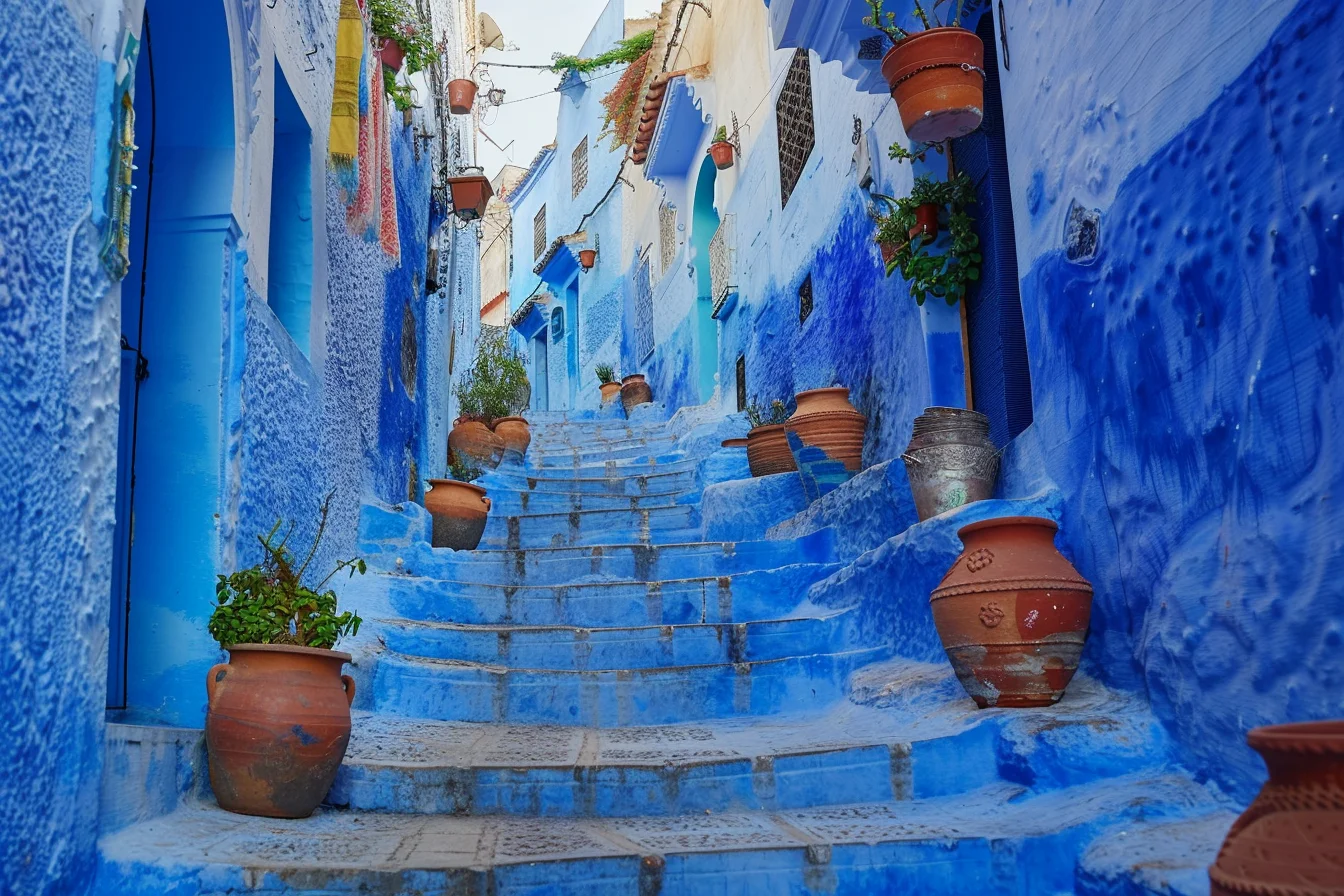
🏛️ Chefchaouen, Rif — tap for northern region context🍯 Amlou — tap to understand the hidden risk🏜️ Desert dining — tap to plan advance notice
Allergen Risk
Allergen Prevalence Index
Morocco’s allergen landscape is defined by three clusters: the tree-nut cluster (almonds, argan oil, almond oil — structural in signature dishes and in amlou breakfast spreads), the sulfite cluster (dried fruit and preserved lemons in sweet-savory tagines), and the dairy cluster (smen, milk-based breads). Notable absences shape the risk profile: peanut oil is not used in Morocco, there is no tahini or structural sesame tradition, and shellfish is concentrated at Atlantic coast venues rather than distributed nationally. Clinical prevalence in Moroccan children (2023 Pan-African Medical Journal study: cow’s milk 58.2%, egg 23.4%, nuts 12.1%, shrimp 10.6%, peanut 9.2%) diverges from supply-side travel risk — for international travelers, the tree-nut cluster presents the highest hidden-vehicle risk because it is structurally embedded in dishes travelers will order without recognizing them as tree-nut vehicles.4,5
Filter by your allergen to highlight relevant rows
Filter by allergen:
Allergen
Supply Prevalence
Hidden Risk
Cross-Contact
Restaurant Risk
Tree Nuts / لوز (louz)Structural in pastilla, lamb tagine with prunes & almonds, and amlou. Argan oil and almond oil are botanical tree nut vehicles.
9
9!
7
9!
⚠ Structural tree-nut alert: Tree nuts are structurally embedded in Moroccan signature cuisine: pastilla (layered pastry with almonds, cinnamon, and chicken or pigeon), lamb tagine with prunes and almonds, amlou (the almond–argan breakfast spread), kaab el ghazal, briouat, and sellou. Argan oil — cold-pressed from the argan tree nut — is a botanical tree nut with documented cross-reactivity. Your card must name أملو (amlou), زيت أركان (zit argan), زيت اللوز (zit louz / almond oil), and the specific dishes explicitly.
Sulfites / كبريتاتCommercial dried fruit (prunes, apricots, raisins) structural in sweet-savory tagines and harira. Moroccan wine.
8
7!
4
7
Dairy / حليب (halib)Smen (aged preserved butter) is structural in tagines. Msemen layered bread, baghrir, lben.
8
7!
5
7
⚠ Name smen specifically:Smen (سمن) is aged, salted preserved butter — unlike ghee, it retains milk protein and is a full dairy allergen. Kitchen staff may not think of smen as “butter” when answering a dairy allergy question because it occupies its own ingredient category. Name smen, lben (لبن), and raib (رايب) explicitly on your dairy card.
Wheat / خبز (khobz)Khobz (the communal torn flatbread) + couscous + msemen + baghrir + warqa pastilla pastry.
9
6
7
7
Egg / بيض (bayd)Structural in pastilla filling. In m’hancha, briouat, and some harira preparations.
7
6
5
6
Fish / سمك (samak)Concentrated on the Atlantic coast — Casablanca, Rabat, Essaouira, Agadir, Dakhla. Inland serves little fish.
7
4
5
5
Shellfish / قمرون (qimroun)Atlantic coast venues. Dakhla oysters and lobster are regional specialties. Cross-contact at shared fryers.
6
5
7
6
Sesame / جلجلان (jenjlan)Less structural than in Middle Eastern cuisines — no tahini tradition. Garnish on khobz, sellou confection.
4
4
3
3
✅ Good news for sesame-allergic travelers: Morocco is materially safer than Turkey, Lebanon, or Greece. There is no tahini tradition, no hummus, no sesame-based sauces. The primary vulnerability is the bread — specific loaves of khobz may carry a sesame seed topping, and because khobz is torn communally at the table, seeds transfer. Request plain khobz (khobz bidoun jenjlan) when ordering.
Peanut / كاوكاو (kaw-kaw)Peanut oil NOT used in Moroccan cooking. Vegetable or olive oil dominates. Rare as snack food only.
2
2
2
2
✅ Morocco is meaningfully safer for peanut-allergic travelers than most destinations. Peanut oil is not used in Moroccan cooking and vegetable oil or olive oil dominates across all venues. Peanuts appear as bar-counter snacks but are not structural in any major Moroccan dish. This is the single most significant positive finding for peanut-allergic travelers considering Morocco.5
⚠ Ras el hanout — the opaque spice blend. Ras el hanout (راس الحانوت / “head of the shop”) is the signature North African spice mixture that seasons most tagines, kefta, and couscous preparations. A traditional blend can contain anywhere from 10 to more than 30 ingredients, and the exact recipe is both regional and spice-merchant specific — there is no standardized formula. Documented blend components across Moroccan regions include cardamom, clove, cumin, coriander, fennel, galangal, ginger, mace, nutmeg, pepper, turmeric, saffron, cinnamon, rosebuds, lavender — but souk-ground blends may also contain sesame seeds, ground almonds or other tree nuts, dried chili, fenugreek, and wheat flour as an anti-caking or bulking filler. Pre-packaged supermarket ras el hanout (Carrefour, Marjane) will have an ONSSA ingredient declaration; souk-purchased ras el hanout by definition does not. For allergens with any concern around sesame, tree nuts, wheat, or fenugreek, the operational answer is to request dishes seasoned with named individual spices (“cumin + paprika only”) rather than ras el hanout when eating at informal venues or desert camps.
Signature Dishes
Moroccan Dishes & Allergen Profiles
Moroccan dishes fall into clear STRUCTURAL vs INCIDENTAL patterns. The signature sweet-savory tagines (lamb with prunes, chicken with raisins) carry structural tree nuts and sulfites — removing them produces a different dish. Pastilla carries structural tree nuts and egg — it cannot exist without either. Savory tagines (chicken with preserved lemons and olives, fish with chermoula) carry primarily incidental allergens that a kitchen can address with advance notice. Grilled meats (kefta, lamb brochettes, mechoui) are among the safest options across the cuisine.
Dish
Allergens
Hidden Risk Notes
Risk
Pastilla (Bastilla)بسطيلة · Layered warqa pastry with chicken or pigeon, almonds, eggs, cinnamon
STRUCTURAL tree nuts (ground and slivered almonds bound into filling). STRUCTURAL egg (scrambled into filling). STRUCTURAL wheat (warqa pastry sheets). Butter between pastry layers adds dairy. There is no almond-free, egg-free, or wheat-free pastilla — these are dish-identity ingredients.
● HIGH
Lamb Tagine with Prunes & Almondsطاجين اللوز والبرقوق · Slow-cooked lamb with prunes, cinnamon, honey, slivered almonds
STRUCTURAL tree nuts (slivered almonds arranged on top as the defining visual presentation). STRUCTURAL sulfites (commercially dried prunes preserved with SO₂). Marrakech’s iconic sweet-savory dish. Quality riads with 24-hour advance notice can prepare modified versions; standard restaurant service cannot.
● HIGH
Chicken Tagine with Preserved Lemons & Olivesطاجين الدجاج · Chicken slow-cooked with preserved lemons, green olives, ginger, saffron
Relatively clean for most allergens. Preserved lemons are primarily salt-preserved rather than sulfite-preserved. No tree nuts, no egg, minimal wheat. This is the safest tagine for tree-nut-allergic travelers and the most reliably-accommodated tagine request.
● LOW
Hariraحريرة · Tomato-based soup with lentils, chickpeas, dried fruit, vermicelli
STRUCTURAL wheat (flour thickener, vermicelli). STRUCTURAL sulfites (dried fruit). INCIDENTAL egg (beaten egg as final thickener in some versions). The Ramadan iftar soup of Morocco, served year-round. Recipe varies substantially by region and family.
● HIGH
Couscous with Seven Vegetablesكسكس بسبع خضار · Hand-rolled semolina with seven simmered vegetables, broth, chickpeas
STRUCTURAL wheat (semolina couscous grain). No structural tree nuts, no egg, no sulfites. Friday lunch tradition. Historically communal — served on a shared platter with diners eating from their own section. The vegetable broth base is typically clean; couscous itself is the wheat vehicle.
● MODERATE
Mechoui (Whole Roasted Lamb)مشوي · Whole lamb roasted in a pit with salt and cumin only
Among the cleanest Moroccan dishes for allergen purposes. Traditional mechoui is seasoned only with salt, cumin, and sometimes paprika before long-slow roasting. No structural tree nuts, dairy, egg, sulfites, or wheat. Ceremonial dish — requires advance booking (6+ hours) at most venues.
● LOW
Kefta (Grilled Spiced Meatballs)كفتة · Grilled lamb or beef meatballs with cumin, paprika, parsley, onion
Grilled kefta skewers (kefta mechwiya) at Jemaa el-Fnaa and souk grill stations are among the cleanest street food options in Morocco. Composition: ground lamb or beef, cumin, paprika, salt, parsley, onion. No structural tree nuts, dairy, egg, sulfites. Cross-contact risk from shared grills with sesame-topped bread.
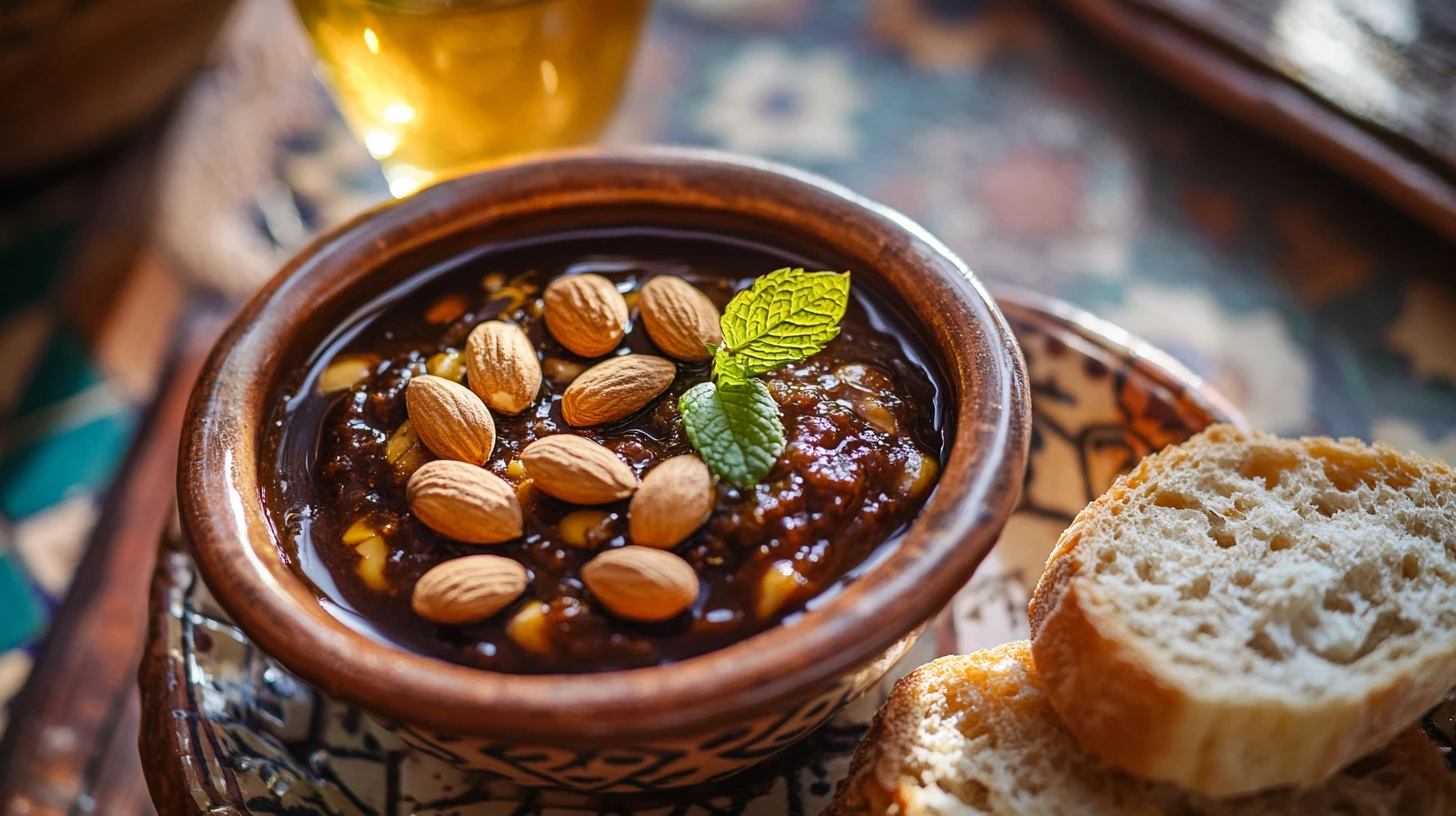
STRUCTURAL tree nuts via TWO vehicles: ground roasted almonds as the body of the spread, plus cold-pressed argan oil extracted from argan tree nuts. There is no amlou without either. Served at breakfast across Moroccan riads, often set out at buffets without labeling. Ask on riad arrival where it sits on the spread.
● HIGH
Msemen (Layered Flatbread)مسمّن · Square layered flatbread with butter or smen, breakfast staple
STRUCTURAL wheat (semolina and flour dough). STRUCTURAL dairy (butter or smen between the folded layers — this is what makes the bread “layered”). A traveler asking for msemen “without butter” is asking for a different bread.
● MODERATE
Chermoula-Marinated Grilled Sardinesسردين مشوي بالشرمولة · Atlantic sardines stuffed with chermoula herb paste, grilled whole
Chermoula is a marinade of cilantro, parsley, cumin, paprika, garlic, lemon — no tree nuts, dairy, egg, or sulfites. Iconic Essaouira, Casablanca, Agadir coastal dish. Cross-contact with shellfish is significant at coastal “poissonnerie” stalls using shared grills.
● MODERATE
Zaalouk (Smoky Eggplant Salad)زعلوك · Charred eggplant and tomato salad with cumin, paprika, garlic, olive oil
Among the cleanest Moroccan side dishes. Composition: charred eggplant, tomatoes, garlic, cumin, paprika, olive oil, cilantro, lemon. Served at the start of most Moroccan meals. Primary risk is cross-contact from shared bread — zaalouk is eaten by dipping bread into it. Request dedicated portion with dedicated spoon.
● LOW
Moroccan Mint Tea (Atay)أتاي · Green tea with fresh mint and sugar, poured from height into small glasses
Traditional atay is green tea, fresh mint, and sugar — no dairy, no nuts, no egg. Poured continuously throughout the meal and evening from a shared pot into shared glasses. Clean for most allergens. Cross-contact from shared glasses at budget venues. Sulfite-sensitive travelers should request fresh (not preserved) mint preparation.
● LOW
Multi-allergen safe path in Morocco: Moroccan salad starter with dedicated spoon, followed by grilled kefta or mechoui (salt + cumin only) or chicken tagine with preserved lemons and olives, with khobz or rice as the starch. Avoid anything described as “sweet” or containing prunes, apricots, or raisins if sulfites are a concern. Avoid pastilla, amlou, and lamb-with-prunes tagine if tree nuts are a concern.
Geography
Regional Allergen Risk Map
Morocco’s regional cuisine variance is genuinely high — the country is not one cuisine but seven, each shaped by its geography and the cultural layers that settled there. The Fes imperial north favors refined preserved-lemon-and-olive tagines. The Marrakech-Atlas south is the home of sweet-savory sauces with dried fruit and almonds. The Atlantic coast (Casablanca, Rabat, Essaouira, Agadir) centers on fish and seafood in chermoula preparations. The Souss Valley is argan country and the origin of amlou. The Drâa-Tafilalet south opens into the Sahara. Medical infrastructure drops sharply moving south and east from the imperial cities.
Loading map…
Hover a region for allergen detail · click to build your card
🕋 Marrakech & High Atlas HIGH
Morocco’s primary entry point for international tourism and the center of the Berber-influenced sweet-savory tagine tradition. Tree-nut risk concentrates here — lamb with prunes and almonds, pastilla, and amlou at every upper-band riad. Medical infrastructure is strong in Marrakech itself; High Atlas south of Asni drops to long ambulance response times.
↑ Tree nuts · Sulfites · Dairy (smen)
🏙️ Casablanca & Rabat (Atlantic) MODERATE
Morocco’s economic and political capital corridor. French is the working kitchen language at upscale venues. Atlantic seafood — grilled sardines, chermoula, shellfish — dominates. Fine dining with allergen matrices available at levels approaching European standards. Best medical infrastructure in Morocco.
↑ Fish · Shellfish · Lower tree-nut concentration
🏛️ Fes & Meknes (Imperial North) HIGH
The spiritual and culinary capital of traditional Morocco. Pastilla is a Fes dish — its structural tree-nut content is a hard constraint here. Smen is used more heavily in Fes tagines than in Marrakech-Berber cooking. Chicken with preserved lemons and olives is the Fes signature. Meknes hosts Morocco’s wine region.
↑ Tree nuts (pastilla) · Dairy (smen) · Egg
⛵ Tangier, Tétouan & Rif MODERATE
Northern Mediterranean coast with Spanish cultural inheritance from the protectorate era. Spanish is spoken alongside Arabic in hospitality. Chefchaouen’s blue-painted medina is a tourist concentration. Cuisine leans Mediterranean. Lower tree-nut concentration than Marrakech or Fes. Rif mountains have long ambulance response times.
↑ Fish · Shellfish · ↓ Tree nuts
🌳 Souss Valley & Agadir HIGH
Argan country. Amlou originates here — every amlou in every riad in Morocco traces back to the Souss. Argan cooperatives welcome visitors for tasting tours. Agadir is the beach tourism center. Highest-concentration tree-nut exposure in Morocco. Berber Tashelhit language widespread alongside Arabic.
↑↑ Tree nuts (argan + almond + amlou origin)
🏜️ Drâa-Tafilalet (Sahara South) HIGH
Erg Chebbi (Merzouga), Erg Chigaga (M’hamid), Ouarzazate, the Drâa Valley date palm corridor. Desert camps dominate the dining context — single-menu, advance-notice-only, shared-tagine eating. Medical evacuation often required for serious emergencies. See Desert Dining section for full detail.
↑ Tree nuts · Sulfites · Shared-vessel cross-contact
🌊 Dakhla & Southern Atlantic Coast MODERATE
Dakhla and Laayoune follow United Nations cartographic convention on this page; Morocco administers the area and Moroccan regulatory and emergency frameworks apply. Emerging kitesurf and desert-adventure tourism. Sahrawi-Moroccan hybrid cuisine — camel meat on some menus, Hassaniya Arabic spoken by Sahrawi cooks alongside Darija. Medical infrastructure is limited; serious emergencies typically pathway through air evacuation.
↑ Shellfish · Fish · Camel meat (novel protein)
Where to Eat
Venue Safety Profile
Morocco’s venue ladder reflects a genuinely bimodal risk profile: informal souk grill stations and budget desert camps at the high end, upscale urban fine dining and luxury riads at the safe end, with a wide mid-range where Moroccan hospitality culture can go either way depending on advance notice and language fit. The critical Morocco-specific distinction is the budget-vs-quality split on desert camps — same venue format, fundamentally different allergen accommodation capacity.
⚠ Argan cooperative tasting tours — concentrated tree-nut exposure. Berber women’s cooperative visits in the Souss Valley are marketed as cultural and agritourism experiences — genuinely worthwhile for the cultural exchange — but include argan oil and amlou tasting. For tree-nut-allergic travelers, this is a concentrated tree-nut exposure context framed as cultural tourism. Skip the tasting portion or decline the visit if the tree-nut allergy is severe.
Ramadan dining shifts — timing and menu change. During Ramadan (dates shift annually), most restaurants and cafés close during daylight hours and reopen for iftar (sunset) with harira, chebakia (honey-sesame pastries), and dates as the standard breaking-fast spread. Non-Muslim travelers can still eat during the day at tourist-corridor hotels, riads, and some cafés in major cities. Chebakia is a sesame-and-almond vehicle worth avoiding for those allergens.
Informal grill stations operating at high turnover with minimal ingredient disclosure. Kefta, lamb brochettes, grilled sardines (coastal), merguez. Shared grills mean cross-contact between dishes is structural. Cooks operate in Darija — French or English cards rarely reach the cook. Jemaa el-Fnaa at peak dinner hours is particularly opaque.
Darija card essential. Grilled kefta skewers are the cleanest option — request “kefta mechwiya bidoun khobz” (without bread) to avoid sesame-topped bread cross-contact. Eat early (6–7pm before peak dinner hour).
HIGH RISK
⛺Desert Camp — Budget (€30–50/night shared)
Single-menu-per-evening. Ingredient supply every few days by 4x4 from nearest supply town. No substitution possible on the day. Shared communal tagine and communal bread tearing. Tour operator may or may not pass allergy notice to camp kitchen. No refrigeration for EpiPen temperature control.
Not recommended for severe allergies. If booking, bring sealed packaged food as complete fallback, carry Darija card to present on arrival regardless of pre-booking notice, bring FRIO-style insulated carrier for medication.
HIGH RISK
🌳Argan Cooperative Tasting Tours (Souss Valley)
Berber women’s cooperative visits include argan oil and amlou tasting as part of the cultural-tourism experience. For tree-nut-allergic travelers, this is a concentrated tree-nut exposure framed as cultural tourism.
Skip the tasting portion if tree-nut allergy is severe. Visit the cooperative for the cultural exchange but decline the breakfast tasting — cooperatives understand and accommodate.
HIGH RISK
🏠Family-Run Riad (€50–150/night)
Small guesthouse with owner-operator or family kitchen. Breakfast served on-site — often including amlou without warning. Dinner by advance request with single-menu constraint. Hospitality is genuinely high; language fit varies widely (French and English front-of-house common, Darija and occasional Berber in the kitchen).
Ask at check-in about breakfast contents — specifically whether amlou, argan oil, or almond oil are served. Most riads will prepare an allergen-free breakfast spread on request. Dinner requires 24-hour advance notice for meaningful accommodation.
MODERATE
🍲Mid-Range Restaurant / Medina Tagine House
Traditional Moroccan restaurants serving a tagine and couscous menu to tourists and local diners. Single-menu structure typical for group dining. Kitchen staff may not speak French; servers often do. Standard signature dishes (lamb with prunes, pastilla) are structural-allergen vehicles that cannot be modified at service time.
Darija or MSA card for the kitchen, French card for the server. Order the preserved-lemon-and-olive chicken tagine (safest signature dish for multi-allergen travelers) rather than the sweet-savory tagines.
MODERATE
🏕️Desert Camp — Quality/Luxury (€150+/night)
Professional operators (Sahara Magic, Desert Majesty, upscale private camps) with formal allergy intake at booking. Advance notice 48–72 hours ahead allows kitchen to source substitute ingredients on the next supply run. Dedicated individual tagine preparation possible. Still no refrigeration for medication — temperature-control burden on the traveler.
Book with written allergy disclosure at the booking inquiry. Confirm in writing that the camp kitchen has been notified. Bring Darija card to present on arrival regardless. Mechoui and plain couscous are standard safe paths.
LOWER
🌴Luxury Riad / Boutique Hotel (€200+/night)
Upscale riads (La Mamounia, Royal Mansour, Amanjena-tier properties, upper-band Marrakech and Fes boutique hotels). Trained hospitality staff, French/English fluency in kitchen, formal allergen-intake at check-in. Dedicated kitchen preparation routine for allergen-restricted guests.
Disclose allergies at booking via email — not just on arrival. Request a written allergen-intake from the restaurant or private chef. This tier will go further than most European upscale hotels in accommodating.
LOW
🍷Casablanca / Rabat French-Moroccan Fine Dining
Upper-band Casablanca and Rabat restaurants — French-Moroccan fusion kitchens operating at European fine-dining standards. Allergen matrices, trained brigade, French as the functional kitchen language. This is the one venue category in Morocco where a French-language card reaches the cook directly and a written allergen disclosure on booking will be treated with European-standard rigor.
French card is the primary tool here. Online booking via restaurant website with allergy disclosure in the booking form is routinely honored. This is the safest venue category in Morocco for severe multi-allergen travelers.
MOST RELIABLE
Buffet warning: At luxury riads and hotel breakfast buffets in Morocco, amlou jars are typically placed alongside jam and honey without any label distinguishing them. A traveler scooping from the unlabeled dark spread may have scooped a concentrated tree-nut exposure. At any Moroccan breakfast buffet, specifically ask which jars contain amlou, argan oil, or almond oil before scooping.
Contextual Intelligence
Desert Dining & Nomadic Kitchens
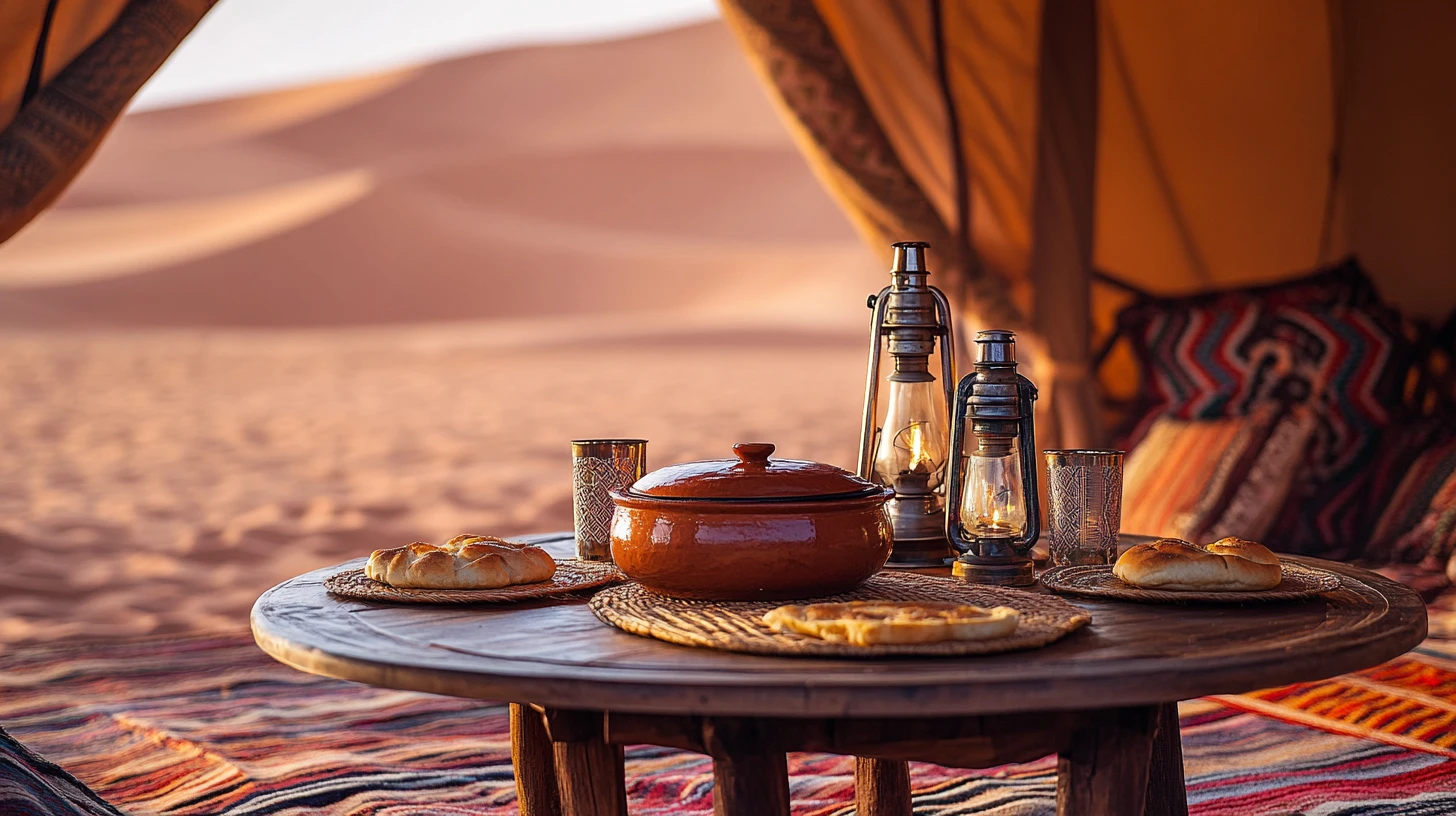
Desert dining in Morocco — at the Erg Chebbi camps near Merzouga, the Erg Chigaga camps near M’hamid, the Dakhla region southern coast, and multi-day camel treks — is a distinctive travel context that fundamentally changes the allergy playbook. Unlike a Marrakech riad, where a 20-minute turnaround on a special meal is possible, a desert camp 80km from the nearest supply town cannot run out to the store. Advance notice is not a courtesy but the only pathway. The good news: quality operators handle this well when notified at booking. The bad news: budget operators often do not pass the notice to the kitchen at all.
🏜️
Notice at Booking, Not Check-In
The camp kitchen does not receive your allergy disclosure unless the tour operator passes it along. Give your allergy information at the booking inquiry, get written confirmation that the camp kitchen has been notified, and budget 48–72 hours between booking and departure so the kitchen can source substitute ingredients on its next supply run from the nearest town (Rissani for Merzouga, Zagora for M’hamid, Dakhla city for southern camps).
🚚
The Kitchen Is 80km From the Nearest Market
Desert camps — whether permanent fixed camps like those at Erg Chebbi and Erg Chigaga, or mobile tented bivouacs set up for each group — source ingredients from the nearest supply town once every few days or once per week. Merzouga camps source from Rissani. Erg Chigaga camps source from Zagora or M’hamid. Dakhla desert camps source from Dakhla city. Fresh produce has traveled hours in a 4x4 before it reaches the kitchen. Preserved goods dominate: sulfited dried fruit (apricots, dates, prunes, raisins), cured meats, tinned fish, frozen meat. Almonds and nuts are shelf-stable and appear in essentially every tagine. The cook makes one menu per evening for the entire camp.
THE SUPPLY RUNEvery few days · Notice must reach the cook BEFORE the next supply run · Booking → operator → kitchen → supply order
📋
Notice Through the Tour Operator, Not the Camp
Desert camp trips are almost universally booked through a tour operator in Marrakech, Fes, Ouarzazate, or online — not directly with the camp. The operator coordinates transport, camel trekking, overnight accommodation, and meals as a package. The camp kitchen does not receive bookings directly and does not receive allergy information unless the operator passes it along. Best-in-class operators have formal allergy intake procedures at booking. Budget operators (€30–50/night shared camp offerings) often do not.
THE PROTOCOLWritten allergy disclosure at booking · Written confirmation from operator · Darija card on arrival · 48–72hr notice minimum
⚠️
What the Desert Kitchen Cannot Avoid
Five risks concentrate at desert camps beyond the standard Moroccan allergen profile. First, the shared communal tagine — an entire group eats from one or two clay tagines, tearing bread from a shared round of khobz. Cross-contact from serving is structural. Second, the mint tea ritual — atay is poured continuously from a shared pot into shared glasses, washed in communal water at budget camps. Third, dried fruit in tagine — lamb with prunes is the desert camp signature, with sulfited prunes and structural almond garnish. Fourth, argan and almond oil at Souss-adjacent camps (Erg Chigaga particularly) draw on Souss Valley food culture. Fifth, temperature control — desert daytime temperatures routinely exceed 45°C in summer, EpiPen storage limit is 25°C, and camps have no refrigeration.
THE FIVE RISKSShared tagine · Shared tea glasses · Structural dried fruit & almonds · Souss oils · NO refrigeration (bring FRIO carrier)
🌾
Plain Couscous, Grilled Meat, Clean Coals
The reliable safe path in Moroccan desert cuisine starts with three bedouin/Berber staples. Plain steamed couscous (كسكس سادة / kuskus sada) cooked in a dedicated pot without broth is the simplest fallback — add بدون لوز (bidoun louz / without almonds) and بدون صلصة (bidoun salsa / without sauce) to cover structural risks. Unseasoned grilled meat over coals (مشوي بدون توابل / mashwi bidoun tawabil) is the second fallback. Mechoui (whole lamb roasted slow over coals, salt and cumin only) is available at many camps with advance notice because it takes 6+ hours. Bring your own safety layer — sealed energy bars, verified packaged dried fruit, packaged bread. Moroccan hospitality culture understands that a guest with a medical need supplementing from their own supplies is not insulting the cook.
NAME ON CARDكسكس سادة (kuskus sada) · مشوي بدون توابل (mashwi bidoun tawabil) · مشوي كامل (mashwi kamil / mechoui)
Cultural Context
Hospitality Etiquette & Communication
Moroccan hospitality culture — ضيافة (diyafa) — is the defining cultural force in Moroccan dining. It is genuinely on the traveler’s side once communication reaches the cook, but it is also a hospitality tradition that values accepting what the host offers, which can work against clear allergy refusal. The etiquette challenge is communicating “I cannot” without communicating “your hospitality is insufficient” — a balance Moroccan hosts navigate well on their end if the traveler provides the tools.
🗣️
Present the Card in the Right Language for the Venue
A Darija card at a French fine-dining venue in Casablanca reads as informal and may not reach the brigade. A French card at a Marrakech souk grill reads as assuming too much and may not reach the cook. Match the card to the venue: Darija for souks, family-run riads, desert camps, and Berber hospitality; MSA for packaged food labels, formal menu reading, and cross-regional portability; French for Casablanca/Rabat fine dining, upscale Marrakech boutique hotels, and international hotel brigades.
📝
Written Communication Beats Verbal
Moroccan kitchen culture weights written communication heavily — a physical card handed to the cook (or explicitly passed from the server to the cook) carries significantly more weight than a verbal allergy statement. This is partly a language-fluency consideration and partly a cultural matter: a written card signals that the allergy is serious enough to have been prepared for in advance. Always hand the card; never only speak it.
🤝
Accepting a Decline as Respect for the Food, Not Rejection of the Host
If a Moroccan host or cook says they cannot safely prepare your meal, accept it as a sign of professional integrity rather than refusal of hospitality. A riad owner who says “we cannot guarantee” is signaling that they understand the stakes, not refusing to serve you. This is a higher-quality response than a cook who promises accommodation they cannot actually deliver. Thank them, eat elsewhere that evening, and return for a different meal the next day. The decline preserves the relationship.
⚠️
Naming Severity Without Alarm
The Darija phrase عندي حساسية خطيرة من (‘andi ḥasasiya khaṭira min / “I have a serious allergy to”) uses “khaṭira” (serious/dangerous) to communicate genuine medical severity without sounding demanding or alarmist. In French at upscale venues: “J’ai une allergie sévère” is the direct equivalent. Avoid dramatic language or invoking “life-threatening” in ways that read as theatrical.
The tea ritual and polite decline: Moroccan mint tea (atay) is offered at every hospitality interaction, from riad check-in to a souk purchase. For most allergic travelers tea is safe, but for sulfite-sensitive travelers or those with concerns about communal glass cross-contact, the polite decline is “شكرا، بعد قليل” (shukran, ba’d qlil / “thank you, in a little while”) — which accepts the gesture without drinking immediately. A direct “no” reads poorly; a “later” reads as tactful.
Communication
Moroccan Languages & Card Strategy
Morocco is a diglossic country where the language strategy for a single allergy card breaks down. Moroccan Darija reaches the cook at souks, family-run restaurants, riad kitchens, and desert camps — it is unrelated enough to Modern Standard Arabic in vocabulary and grammar that a Darija speaker hearing only MSA experiences it as formal, distant, slightly foreign. MSA is the written language of menus, ONSSA-compliant packaged food labels, formal hotel signage, and every literate Moroccan reads it regardless of their spoken dialect. French is the functional kitchen language at Casablanca and Rabat fine dining, Marrakech riads in the upper price band, and international hotels. Prepared Travel generates three separate Morocco cards rather than attempting a single multilingual document.
The three-card strategy: Darija reaches the cook at the souk grill, the riad kitchen, the desert camp. MSA reaches every packaged food label, every formal menu, and every literate Moroccan regardless of spoken dialect. French reaches the brigade at Casablanca fine dining, upper-band Marrakech riads, and most international hotel kitchens. Carry all three for comprehensive coverage. The audio layer matches the register: Darija audio is rendered in authentic Moroccan pronunciation via Azure neural text-to-speech (ar-MA voices Mouna and Jamal), MSA and French audio via OpenAI TTS.
Dialect note — spoken vs. written register: Morocco is the first destination in the Prepared Travel catalog where the card-language architecture explicitly separates spoken and written registers of the same language. Written Darija on the card uses Arabic script (not Arabizi / Latin-letter-with-numbers form), maintaining card dignity while using Moroccan vocabulary — كاوكاو (kaw-kaw) for peanut rather than formal فول سوداني, for example.
Language
Primary Regions & Venues
Kitchen Penetration
Card
Moroccan Darija الدارجة المغربية · 🇲🇦
Nationwide — spoken kitchen language at souks, family-run restaurants, riad kitchens, desert camps, and Berber hospitality across all regions
Darija reaches kitchen staff reliably at nearly every food venue in Morocco. The default kitchen language across all price tiers below luxury. Audio rendered via Azure neural TTS (ar-MA-MounaNeural, ar-MA-JamalNeural) in authentic Moroccan pronunciation.
~90% primary kitchen
Modern Standard Arabic العربية الفصحى · 🇲🇦
Nationwide — written language of menus, ONSSA-compliant packaged food labels, formal hotel signage, newspapers, formal business communication
Every literate Moroccan reads MSA regardless of the dialect they speak — this is the universal-reach card for packaged food label reading and formal restaurant menu reading. Does not sound natural as a spoken kitchen register but is read and understood silently without difficulty.
~80% adult literacy
French Français · 🇫🇷
Casablanca, Rabat, upper-band Marrakech, international hotel kitchens across Morocco, French-Moroccan fine dining
The functional kitchen language at Casablanca and Rabat fine dining, Marrakech upper-band riads, and international hotel brigades. At these venues French carries more weight than Arabic because the kitchen is organized around French culinary terminology. At informal venues French reaches the server but often not the cook.
~30% upscale kitchen
Tashelhit (Southern Berber) ⵌⵐⴟⴼⵇⵓⵔⵇⴸ · Not carded
Souss Valley, Agadir region, High Atlas south of Marrakech, Anti-Atlas
High at Berber village hospitality, argan cooperatives, rural Souss restaurants. Near-zero in urban hospitality. Tashelhit speakers are typically also functional in Darija; a Darija card is understood.
~8M speakers
Tamazight (Central Atlas Berber) ⵌⵐⵃⵔⵂⵚⵎⴺ · Not carded
Middle Atlas, parts of High Atlas (Ifrane, Azrou, Khenifra regions)
Moderate in Middle Atlas Berber hospitality. Tamazight uses Tifinagh script (ⵌⵐⵃⵔⵂⵚⵎⴺ) — the only non-Arabic, non-Latin script a traveler may encounter on Moroccan official signage following 2011 constitutional co-official status.
~3M speakers
Tarifit (Northern Berber / Rif) ⵌⵐⵁⵚⵑⵚⵎ · Not carded
Moderate in the Rif. Lower tourist density than Souss or Atlas Berber regions. Tarifit speakers in tourist-facing hospitality (Chefchaouen particularly) operate fluently in Darija.
Genuine in the northern Mediterranean coast and former Spanish Protectorate region. Tangier and Tétouan hospitality carry Spanish alongside Arabic and French as a functional third language.
~5% northern coast
English 🇬🇧 · Not carded
Marrakech tourist core, Chefchaouen tourist corridor, international hotel front-of-house, desert camp guides
English reaches front-of-house staff at Marrakech tourist-corridor venues, international hotel receptions, and desert camp guides. It rarely penetrates the kitchen anywhere in Morocco. An English-only card is functionally invisible at the venues where the allergen risk is highest.
<3% kitchen reach
Communication
Essential Safety Phrases
Moroccan safety phrases are presented in Moroccan Darija with French phrases at upscale urban venues. Written Arabic via your allergy card is the primary safety tool — these phrases are supplementary verbal tools.
Scenario 01
Declaring your allergy
DarijaEssential
عندي حساسية خطيرة من اللوز
‘andi ḥasasiya khaṭira min al-louz · AHN-dee hah-sah-SEE-ya khah-TEE-ra min al-LOOZ
I have a severe allergy to almonds. Substitute your allergen — al-louz for tree nuts; halib or smen for dairy; bayd for eggs.
DarijaSeverity
باش ما نمرضش
bash ma nemrḍsh · bash ma NEM-rrrsh
So that I don’t get sick. Follow-up phrase that provides medical severity framing without alarm.
FrenchUpscale venues
J’ai une allergie sévère aux amandes
zhay oon ah-lair-ZHEE seh-VAIR oh zah-MAHND
I have a severe allergy to almonds. Use at Casablanca/Rabat fine dining, upscale riads, international hotels.
Scenario 02
Asking about hidden vehicles
DarijaBreakfast
واش فيه الأملو أو زيت أركان؟
wash fih al-amlou aw zit argan? · wash FEE al-AM-loo aw ZEET ar-GAHN
Does this contain amlou or argan oil? Ask at riad breakfast before scooping from unlabeled jars.
DarijaTagine
واش فيه اللوز أو البرقوق؟
wash fih al-louz aw al-barquq? · wash FEE al-LOOZ aw al-bar-KOOK
Does this contain almonds or prunes? Critical question before ordering lamb tagine variants.
DarijaDairy
واش فيه السمن أو الزبدة؟
wash fih as-smen aw az-zibda? · wash FEE as-SMEN aw az-ZIB-da
Does this contain smen or butter? Name smen separately because kitchen may not think of it as “butter.”
DarijaPeanut reassurance
واش كتستعملو زيت نباتي ولا زيت الزيتون؟
wash katsta’amlu zit nabati wla zit az-zitoun?
Do you use vegetable oil or olive oil? Peanut oil is not used in Morocco — this phrase confirms rather than searches.
Did the agency tell you about my allergy? First question on desert camp arrival — confirms whether the operator passed the notice.
DarijaSafe path
كسكس سادة بدون لوز من فضلك
kuskus sada bidoun louz min faḍlak · KOOS-koos SA-da bee-DOON LOOZ min FAHD-lahk
Plain couscous without almonds, please. Desert camp safe-path request.
DarijaMechoui
مشوي كامل، فقط ملح وكمون
mashwi kamil, faqaṭ milḥ wa kammoun · MASH-wee ka-MIL, fa-KAT milh wa KAM-moon
Whole mechoui, only salt and cumin. Advance notice required (6+ hours cooking).
Scenario 04
Confirming safely before eating
DarijaConfirmation
واش هاد الطبق آمن ليا؟
wash had aṭ-ṭabaq amin liya? · wash HAD at-TAH-bak A-min LEE-ya
Is this dish safe for me? Final confirmation before eating.
DarijaShared vessel
بغيت طاجين فردي من فضلك
bghit tagine fardi min faḍlak · BGHEET ta-JEEN FAR-dee min FAHD-lahk
I would like an individual tagine, please. Critical request at communal dining contexts — desert camps, group riad dinners, traditional family restaurants.
I need an ambulance! I’m having anaphylaxis! French fallback — effective at urban venues and with most medical personnel.
Pronunciation Reference
Allergen Phonetic Glossary
How to say and read key allergen names in Moroccan Darija, Modern Standard Arabic, and French. Always prefer a printed card so staff can read the terms directly — these phonetic cues are for verbal communication support.
Card tip: All three language cards print the same allergens but in different vocabulary and register. Your Darija card uses colloquial kitchen terms (kaw-kaw, jenjlan). Your MSA card uses the formal register that matches packaged food labels. Your French card uses European allergen vocabulary matching hotel and fine-dining conventions. Match the card to the venue for maximum effect.
Reading Labels
Arabic Script & Allergen Label Guide
Arabic script on Moroccan packaged food labels uses Modern Standard Arabic (العربية الفصحى). ONSSA-compliant packaged food in formal retail (Carrefour, Marjane, BIM supermarkets) displays allergen information in MSA and usually also in French. The allergen declaration typically appears at the end of the ingredient list or in a separate “يحتوي على” (yahtawi ‘ala / “contains”) section. Save the characters below to your phone for pattern-matching on labels and menus.
لوز
LOUZ / ALMOND
The primary tree nut vehicle. Structural in pastilla, lamb tagine with prunes, amlou. On packaged dates, sweets, pastry.
أركان
ARGAN / ARGAN (TREE NUT)
Botanical tree nut with cross-reactivity. On argan oil bottles, amlou jars, some food-adjacent cosmetics.
أملو
AMLOU / AMLOU SPREAD
Almond + argan + honey. On jars at supermarkets, cooperatives, airport shops. Always a tree-nut concentrated product.
حليب
HALIB / MILK
Standard dairy term. Also زبدة (zibda / butter) and سمن (smen / preserved butter, full dairy).
سمن
SMEN / AGED PRESERVED BUTTER
Full dairy allergen. In ingredient lists for tagines, breads, Ramadan foods. Not the same as fresh butter.
بيض
BAYD / EGG
Standard egg term. In pastilla filling, cookies, m’hancha, briouat, harira.
Also قمرون (qimroun / shrimp in Darija), كلامار (calamar / squid).
سمسم
SIMSIM / JENJLAN / SESAME
Less common than Middle Eastern cuisines. On khobz topping, sellou, some ras el hanout. Darija: جلجلان (jenjlan).
كبريتات
KIBRITAT / SULFITES
ONSSA labeling for SO₂ above 10 mg/kg. On dried fruit, wine, commercial preserved lemons.
يحتوي على
YAHTAWI ‘ALA / CONTAINS
The allergen declaration phrase on ONSSA packaged food. Look for this followed by allergen list, typically at end of ingredients.
Save these to your phone. Screenshot this grid or photograph the terms for your specific allergens. Having the Arabic script patterns on your phone while scanning a supermarket label is faster and more reliable than any translation app.
Menu reading note: On restaurant menus, watch for بسطيلة (pastilla — structural almonds), طاجين اللوز والبرقوق (lamb tagine with prunes and almonds — structural tree nuts and sulfites), and أملو (amlou) on riad breakfast menus. Menus in French will list amandes, pruneaux, huile d’argan — the French card reading is more straightforward than the Arabic menu reading.
Pre-Trip Preparation
Allergy-Specific Packing List for Morocco
Morocco-specific packing centers on temperature-control for medication (desert and summer urban both exceed EpiPen storage limits), language tools (three cards printed and wallet-loaded), and sealed packaged food fallback for desert and remote contexts. A traveler staying only in Marrakech, Fes, and Casablanca has lighter needs than one including Sahara camps or Souss Valley excursions.
💉 Medical Essentials
✓
Two epinephrine auto-injectors in original packaging with prescription label
✓
FRIO-style insulated medication carrier rated for sustained 45°C+ exposure — essential for desert, Souss, Dakhla, or any summer travel outside climate-controlled hotels
✓
Doctor’s letter in English AND French stating medical necessity of epinephrine — French is the operating language of Moroccan customs and medical professionals
✓
Antihistamine for mild reaction (cetirizine 10mg or equivalent) — available over-the-counter at Moroccan pharmacies but bring your own quantity
✓
Two-week supply of any chronic medications — pharmacies in cities stock international brands; rural and desert areas have limited availability
🗡️ Communication Tools
✓
Three printed Morocco allergy cards: Darija (primary), MSA (packaged food / formal), French (upscale venues) — printed on card stock, not laminated (cards are disposable by design)
✓
Wallet-format copies of all three cards on phone — digital fallback for when printed card is lost or damaged
✓
Darija audio MP3 loaded offline on phone — Moroccan cell coverage is reliable in cities and along main roads but drops in desert, High Atlas, and Drâa Valley
✓
Printed list of medical Arabic/French emergency phrases — anaphylaxis, ambulance, allergy, injection — in a waterproof pouch
📋 At-Destination Habits
✓
At every riad check-in, ask which breakfast items contain amlou, argan oil, or almond oil — request allergen-free breakfast spread if tree-nut allergic
✓
For desert camp trips: confirm in writing with tour operator 48–72 hours before departure that allergy notice has been passed to camp kitchen
✓
Carry sealed packaged food fallback for desert, Souss cooperative, or High Atlas excursions — energy bars, verified packaged dried fruit (non-sulfited), sealed bread
✓
At tagine service: request dedicated individual tagine (طاجين فردي / tagine fardi) rather than eating from shared communal vessel
✓
At grill stations and souks: present Darija card to the cook, not the server — watch the cook physically read it before ordering
Emergency
Emergency Infrastructure
Morocco operates distinct emergency numbers by service rather than a single universal number. For ambulance, 150 is the primary published number; 141 reaches SAMU (doctor-dispatched medical emergency following the French model). From mobile phones, 112 connects to a dispatcher. English-speaking operators are not guaranteed — French and Arabic are the operational languages. Response times in Casablanca, Rabat, and Marrakech average 10–20 minutes; in rural High Atlas, Sahara, Dakhla, and Rif regions, response often exceeds 60 minutes.6,7
150
Ambulance (national) · 141 SAMU · 112 from mobile
From mobile phones, 112 also works and routes to the appropriate service. 141 reaches SAMU (Service d’Aide Médicale Urgente) — the doctor-dispatched mobile medical response following the French model, available in major cities. Secondary numbers: 15 (fire/civil protection), 19 (urban police), 177 (Gendarmerie Royale rural and intercity).
Language barrier at emergency dispatch: English-speaking emergency operators are not guaranteed in Morocco. French is universally operational at emergency dispatch, medical reception, and urban hospital staff. Arabic (MSA or Darija) is operational everywhere. A traveler without French should have a printed emergency phrase card in French or use the French fallback phrase “J’ai besoin d’une ambulance! Je fais une anaphylaxie!” rather than attempting English.
Public vs. private hospital system: Public hospitals (CHU / Centre Hospitalier Universitaire) serve Moroccan citizens and are accessible to tourists. Private hospitals and clinics serve international travelers, expatriates, and Moroccans with private insurance. For anaphylaxis, private hospitals in Casablanca, Rabat, and Marrakech provide faster access and more reliable English/French communication. Confirm which facilities are in-network with your travel insurance before departure. Expect upfront payment at private facilities with reimbursement via insurance claim.
Desert & remote evacuation: For serious anaphylaxis in the Sahara south (Erg Chebbi, Erg Chigaga, Drâa Valley) or remote High Atlas, the realistic emergency pathway is evacuation to Marrakech or Ouarzazate rather than public ambulance to local clinics. Quality desert tour operators maintain emergency contracts with private evacuation services — confirm at booking. For Dakhla region, air evacuation routes typically through Casablanca or Las Palmas depending on insurance arrangements.6
Clinique Ghandi / Clinique Internationale — Casablanca
9 Rue Sanaa, Casablanca · +212 522 77 38 00
Private hospital with anaphylaxis management capability and French/English-speaking staff. Among Morocco’s best medical infrastructure.
Largest public hospital in Morocco. Emergency department 24/7. French as operating language.
Casablanca · Public
CHU Ibn Sina — Rabat
Avenue Mohammed Belhassan El Ouazzani, Rabat · +212 537 67 28 00
Major public hospital serving the capital region. 24/7 emergency services.
Rabat · Public
CHU Mohammed VI — Marrakech
Avenue Ibn Sina, Amerchich, Marrakech · +212 524 30 07 00
Public hospital serving Marrakech and the High Atlas south. 24/7 emergency; French primary operating language.
Marrakech · Public
Polyclinique du Sud — Marrakech
Rue de Yougoslavie, Marrakech · +212 524 44 79 99
Private hospital with English/French staff, often preferred by international travelers and tour operators for urgent care in Marrakech.
Marrakech · Private
CHU Hassan II — Fes
Route Sidi Harazem, Fes · +212 535 61 91 70
Major public teaching hospital serving northern Morocco. 24/7 emergency.
Fes · Public
Hôpital Régional Hassan II — Agadir
Boulevard Hassan II, Agadir · +212 528 84 14 77
Regional reference hospital for Souss-Massa and Drâa-Tafilalet regions. 24/7 emergency.
Agadir · Regional
Hôpital Hassan II — Dakhla
Boulevard Mohammed V, Dakhla · +212 528 89 86 61
Regional hospital serving the Southern Atlantic Coast. For serious emergencies, air evacuation to Casablanca or Las Palmas is the realistic pathway.
Dakhla · Regional
Medications & Imports
EpiPen Import & Medication Guidance
Epinephrine auto-injectors can be imported into Morocco for personal medical use with documentation. The practical path is: doctor’s letter in English and French stating medical necessity, prescription or medical summary, device kept in original packaging, and proactive disclosure to customs rather than waiting for the device to be found in luggage. EpiPen-equivalent auto-injectors are NOT reliably available for emergency replacement at Moroccan pharmacies — bring sufficient quantity for the full trip plus margin. Temperature control is a significant constraint.3
Confidence level: MEDIUM. Morocco’s Direction du Médicament et de la Pharmacie (Ministry of Health) oversees pharmaceutical import, and prescription auto-injectors for personal use are generally permitted with appropriate documentation. However, specific customs practice at Mohammed V Airport (Casablanca), Marrakech Menara, and other entry points is not uniformly documented — some travelers report minimal scrutiny while others report being asked to present the doctor’s letter.
01
Doctor’s letter in English AND French. Obtain a letter from your prescribing allergist stating that you have a life-threatening food allergy requiring epinephrine auto-injectors for emergency use. The letter should identify the specific device (EpiPen, Auvi-Q, Jext, Emerade) by brand and dosage. French is the operating language of Moroccan customs — an English-only letter may be requested to be translated on the spot.
02
Keep devices in original packaging. Do not remove auto-injectors from their original manufacturer packaging with prescription label. A loose auto-injector presented at customs without packaging or labeling reads as a controlled pharmaceutical product without clear medical provenance.
03
Carry documentation in carry-on, not checked luggage. Auto-injectors must not be placed in checked luggage due to temperature exposure in the cargo hold. The doctor’s letter and devices together in carry-on facilitates customs disclosure and ensures the device is accessible during travel.
04
Declare proactively at customs if asked. Moroccan customs officers have broad discretion. If asked about medications, disclose the auto-injectors and present the doctor’s letter. Do not attempt to conceal medical devices — discovery during secondary inspection is handled less favorably than proactive disclosure.
05
Bring sufficient quantity for full trip plus margin. EpiPen-equivalent auto-injectors are not reliably available for purchase or emergency replacement at Moroccan pharmacies. Some Casablanca and Rabat private pharmacies stock Anapen or imported equivalents, but supply is inconsistent. Bring a minimum of two devices for any trip and four for trips exceeding two weeks or including desert/remote destinations.
🌡️ Temperature control is the concrete infrastructure constraint. Epinephrine storage range is 15–25°C (59–77°F). Moroccan summer daytime temperatures routinely exceed 35°C in urban areas and 45°C+ in the Sahara. Winter desert nights drop below freezing. A FRIO-style insulated medication carrier — rated for sustained high-temperature exposure and capable of evaporative cooling in hot conditions — is essential for any travel outside climate-controlled hotel rooms. Test the carrier in advance to confirm it maintains the storage range. Never leave auto-injectors in a parked vehicle in Morocco during daylight hours.
Regulation
Moroccan Food Labeling Law — ONSSA Decree 2-12-389
Moroccan food labeling is governed by Law 28-07 on food safety (2010), implemented via Decree 2-12-389 of April 22, 2013, enforced by ONSSA (Office National de Sécurité Sanitaire des produits Alimentaires). The law recognizes 14 Codex-aligned mandatory allergens on packaged food labels. Implementation is uneven — a 2022 academic study found approximately 72% of surveyed supermarket products had at least one labeling nonconformity. Restaurant allergen disclosure is NOT required under any current regulation.1,2
Law framework
Law 28-07 relative à la sécurité sanitaire des produits alimentaires, implementing Decree 2-12-389 of April 22, 2013.
Enforcement body
ONSSA — Office National de Sécurité Sanitaire des produits Alimentaires (المكتب الوطني للسلامة الصحية للمنتجات الغذائية)
Mandatory allergens
14 Codex-aligned — cereals containing gluten, crustaceans, eggs, fish, peanuts, soybeans, milk and dairy products, tree nuts, celery, mustard, sesame, sulfur dioxide and sulfites (>10 mg/kg), lupin, molluscs
Restaurant disclosure
NOT required. Morocco has no law requiring restaurants, cafés, souks, desert camps, or riad kitchens to disclose allergens — proactively, in writing, or on request.
Enforcement reality: A 2022 research study of 156 supermarket products across Moroccan retail (Boulaajine & Hajjaj, 2025) documented approximately 72% of surveyed products showing at least one labeling nonconformity — missing allergen declarations, missing ingredient lists, missing nutritional information, or illegible script size below the 1mm minimum. Formal retail (Carrefour, Marjane, BIM, Acima) has higher compliance than informal retail. Packaged goods sold at souks and traditional markets often carry no labeling at all.1
Regional product callout: Traditional regional products — amlou sold at Souss cooperatives, dried fruit sold at souks, artisanal olive oil sold at rural markets — are frequently exempt from ONSSA labeling in practice because they are sold at point of production or in informal retail contexts not subject to regular ONSSA inspection. For travelers: any food product purchased at a souk, argan cooperative, or rural market without a printed label and nutritional panel is effectively unlabeled regardless of what Moroccan law requires.
Smen vs. ghee distinction (important edge case): Ghee is clarified butter (milk protein removed) and may be labeled as dairy-free in some retail contexts. Smen is salted and aged butter that retains milk protein and is a full dairy allergen. Label reading alone is insufficient — if a product is labeled “ghee” in a Moroccan retail context, confirm whether it is clarified ghee (safe for most dairy allergies) or labeled “ghee” loosely for smen-style preserved butter (not safe). When in doubt, treat all traditional Moroccan preserved butters as full dairy allergens regardless of how the product is labeled.
Sulfite threshold note: Under Decree 2-12-389, sulfur dioxide and sulfites must be declared when present above 10 mg/kg or 10 mg/L in the finished product. This threshold aligns with Codex Alimentarius and EU 1169/2011. Moroccan wine, commercial dried fruit, and some commercial preserved lemons typically exceed this threshold and carry the declaration on packaged product. Restaurant-served dishes have no declaration requirement regardless of sulfite content.2
Verification
Sources & Verification
This page is built on a combination of peer-reviewed academic sources, Moroccan government documentation, primary-source expert travel writing with deep Morocco experience, and authoritative NGO medical references. Each claim on this page traces back to one of the 10 sources listed below.
📚 Show full source list (10 references)▾
[1]
Boulaajine S., Hajjaj H. (2025). Overview of Food Safety and Labeling Regulatory Frameworks in Morocco. North African Journal of Food and Nutrition Research, Volume 9, Issue 20. Peer-reviewed academic review of Moroccan food labeling law implementation, ONSSA enforcement, and compliance rates (72% nonconformity in surveyed products). najfnr.com/home/article/download/617/395
[2]
USDA Foreign Agricultural Service (2018). Food Labeling Requirements: Morocco — unofficial translation of Decree No. 2-12-389 on food labeling implementing Articles 16-20 of Law No. 28-07 on food safety. Primary source for exact text of Decree provisions, mandatory allergen categories, sulfite threshold (10 mg/kg), and packaging label script size requirements. apps.fas.usda.gov (Morocco Food Labeling Requirements)
[3]
Direction du Médicament et de la Pharmacie, Ministère de la Santé et de la Protection Sociale, Royaume du Maroc. Pharmaceutical import and personal medical use regulations. Reference for EpiPen import status. Requires reverification via consular or embassy channel for specific personal-use import guidance. sante.gov.ma
[4]
Guennouni M., Ouardirhi M., Touabti M., Admou B., Bourrhouate A., Hilali A. (2024). An overview of a preliminary multicenter retrospective study on food and drug allergies in Moroccan pediatric population. Pan African Medical Journal, 47:24. Primary source for clinical allergy prevalence in Moroccan pediatric population: cow’s milk 58.2%, egg 23.4%, nuts 12.1%, shrimp 10.6%, peanut 9.2%, wheat 7.1%. panafrican-med-journal.com/content/article/47/24/full
[5]
MarocMama (Amanda Mouttaki). Eating in Morocco with Food Allergies. Marrakech-based food writer and long-term expatriate, married into a Moroccan family, with deep kitchen-culture knowledge. Primary source for ground-truth Moroccan kitchen culture — confirmed that peanut oil is not used in Morocco, tahini is absent, sesame is garnish-only rather than structural, nut awareness is genuinely high when named. marocmama.com/eating-in-morocco-food-allergies
[6]
Trek Medics International (2022). Morocco Emergency Medical Services Database — overview of SAMU emergency medical system, ambulance numbers (150, 141), Civil Protection (15), and Gendarmerie Royale (177). Primary source for emergency number verification and system structure. trekmedics.org/database/morocco-2
[7]
Lawrence of Morocco — travel agency with long-term Morocco operating experience, published reference list of Moroccan emergency and consular numbers for traveling visitors. Cross-reference source for Moroccan emergency numbers (150 ambulance, 15 fire, 19 police, 177 gendarmerie, 141 SAMU) and useful tourism contacts. lawrenceofmorocco.com/holiday-advice/useful-telephone-numbers-for-morocco
[8]
Warsi S., Sharma V., McSweeney T., et al. (2023). Food Allergy Labeling Laws: International Guidelines for Residents and Travelers. Current Allergy and Asthma Reports, 23(2):85-96. Comparative international food allergen labeling law reference — contextualizes Morocco’s 14-allergen Codex alignment against other national regimes and confirms mollusc inclusion. pmc.ncbi.nlm.nih.gov/articles/PMC10169132
[9]
Highcharts Map Collection v2.3.0 — @highcharts/map-collection NPM package, ma/ma-all.topo.json (Morocco, UN-standard default boundaries). Morocco regional map source file used with D3.js v7 for map rendering. code.highcharts.com/mapdata/countries/ma/ma-all.topo.json
[10]
Moroccan Travel Trips (2026). What to Eat in Morocco — regional food guide covering signature dishes, amlou origin in Souss, pastilla Andalusian heritage, and regional variations. Reference for Moroccan dish regional distribution — Fes preserved-lemon tradition, Marrakech-Berber sweet-savory tagines, Atlantic coast chermoula-based fish dishes, Souss amlou and argan origin. moroccantraveltrips.com/what-to-eat-in-morocco
Synthesized from tour operator practice and expatriate accounts; representative but varies by operator
Dakhla & Southern Atlantic Coast scope treatment
● MEDIUM
UN cartographic convention applied per editorial policy; requires sign-off before publish
This page is a living document. Labeling laws change, hospitals change ownership, and allergy awareness in kitchens improves over time. Last verified April 2026.
You’ve done the research. Now build the tools.
The medina table is waiting. Go prepared.
Generate your Morocco food allergy cards in Moroccan Darija (for the cook at souks and family-run venues), Modern Standard Arabic (for packaged food labels and formal menus), and French (for Casablanca fine dining and upscale Marrakech riads). All three cards name amlou, pastilla, argan oil, and your specific allergens in the vocabulary Moroccan kitchens recognize.