Portugal scores 4 out of 10 on the Prepared Travel difficulty scale — moderate, in the EU-FIC protected band alongside Italy and Croatia, below Greece — because EU Regulation 1169/2011 is transposed into Portuguese law via Decreto-Lei 26/2016, the 14 mandatory EU allergens are declared on packaged food, and Lisbon, Porto, Algarve, and Madeira tourist-corridor restaurants generally handle allergies well in English. The structural friction is vocabulary, not infrastructure: salt cod (bacalhau) is its own working category in the Portuguese kitchen mind — not ‘fish’ — and appears in dozens of dishes whose menu names don’t signal fish: pastéis de bacalhau, bacalhau à brás, bacalhau com natas, bacalhau à Gomes de Sá. Egg yolk (gema) is structural in nearly every traditional Portuguese pastry — a 500-year monastic inheritance. Coriander (coentros) is structural in Alentejo at near-pesto density. A Portuguese card naming bacalhau, gemas, coentros, and frutos de casca rija directly is the single highest-leverage prep step.
🇵🇹 Food & Culture
Portugal’s pastry tradition is monastic. Cloistered nuns starched their habits with egg whites and faced a permanent surplus of yolks; the yolks became ovos moles, pastéis de nata, fios de ovos, papos de anjo, toucinho do céu, travesseiros de Sintra, pastéis de Tentúgal, barriga de freira, encharcada. Five hundred years later, every neighborhood pastelaria in Lisbon and Porto still sells yolk-built sweets as breakfast. The other inheritance is bacalhau — salt cod, traded from the Newfoundland Grand Banks since the 1500s — which Portuguese cooks claim to prepare 365 ways, one for every day of the year. Together they make Portugal a country where the two most beloved foods are both, structurally, allergens hidden by familiarity.
Core Safety Metrics — hover each for full explanation
Overall Allergy Travel Difficulty
4/10
Moderate — EU-FIC protection vs. bacalhau-vocabulary gap and yolk-built pastry
Portugal sits in the EU-FIC protected band alongside Italy and Croatia, below Greece. The 14 EU mandatory allergens are legally declared on packaged goods and available in writing at all compliant restaurants on request. Lisbon, Porto, Algarve, and Madeira tourist-corridor staff handle allergies well in English. The deduction comes from two practical failure modes: servers may not map ‘fish allergy’ to bacalhau dishes (the kitchen treats salt cod as its own category), and traditional pastelarias offer almost no yolk-free safe path. The Alentejo interior is the hardest mainland region — coriander is structural, written allergen lists are rare, English fluency drops.
Allergen Labeling Law Strength
9/10
EU Regulation 1169/2011 transposed via Decreto-Lei 26/2016 — full force
Portugal operates under EU Regulation 1169/2011 (Food Information to Consumers, FIC), transposed into Portuguese law via Decreto-Lei n.º 26/2016. All 14 mandatory EU allergens must be declared on packaged food labels, distinguished from other ingredients by bold, capitalization, italics, or color. Restaurants and all non-prepackaged food businesses must disclose allergen information on customer request — written documentation must be available, though not on the menu by default. Enforcement via ASAE (Autoridade de Segurança Alimentar e Económica). The law lists peixe (fish) as the mandatory category; it does not separately call out bacalhau, even though salt cod is functionally a distinct kitchen ingredient. This is the legal-versus-practical gap your card has to close.1
Kitchen Awareness
7/10
High in Lisbon & Porto; lower in Alentejo and outer islands
Awareness runs on a bimodal distribution. Lisbon, Porto, Algarve, and Madeira tourist-corridor restaurants regularly handle gluten-free, lactose-free, vegan, and severe allergy requests — chef-driven petisco bars in Príncipe Real, Cais do Sodré, and Cedofeita have written menus and English-fluent staff. Interior Alentejo and Trás-os-Montes tascas operate on tradition; written allergen lists may not exist despite the law. Tasca culture is fast and small — a card outperforms verbal disclosure even with English-fluent staff. ‘Sou alérgico/a a peixe e também a bacalhau’ — named separately — is the working sentence.6
Hidden Allergen Vehicle Density
7/10
Elevated — bacalhau across menus, gema across pastry, coentros in Alentejo
Bacalhau appears in pastéis de bacalhau, bolinhos de bacalhau, pataniscas de bacalhau, bacalhau à brás, bacalhau com natas, bacalhau à Gomes de Sá, bacalhau espiritual, bacalhau à lagareiro, arroz de bacalhau, feijoada de bacalhau — names that don’t read as fish. Egg yolk (gema) is structural in nearly every conventual pastry: pastéis de nata, ovos moles, fios de ovos, papos de anjo, toucinho do céu, travesseiros de Sintra, pastéis de Tentúgal, barriga de freira, encharcada. Coriander (coentros) is structural in Alentejo at near-pesto density. Piri-piri grills cross-contact with shellfish in Algarve and Lisbon churrasqueiras. Italy scores higher (pinoli); Japan scores higher (dashi); Portugal sits in the mid-upper band.2
Emergency Response Quality
8/10
Strong urban response; longer transport in rural and outer-island Azores
The Serviço Nacional de Saúde (SNS) provides universal coverage. 112 (NUE) is the EU-universal number; Portuguese INEM (Instituto Nacional de Emergência Médica) operates ambulance and emergency medical dispatch nationwide, with multilingual operators (Portuguese, English, French, Spanish). Urban response in Lisbon and Porto is fast by EU standards; rural Alentejo, Trás-os-Montes, and outer Azores islands have meaningfully longer transport times, with helicopter EMS available for serious cases. Public SNS hospitals provide emergency care to all visitors; private hospitals (CUF, Lusíadas, Luz) are faster for non-emergency follow-up but charge upfront. Epinephrine is available in all Portuguese serviços de urgência.7
Difficulty in context — how Portugal compares globally4 / 10 Moderate
🇩🇰 Denmark 2🇦🇺 Australia 3🇵🇹 Portugal 4🇯🇵 Japan 7🇮🇳 India 9
🇵🇹
On the Ground
Portugal feels easier in Lisbon and Porto because servers understand the concept of severe allergy and most front-of-house staff speak English. It becomes harder when the risk term is local-cuisine-specific — especially bacalhau rather than generic peixe — because the kitchen vocabulary doesn’t map cleanly onto English allergen categories. A traveler who hands a Portuguese card naming bacalhau, gemas, coentros, and frutos de casca rija will be treated with the seriousness the request deserves. The same traveler saying ‘I’m allergic to fish’ at a Cais do Sodré tasca will get a server who nods, sincerely means well, and forgets the bacalhau in the pastéis. The gap is not intention; it is specificity.
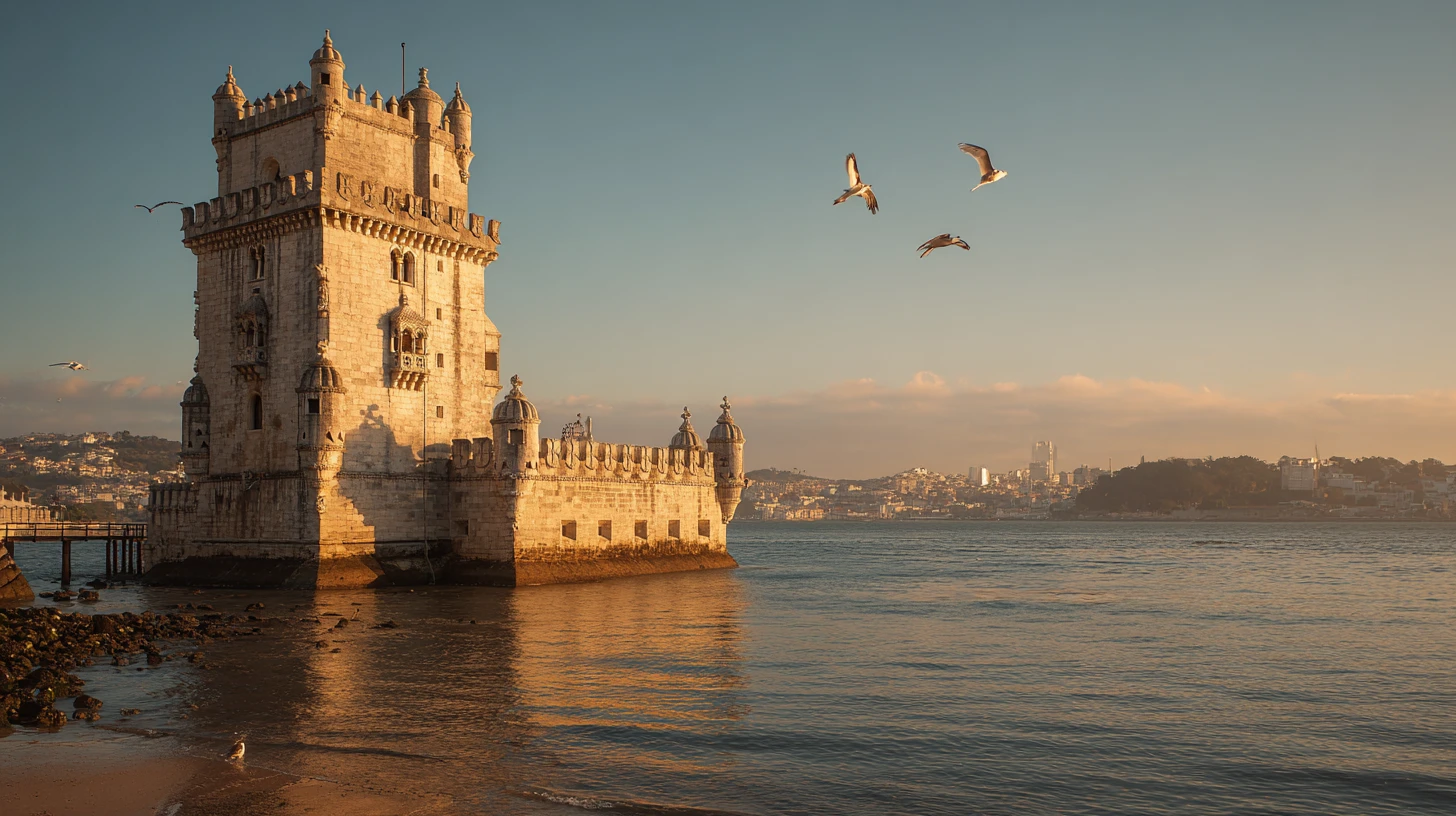
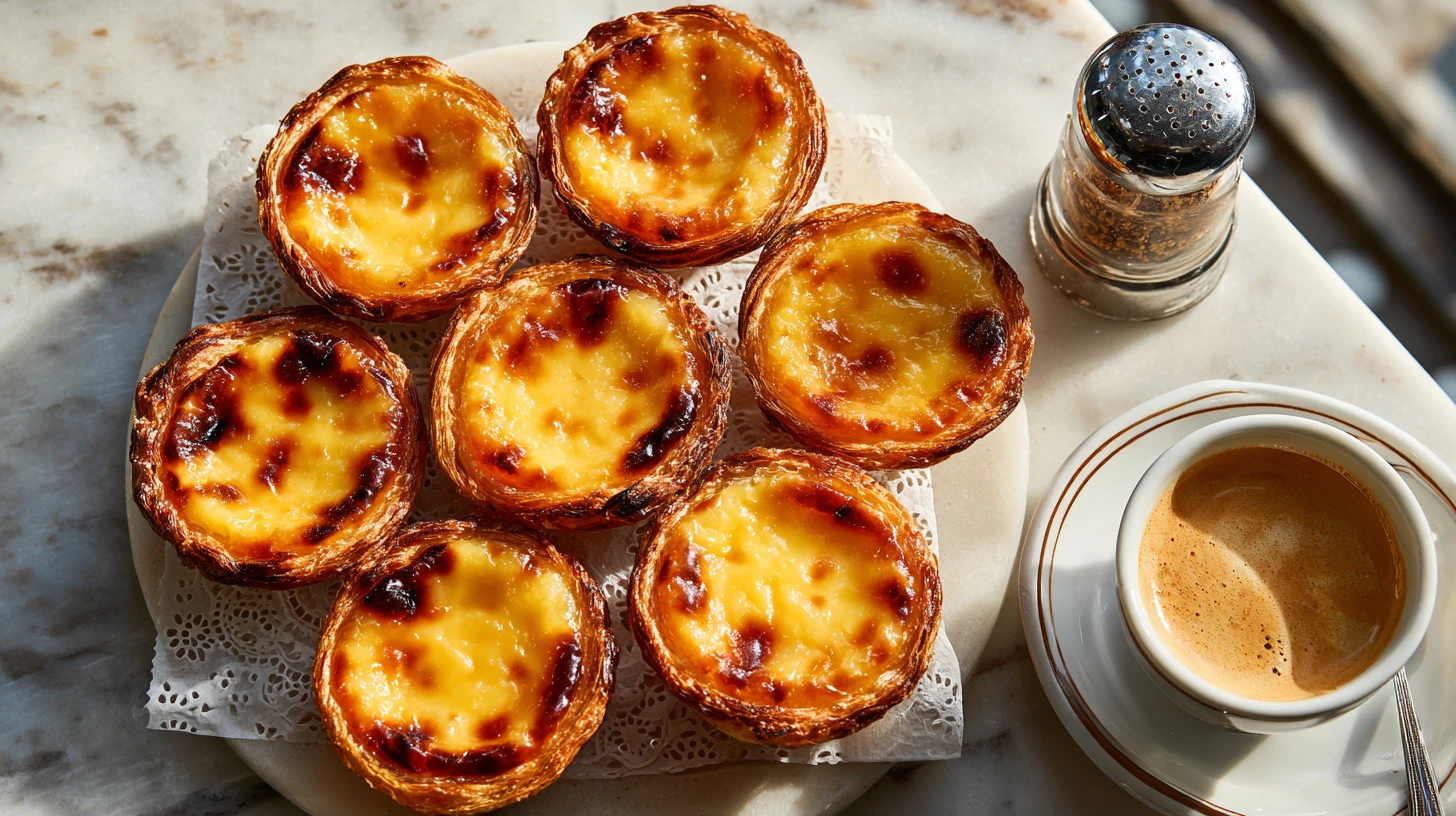
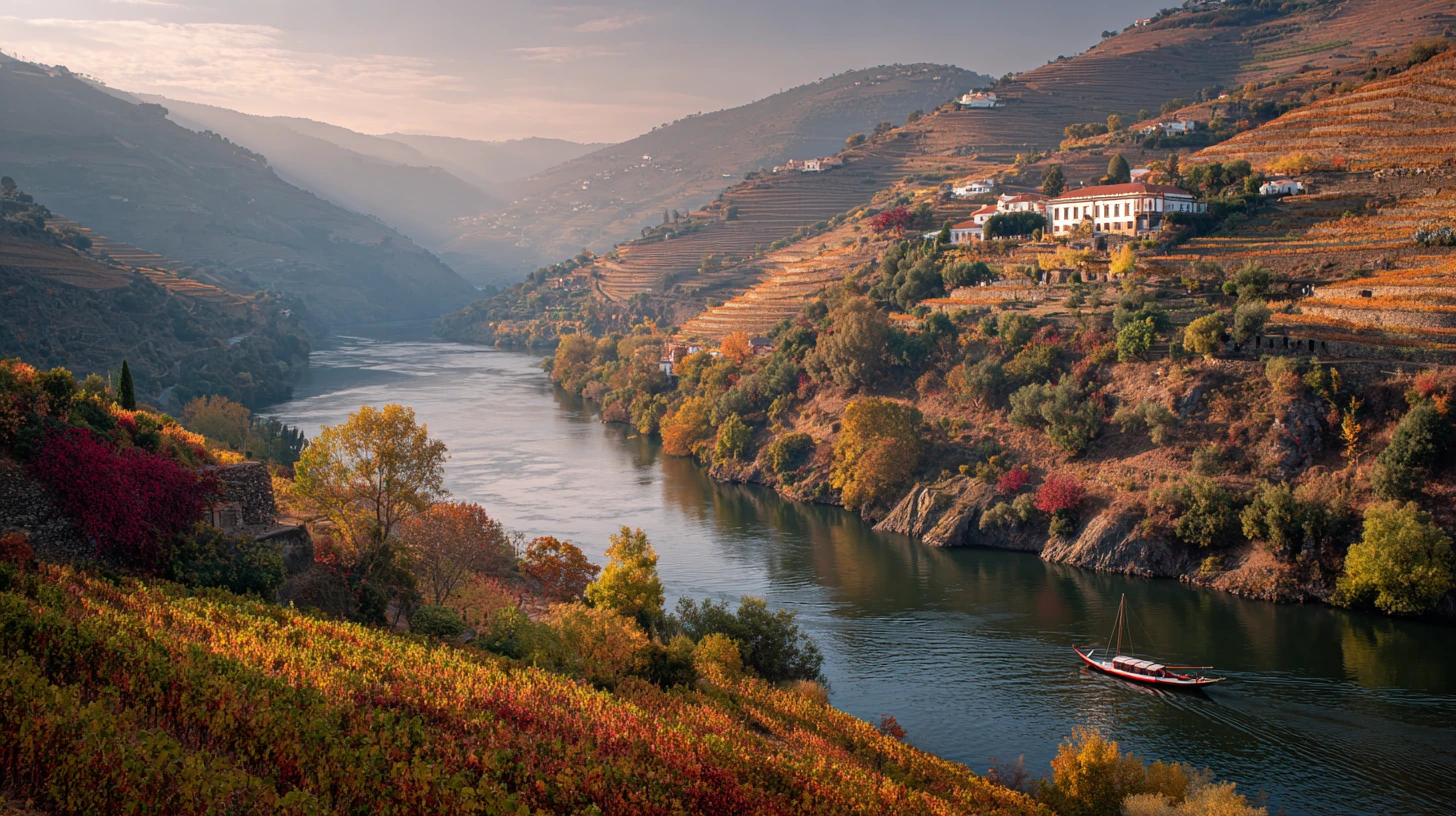
🏛️ Tower of Belém · Tap to read🥐 Pastéis de nata · Tap to read🍷 Douro Valley · Tap to read
Geography
Regional Allergen Risk Map
Portugal’s allergy map splits less by geography than by service model: Lisbon and Porto tourist kitchens, Algarve seafood grills, Alentejo coriander-and-bread interiors, northern cured-meat and fortified-wine country, and the Atlantic islands with thinner emergency redundancy. The constant across all regions is bacalhau — salt cod traded since the 1500s, prepared 365 ways, woven into every regional cuisine under dish names that don’t signal fish. Madeira and the Azores are autonomous regions with distinct cuisines (espetada, bolo do caco, lapas, cozido das Furnas, alcatra, queijo São Jorge) and longer transport times to specialist care in outer islands.
Loading region map…
↑ Hover a region for detail
🏛️
Lisbon & Tagus Valley · Lisboa e Vale do Tejo
EASIER
Highest English fluency, broadest allergen-aware restaurant network, fastest emergency response. The pastelaria-tasca rhythm at its densest. Hidden allergens are present (bacalhau in dozens of forms, gema in every pastelaria) but kitchen reflexes are strongest here. Modern petisco bars in Príncipe Real and Cais do Sodré have written menus and English-fluent staff. Fado-house dinners in Alfama and Mouraria sit on older menus and benefit from a written card.
Porto’s Ribeira and Foz handle allergies well. Douro and Gaia port lodges (Sandeman, Taylor’s, Graham’s) are lower food-risk than tascas because tastings are beverage-led, staff-facing, and reservation-based — the relevant allergen issue is sulfites, not kitchen cross-contact. Interior Minho and Trás-os-Montes villages run on smoked pork, kale soup (caldo verde — confirm chouriço variant for sulfites), and yolk-built sweets. Francesinha is the Porto multi-allergen sandwich (bread, cheese, ham, sausage, beer-tomato sauce, fried egg by default).
Hardest mainland region for hidden allergens. Coriander (coentros) is structural in açorda alentejana, carne de porco à alentejana, and migas — not a garnish but the dominant flavor, at near-pesto density. English fluency drops outside Évora. Tascas in small towns may operate without written menus despite the law. Carry your card; expect to use it. Bacalhau still threads through (açorda de bacalhau) but coriander is the regional through-line.
Summer tourism corridor with multilingual menus and English-speaking staff. Cataplana de marisco (shellfish stew) and grilled fish are signatures. Piri-piri chicken and prawns share grills — flag the cross-contact risk explicitly. Almond is heavy in Algarve sweets (Dom Rodrigo, morgado, bolo de amêndoa). Tavira and Lagos are easier than tourist-village strips along the EN125 corridor.
Coimbra and Aveiro have university-tourism English fluency. The Beiras interior is closer to Alentejo — small tascas, traditional menus, conventual pastry density. Aveiro is the home of ovos moles — pure yolk paste in rice-paper shells (EU PGI-protected). Pastéis de Tentúgal (laminated yolk pastry) and queijadas de Sintra are Centro signatures. Roast suckling pig (leitão) in Bairrada is allergen-light, prepared simply.
↑ ['egg' (ovos moles pure gema, pastéis de Tentúgal), 'fish' (bacalhau), 'animal_proteins' (leitão)]
🌋
Madeira (autonomous region) · Madeira
MODERATE
Madeiran cuisine is distinct: espetada (beef on laurel sticks), bolo do caco (wheat flatbread served with garlic butter — wheat AND dairy AND allium), peixe-espada preto com banana (black scabbard fish with banana, name doesn’t read as fish), lapas grelhadas (grilled limpets — molluscs), milho frito (fried cornmeal). Madeira wine is sulfited. Poncha — honey-citrus-aguardente cocktail — is at every tasca. Funchal has good allergen awareness; outer-island villages do not.
↑ ['wheat + milk + allium' (bolo do caco com manteiga de alho), 'shellfish' (lapas), 'fish' (peixe-espada), 'sulfites' (Madeira wine)]
🐄
Azores (autonomous region) · Açores
HARDER
Nine-island archipelago. São Miguel and Terceira have moderate tourist infrastructure; outer islands (Flores, Corvo) have very limited dining options and longer emergency response. Azorean cuisine is dairy-heavy (the islands are Portugal’s main dairy producer): queijo São Jorge DOP is on almost every menu. Atum (tuna) is signature in Pico and Faial. Lapas grelhadas (limpets) and cracas (gooseneck barnacles) appear as starters. Cozido das Furnas (geothermal-cooked meat-and-vegetable stew on São Miguel) is signature but ingredient-opaque. Alcatra (Terceira beef stew) uses wine and spice mixes worth confirming.
The Portuguese allergen landscape is fish-dense, egg-dense, and wheat-dense, with two cultural through-lines that punch above their statistical weight: bacalhau (salt cod) as the hidden vehicle in dozens of non-fish-named dishes, and gema (egg yolk) as the structural binding of nearly every traditional Portuguese pastry. Shellfish concentrates on the Algarve and Lisbon coasts via mariscarias and piri-piri grills. Coriander (coentros) is structural in Alentejo at a density that surprises travelers expecting a garnish. Sulfites carry across port, Madeira, vinho verde, and cured pork. The rows below order by structural supply prevalence across Portuguese regional cuisines.
Tap an allergen chip to filter the table below
Filter:
Allergen
Supply Prevalence
Hidden Risk
Cross-Contact
Restaurant Risk
Fish⚠peixe · bacalhau · bacalhau à brás · pastéis de bacalhau · sardinha · atum · EU FIC mandatory
Clinical allergen prevalence in Portugal: Portuguese national prevalence broadly tracks EU averages — cow's milk and egg dominate pediatric food allergy; tree nuts, peanut, fish, and shellfish dominate adult presentations. SPAIC (Sociedade Portuguesa de Alergologia e Imunologia Clínica) is the national professional body and publishes clinical guidance. Fish allergy is meaningfully more clinically visible in Portuguese populations than in landlocked European countries, in line with national consumption per capita (the highest in Europe).4
Why these allergens matter in Portugal specifically: The EU FIC 14 is the legal floor. Portuguese restaurants, tascas, pastelarias, and all food businesses must disclose the 14 mandatory allergens on customer request — written documentation must exist, though not on the menu by default. The friction isn't legal coverage; it's specificity: naming bacalhau activates the kitchen's actual category, while the legal term peixe may not surface salt-cod dishes at every venue. The three rows to watch most closely for a Portugal trip are fish (bacalhau across non-fish-named dishes), egg (gema structural in nearly every conventual pastry), and fruits_vegetables (coriander as Alentejo through-line, not a garnish).
Regional variance within Portugal: These scores reflect national averages. An Alentejo tasca in Évora sees coriander supply at 10/10 and hidden-risk at 9/10 via açorda alentejana; an Algarve mariscaria concentrates shellfish at far higher rates; a Madeiran bolo do caco operation concentrates wheat + dairy + allium in a single bread; an Azorean cozido das Furnas operation collapses allergen visibility into a single buried geothermal pot. The seven regions above surface these gradients.
What's safer than expected in Portugal:Peanut is meaningfully less structural in Portuguese cuisine than in North African, Southeast Asian, or American contexts — for peanut-allergic travelers, Portugal is a high-confidence destination with a dedicated Portuguese card. Soy is essentially absent from traditional Portuguese cuisine (modern fusion venues are the exception). Plain grilled fish (peixe grelhado) with boiled potatoes is among the cleanest tasca orders for non-fish-allergic travelers. Leitão and espetada are among the lowest-risk traditional choices for non-pork / non-beef allergies respectively.
Languages
Languages Spoken
Portugal’s linguistic situation is structurally simple for card strategy: European Portuguese (português europeu) is the single kitchen language nationwide, including Madeira and the Azores. A single European Portuguese card works from Bragança to Faro to Funchal to Ponta Delgada. Spanish-language fluency is widespread but Spanish ingredient terms differ — do not use a Spanish card in Portugal: bacalhau, coentros, natas, fiambre, marisco, frutos de casca rija are the terms a Portuguese kitchen will act on. English reliably reaches tourist-corridor front-of-house staff in Lisbon, Porto, the Algarve, and Funchal, but does not consistently reach the cook in interior Alentejo or Trás-os-Montes tascas. One card, one language.
~100% — European Portuguese reaches the cook in every tasca, pastelaria, mariscaria, fado-house, agriturismo, restaurant, and hotel kitchen on mainland Portugal, Madeira, and the Azores. The written kitchen language (menus, allergen documentation, packaging labels, regulatory notices) is European Portuguese nationwide. The 1990 orthographic reform standardized spelling between European and Brazilian Portuguese, but lexical and grammatical differences remain operationally significant.
Nationwide — the kitchen language of every Portuguese regional cuisine, mainland and autonomous regions
~65% front-of-house in tourist corridors; lower in tascas, agriturismi, family-run venues; near-zero in interior Alentejo, Trás-os-Montes, and outer Azores islands. English reaches the waiter who takes your order, not always the cook who prepares it. Portugal has Europe’s highest English-fluency among non-native English-speaking populations after the Nordic countries.
Lisbon tourist corridor, Porto Ribeira/Foz, Algarve coast, Madeira/Funchal, major hotels and chef-driven restaurants
Widely understood through linguistic similarity (mutual intelligibility runs ~60% in conversation) but Spanish ingredient terms differ enough to mislead. Spanish ‘jamón’ ≠ Portuguese ‘presunto’; Spanish ‘cilantro’ ≠ Portuguese ‘coentros’; Spanish ‘frutos secos’ covers different items than Portuguese ‘frutos de casca rija.’ Do not use a Spanish card in Portugal.
Spanish border zones (Beira interior, Alto Alentejo), Algarve tourist corridors with Spanish day-trippers
Stronger among older generations (Portuguese-French emigration ties to France from the 1960s) and in Algarve zones with French expat clusters. Younger Portuguese in tourist corridors default to English.
Co-official regional language in the Miranda do Douro municipality (northeast Trás-os-Montes), recognized by Lei n.º 7/99. Spoken by ~5,000–15,000 speakers as a daily language. Written menus and allergen documentation are in standard European Portuguese; a Mirandese card would not improve kitchen reach.
Miranda do Douro (Trás-os-Montes, NE corner)
~5–15K speakers
One language, every kitchen: Generate one European Portuguese card. That is the card strategy for every Portuguese destination — mainland, Madeira, and the Azores. The card must name bacalhau, gemas, coentros, and frutos de casca rija by specific European Portuguese ingredient name — a generic peixe or frutos secos declaration is legally accurate but operationally weaker. European Portuguese specificity signals cultural fluency that activates genuine kitchen helpfulness. For shellfish-sensitive travelers, name crustáceos and moluscos separately; the collective term marisco is ambiguous in both directions.
Reading Labels
Portuguese Label & Menu Guide
Portugal uses the Latin alphabet, so script recognition is not the issue — specific-ingredient-term recognition is. A fish-allergic traveler who reads ‘pastéis de bacalhau’ on a menu but doesn’t know bacalhau means salt cod is unprotected. An egg-allergic traveler who reads ‘ovos moles’ but doesn’t recognize it as pure yolk paste loses the whole point of reading the label. The cards below give the specific Portuguese terms for each allergen and where they appear on packaging and menus.
Portuguese labeling follows EU Regulation 1169/2011 (transposed via Decreto-Lei n.º 26/2016): the 14 mandatory allergens must be declared in the ingredient list, distinguished from other ingredients by bold, capitalization, italics, or color. The declaration is within the ‘Ingredientes:’ list rather than a separate ‘Contém’ or ‘Alergénios’ box on most products — a wheat-allergic traveler looks for ‘trigo’ or ‘glúten’ in bold. EU PDO/PGI products (Ovos Moles de Aveiro IGP, Queijo da Serra DOP, Pastéis de Tentúgal IGP, Presunto de Barrancos DOP, Vinho do Porto DOC) carry origin and method protection but do NOT change FIC allergen disclosure rules. At restaurants, on-request disclosure is required — written documentation must exist, though it’s rarely on the menu by default.
BACALHAU
Salt cod ⚠
Salt-cured cod. Treated as its own category in Portuguese kitchens — not generic ‘peixe’. Appears in dozens of dishes whose menu names don’t signal fish. Name on the card AS its own term.
PEIXE
Fish (FIC) ⚠
Fresh fish, generally. Use alongside bacalhau on the card — not as a substitute. Sardinha (sardine), atum (tuna), carapau (horse mackerel), pescada (hake) are common menu terms.
CRUSTÁCEOS
Crustaceans ⚠
Shrimp (gambas, camarão), lobster (lagosta), crab (sapateira), prawns. Separate EU FIC category from molluscs. Algarve cataplana de marisco mixes both.
MOLUSCOS
Molluscs ⚠
Clams (amêijoas), octopus (polvo), squid (lulas), mussels (mexilhões), limpets (lapas, Madeira/Azores), gooseneck barnacles (percebes). Separate EU FIC category from crustáceos.
OVO · GEMA
Egg / yolk ⚠
‘Gema’ specifically means yolk — the structural ingredient of conventual pastry. List ovo and gema on the card to catch yolk-saturated sweets that don’t list ovo on the menu.
LEITE
Milk / dairy
Leite for milk; lacticínios for dairy products generally. Nata = cream. Manteiga = butter. Queijo = cheese. Bacalhau com natas is cream-bound salt cod — structural dairy AND structural fish.
GLÚTEN · TRIGO
Gluten / wheat ⚠
‘Glúten’ is the FIC category; trigo (wheat), cevada (barley), centeio (rye), aveia (oats) are the specific cereals. Bolo do caco is wheat-based despite its sweet-potato look.
FRUTOS DE CASCA RIJA
Tree nuts (FIC) ⚠
EU FIC term in Portugal. Frutos secos is colloquial and ambiguous (may include dried fruits). Specific terms: amêndoa (almond), noz (walnut), avelã (hazelnut), pinhão (pine nut), castanha (chestnut).
AMENDOIM
Peanut ⚠
Separate EU FIC category from tree nuts. Less culinary use in Portugal than in Asian destinations. Appears in imported snacks, Asian fusion, some pralina/chocolate.
SOJA
Soy ⚠
EU FIC mandatory. Less culinary use than in Asia but appears in packaged sauces, vegan alternatives, processed meats. Modern fusion venues use molho de soja.
COENTROS
Coriander / cilantro ⚠
Not FIC-mandatory but critical for coriander-allergic travelers — structural in Alentejo cuisine at near-pesto density. Açorda alentejana, amêijoas à bulhão pato, carne de porco à alentejana.
SULFITOS
Sulfites · SO₂
Required on labels if >10mg/kg. ‘Contém sulfitos’ on port, Madeira, vinho verde, cured pork. Look for ‘SO₂’ on wine labels.
How allergens appear on Portuguese packaging: The 14 EU FIC allergens appear in the ‘Ingredientes:’ list, distinguished by bold, capitalization, or italics. ‘Pode conter vestígios de...’ = ‘may contain traces of...’ is voluntary precautionary labeling, common but not legally required. EU PDO/PGI products carry origin and method protection but do not change FIC disclosure rules.
How bacalhau hides on Portuguese menus: Bacalhau is the term to recognize. If a dish name contains bacalhau anywhere — pastéis de bacalhau, bolinhos de bacalhau (northern synonym), pataniscas de bacalhau (flat fritters), bacalhau à brás, bacalhau com natas, bacalhau à Gomes de Sá, bacalhau espiritual, bacalhau à lagareiro, arroz de bacalhau, feijoada de bacalhau, açorda de bacalhau — it contains salt cod, regardless of whether peixe appears anywhere. Names that read like ‘cakes,’ ‘fritters,’ ‘rice,’ ‘stew,’ or ‘with cream’ are the trap.
Cuisine
Dish Allergen Map — 12 Portuguese Dishes
Portuguese dishes sort into three structural profiles — bacalhau-built (salt cod hidden under names that don't signal fish), conventual-pastry (yolk-built doces conventuais — the entire pastelaria tradition), and regional signatures (Alentejo bread soup, Algarve shellfish stew, Porto multi-allergen sandwich, Madeira beef skewers, Bairrada suckling pig). Every dish below is classified STRUCTURAL (the allergen defines the dish) or INCIDENTAL (the allergen appears via sauce, garnish, or variant and may be mitigated). The STRUCTURAL distinction matters because Portuguese kitchens defend canonical recipes — you cannot remove the bacalhau from bacalhau à brás and order 'just the potatoes,' and you cannot remove the gema from pastel de nata.
Dish
Allergen Tags
Hidden Risk Notes
Risk
Salt-cod frittersPastéis de bacalhau / bolinhos de bacalhau / pataniscas · Nationwide
STRUCTURAL bacalhau and egg: cannot be removed without becoming a different dish. The menu name reads 'cakes' or 'fritters' — a fish-allergic traveler may miss it entirely. Wheat is variant-dependent — pataniscas use a flour batter and are wheat-structural; the croquette form is potato-bound and may be wheat-free. Fried in shared oil with prawn rissóis at most pastelarias. Bolinhos de bacalhau is the common northern/Porto synonym.
HIGH
Cod 'in the Brás style'Bacalhau à brás · Nationwide
FISH (bacalhau) — STRUCTURALEGG — STRUCTURAL
The dish reads as a potato-and-egg dish in English shorthand, but cod is the protein — STRUCTURAL. Egg is STRUCTURAL (the egg binds the dish). Olives are STRUCTURAL but rarely allergenic. The name does not signal fish to a non-Portuguese reader. One of the cleanest examples of Portugal's hidden-fish problem.
Triple-structural. Bacalhau is the protein, cream is the binder, béchamel adds wheat flour. Reads on the menu as a 'cream casserole' — the fish reference is buried in the second word. One of the cleanest examples of the Portuguese hidden-fish problem.
HIGH
Custard tartPastel de nata · Every pastelaria nationwide
Triple-structural conventual pastry. Egg yolk (gema) is the custard. Milk is the custard base. Wheat is the laminated shell. No allergen-free version exists in any traditional pastelaria. Some Lisbon and Porto specialist bakeries (Made in Nata, vegan and GF spots in Príncipe Real and Cedofeita) offer GF or vegan versions on a separate counter — ask 'tem pastel de nata sem ovo / sem leite / sem glúten?'
HIGH
Soft egg yolks of AveiroOvos moles · Aveiro IGP · Centro
EGG (pure gema paste) — STRUCTURAL
Single-allergen but at maximum density — ovos moles is essentially pure cooked egg yolk and sugar. The rice-paper shell is wheat-free in traditional preparation but confirm. EU PGI-protected. Often given as gifts in molded shell shapes — confirm contents at every encounter.
Açorda IS bread soup — wheat is structural and unmodifiable. Coriander (coentros) is the dominant flavor at near-pesto density — structural. Egg is structural. A coriander-allergic traveler ordering bread soup is exposed within the first spoonful. Variants substitute cod (açorda de bacalhau) or shellfish (açorda de marisco) for the broth base.
HIGH
Clams Bulhão PatoAmêijoas à bulhão pato · Coastal nationwide
STRUCTURAL clams (mollusc — covered by Prepared Travel's shellfish id). STRUCTURAL coriander at heavy density — this is the dish where Alentejo coriander style meets coastal shellfish. STRUCTURAL sulfites via white wine (the wine is the cooking liquid, not a finishing splash). The simplest-looking shellfish dish on most menus, and often the most coriander-heavy.
Multi-shellfish: typically clams, prawns, mussels, sometimes lobster. Often includes white fish and chouriço (pork + nitrites + sulfites). Wine in the base. Not modifiable — cataplana IS the shellfish stew, and removing the shellfish gives you a different dish. The copper clamshell pan it's cooked in shares its name.
Porto's most photographed dish, and structurally one of the most allergen-dense. Bread, melted cheese cover, ham, sausage, beer-based tomato sauce, and a fried egg on top (standard on most house versions — must be explicitly declined: 'sem ovo em cima, por favor'). Fries on the side often shared-oil with seafood.
HIGH
Grilled sardinesSardinhas assadas · Lisbon summer street food
FISH (sardine) — STRUCTURALWHEAT (bread base) — STRUCTURAL
Single allergen, transparent dish, but the airborne risk is real: Santos Populares festivals appear across Lisbon throughout June, with peak exposure on Santo António night (June 12 into June 13) in Alfama, Bairro Alto, Madragoa. Whole-block exposure for fish-allergic travelers. Bread (wheat) underneath is STRUCTURAL to the traditional serving format — sardines are plated on bread that absorbs the oil. Order without the bread slice if avoiding wheat ('sem pão por baixo, por favor'). Olive-oil only — no shared fryer.
HIGH
Roast suckling pig of BairradaLeitão da Bairrada · Bairrada / Centro
One of Portugal's allergen-cleanest signature dishes. Single-protein (pork), simple lard-and-pepper rub, no breading, no sauce-base wheat. Served with orange slices and chips. Pork allergy is rare; for everyone else, leitão is among the lowest-risk traditional choices. Confirm chips are not shared-fryer with fish ('sem batatas fritas, por favor').
BEEF (beef) — STRUCTURALWHEAT (bolo do caco side) — INCIDENTALFISH (shared fryer) — CROSS-CONTACTMODIFIABLE — SAFE PATH AVAILABLE
Among the cleanest signatures in Madeira: beef, laurel, salt, garlic. The risk shifts to what comes alongside — bolo do caco (wheat sweet-potato flatbread with garlic butter) is the traditional accompaniment and is structural wheat + dairy + allium. Order plain espetada; substitute fries if shared-fryer is acceptable ('sem bolo do caco, por favor').
LOW
Cleanest Portugal options depend on your trigger.Non-fish-allergic travelers: peixe grelhado (plain grilled fish) with boiled potatoes is among the simplest tasca orders. Fish-allergic travelers: avoid mixed grills entirely; choose plain leitão without bolo do caco, espetada madeirense without sides, or modern Lisbon/Porto counter-service restaurants where ingredients are assembled visibly. At pastelarias, plain espresso (bica) avoids the counter — dairy-allergic travelers should skip galão and meia de leite. Caldo verde without chouriço is reliable for most profiles; confirm the broth base.
The pastelaria yolk-saturation pattern: Egg-allergic travelers should expect almost no traditional Portuguese pastry to be safe. Pastéis de nata, ovos moles, fios de ovos, papos de anjo, toucinho do céu, travesseiros de Sintra, pastéis de Tentúgal, barriga de freira, encharcada, queijadas de Sintra — all yolk-built. Sintra and Coimbra layer almond on top of yolk (travesseiros, pastéis de Tentúgal) — double-allergen for egg- and nut-allergic profiles. Modern specialist bakeries (Made in Nata, Príncipe Real vegan and GF spots in Lisbon; Cedofeita in Porto) sell explicitly egg-free, dairy-free, and gluten-free alternatives — they are separate businesses, not pastelaria menu items.
The buffet pattern: Hotel breakfast buffets in Lisbon, Porto, Algarve, and Madeira routinely place fios de ovos, pastéis de nata, queijo cheese, and presunto on shared serving tables with shared tongs. Egg-allergic and dairy-allergic travelers should request plated breakfast or eat at a separate specialist bakery. Algarve summer-tourism hotels (Vila Vita, Conrad Algarve, Bela Vista) maintain dedicated allergen stations on request.
Where to Eat
Venue Safety Profile
Portuguese venue tiers sort along the pastelaria-tasca daily rhythm. Chef-driven petisco bars in Lisbon (Príncipe Real, Cais do Sodré) and Porto (Cedofeita, Bonfim) handle allergies well — written menus, English-fluent staff, allergen awareness as a chef-driven discipline rather than legal compliance. Traditional tascas are Portugal’s dominant working-class lunch venue — small, fast, often without printed menus; the bacalhau hidden-vehicle gap is most consequential here, and a Portuguese card outperforms verbal disclosure even with English-fluent staff. Pastelarias run a parallel breakfast track — yolk-built, fast, walk-in. Mariscarias in Lisbon and the Algarve are shellfish halls with structural cross-contact for shellfish-allergic travelers (not a fit at any severity). Chef-driven Michelin-tier venues route allergen notes through the reservation system and pre-service briefing.
Higher Risk
Most Reliable
🐟Street grills & festivals (Santos Populares)
June Santos Populares festivals in Lisbon and Porto fill streets with sardine grills, chouriço, and aguardente. Smoke is unavoidable across whole districts on peak nights. Communal seating, no written menus, no allergen disclosure infrastructure. Peak is Santo António (Lisbon, June 12–13).
If sardine grill smoke is dangerous for you, avoid Alfama, Bairro Alto, and Madragoa on June 12–13 entirely. Relocate to Belém or Príncipe Real for those nights.
HIGH
🍷Traditional tasca (small neighborhood eatery)
The default working-class lunch venue. Small, fast, paper menus (or no menu). Strong on grilled fish, bacalhau, caldo verde, vinho da casa. Written allergen lists rarely exist despite EU law. The bacalhau vocabulary gap is most consequential here — the kitchen treats salt cod as its own category and may not map ‘fish allergy’ to pastéis de bacalhau or bacalhau à brás.
Hand the Portuguese card naming bacalhau, peixe, gemas, coentros BEFORE ordering. Tasca servers move fast — verbal disclosure after the order is placed is usually too late. ‘Sou alérgico/a a peixe e também a bacalhau’ is the working sentence.
MOD
🥐Pastelaria (pastry shop / café)
Every neighborhood block. Stand-at-the-counter rhythm. Almost every traditional sweet is yolk-built (gema) — pastéis de nata, ovos moles, fios de ovos, papos de anjo, toucinho do céu, travesseiros de Sintra, pastéis de Tentúgal, barriga de freira, encharcada. Shared utensils across the counter, shared fry oil for savory rissóis and pastéis de bacalhau.
Egg-allergic travelers should assume nearly all traditional pastries are unsafe. Modern specialist bakeries (Made in Nata, vegan and GF spots in Príncipe Real and Cedofeita) are the exception — identify two or three before arrival.
MOD
🍽️Modern petiscos / chef-tasca
Lisbon’s Príncipe Real, Cais do Sodré, and Porto’s Cedofeita / Bonfim have a new generation of chef-driven petisco bars with written menus, allergen awareness, and English-fluent staff. Small plates make substitution easier when ordered before the pass is built; once dishes are shared at the table, cross-contact becomes harder to control.
Ask for the chef’s recommendation given your card. These kitchens are accustomed to allergy guests and treat the card as professional input. At petisco bars, explicitly flag piri-piri grill cross-contact for shellfish-allergic travelers.
LOWER
🦐Mariscaria / cervejaria (shellfish hall)
Specialized shellfish restaurants — Cervejaria Ramiro (Lisbon), Marisqueira Antiga (Porto). Crustaceans and molluscs are the entire menu. Cross-contact is ambient — boiling pots, shared tongs, shared ice display, airborne aerosols. Not a fit for shellfish allergy of any severity, even when accompanying dining companions.
Shellfish-allergic travelers should not enter a mariscaria even to accompany others — airborne and surface cross-contact is significant. For mixed parties, suggest a tasca with a separate shellfish dish; for pure shellfish gatherings, eat elsewhere.
HIGH
⭐Chef-driven & Michelin tier
Belcanto, Alma, Eleven, The Yeatman, Vila Joya — Portugal has 38 Michelin-starred restaurants in 2025. These kitchens route allergy notes through the reservation system and pre-service briefing, which makes them safer than walk-in tascas despite more complex menus. Most accept advance allergen disclosure 48 hours ahead.
Call or email allergens 48 hours before. Tasting-menu venues will rebuild the menu around your card; à-la-carte venues will guide you. The card is treated as professional input, not a complaint.
BEST
The breakfast-buffet cross-contact pattern: International hotel breakfast buffets in Lisbon, Porto, Algarve, and Madeira routinely place fios de ovos, pastéis de nata, queijo cheese, and presunto on shared serving tables with shared tongs. Portuguese hotel breakfast tends to be pastry-heavy (pastéis, queijadas, bolos with cinnamon — all cross-contact risks). Ask for ‘colação sem glúten’ or ‘sem ovo’ and request individually plated preparation where possible.
The fado-house dinner pattern: Casa de fado dinners in Lisbon’s Alfama and Mouraria and Porto’s Ribeira are tourist-priced but operate on older menus: bacalhau, sopa, leitão, caldo verde, conventual desserts. Service is timed to the music — slow, formal, multiple courses. English fluency varies; the staff is more focused on the singer’s set than on table-by-table allergen consultation. Reserve ahead, mention alergia alimentar grave at booking, hand the card on arrival, confirm the courses before the music starts.
The Douro port-tasting pattern: Port lodge tastings (Sandeman, Taylor’s, Graham’s, Sogrape) are reservation-based and beverage-led — lower food-risk than tascas. The relevant exposure is fortified-wine sulfites at higher concentration than table wine, plus standard pairing trays of queijo, nuts, chocolate, and dried fruit. Decline pairings or specify exclusions before the flight begins; substitutions are easy when requested in advance, awkward once the tray arrives.
The piri-piri grill cross-contact pattern: Piri-piri sauce itself is chile, garlic, oil, and vinegar — not a shellfish risk on its own. The risk is the grill: piri-piri chicken and piri-piri prawns share the same grill surface, the same brush, and often the same tongs at Algarve churrasqueiras and Lisbon street kitchens. Shellfish-allergic travelers should explicitly ask ‘A grelha do piri-piri também é usada para gambas?’ The honest answer in most cases is yes.
The contextual section
Pastelaria & Tasca — the daily rhythm that defines Portuguese eating
Portugal's signature experience is not a landmark — it is a rhythm: pastelaria morning, tasca lunch, petiscos evening, fado dinner. Every layer of the rhythm carries a specific allergen pattern. Pastelarias are yolk-saturated. Tascas hide bacalhau in non-fish-named dishes. Petisco bars cluster shellfish and pork. Fado-house menus are often older, less English, more dependent on a written card. Mastering the rhythm means knowing which card to lead with at which time of day.
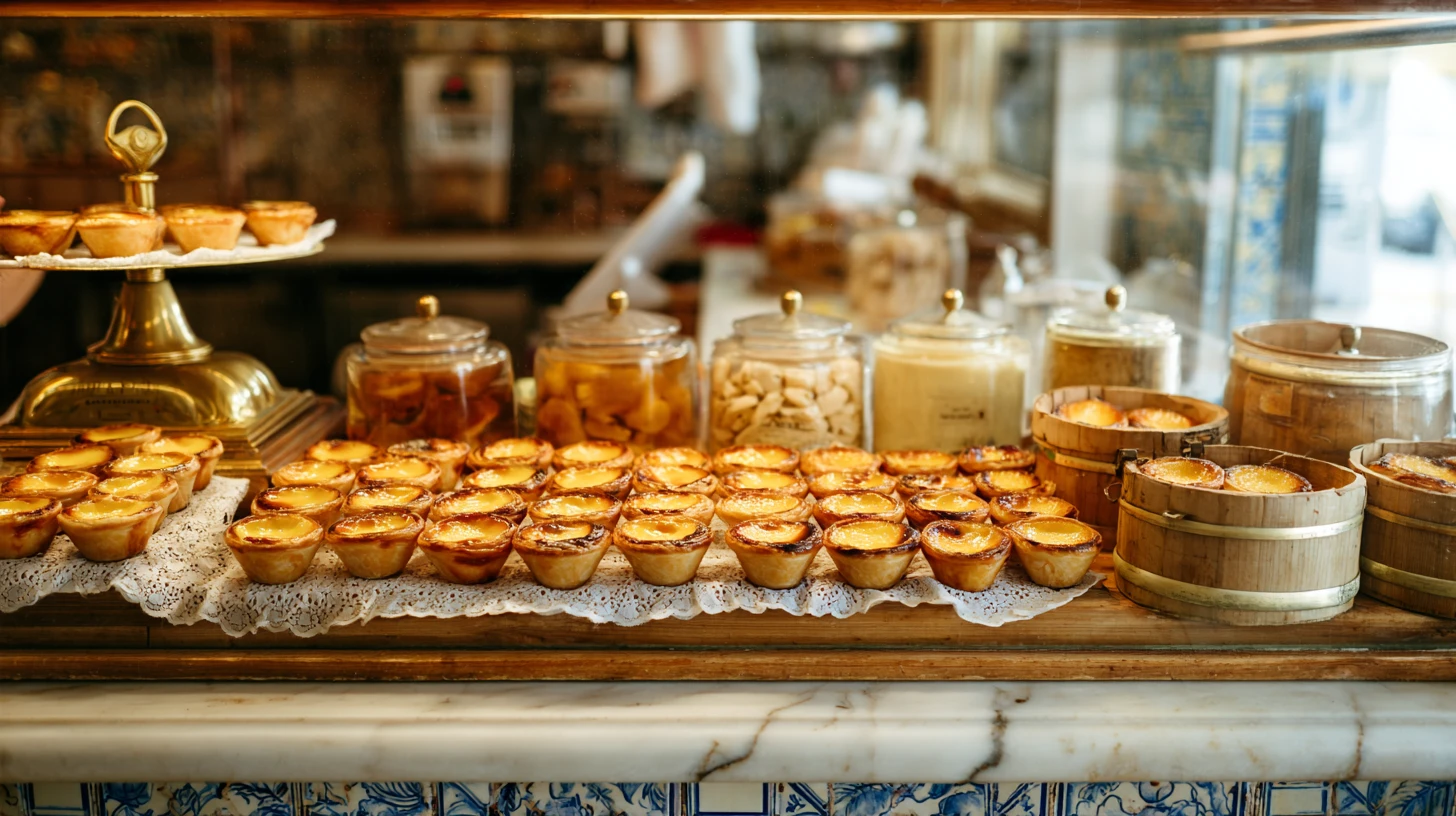
The pastelaria counter at work — pastéis de nata pressed by hand into copper molds, a craft built on centuries of conventual egg-yolk surplus.
🥐
The one rule that governs every meal
Hand the card on arrival, before ordering. Portuguese service is fast and physical — server takes your order, walks it to the line, food returns. Once an order is in the kitchen, modification is unreliable. The card on the table at the start changes the kitchen's first-pass decisions; verbal disclosure mid-meal does not.
🥐
Pastelaria mornings — assume yolk
Portugal's monastic-pastry tradition built nearly every traditional sweet on egg yolk (gema). Pastéis de nata, ovos moles, fios de ovos, papos de anjo, toucinho do céu, queijadas de Sintra — all structural yolk, no version-without-yolk exists in traditional pastelarias. Modern specialist bakeries (Made in Nata, vegan and GF cafés in Lisbon's Príncipe Real and Porto's Cedofeita) sell explicitly egg-free, dairy-free, and gluten-free alternatives, but they are separate businesses, not pastelaria menu items.
The rule: Egg-allergic travelers: do not order from traditional pastelarias. Identify two or three specialist bakeries before arrival.
Allergen pattern: Egg yolk (gema) is structural in conventual sweets. Dairy and wheat are also structural in most. The card must name all three.
🍷
Tasca lunches — name bacalhau separately from peixe
A working-class tasca lunch is built around grilled fish, bacalhau in some form, caldo verde, and vinho da casa. The kitchen-vocabulary trap is that bacalhau is its own category in Portuguese cooking — not 'fish.' A card saying only 'peixe' may not trigger the mental flag for pastéis de bacalhau, bacalhau à brás, or bacalhau com natas. Name bacalhau (bacalhau salgado) and peixe as two separate items on the card. Hand it before ordering; tascas are too fast for mid-meal correction.
The rule: Card must list bacalhau and peixe as separate terms. 'Sou alérgico a peixe' alone is not enough.
Allergen pattern: Fish (bacalhau) is the structural hidden vehicle of this rhythm layer.
🍤
Petiscos evenings — shellfish density and grill cross-contact
Petisco bars and modern chef-tascas in Lisbon's Cais do Sodré and Príncipe Real, Porto's Cedofeita, and the Algarve's chef-driven coast cluster shellfish dishes — clams, prawns, octopus, mussels — on small plates designed to share. Cross-contact across plates is high. Piri-piri grills handle prawns and chicken on the same surface. Petiscos kitchens are usually more allergen-aware than tascas — chef-driven, English-fluent — and will work with the card.
The rule: At petisco bars, explicitly flag piri-piri grill cross-contact for shellfish-allergic travelers. Hand the card and ask for the chef's recommendation.
Allergen pattern: Shellfish cross-contact (crustaceans and molluscs both) is the dominant evening risk.
🎶
Fado dinners — older menus, more card-dependent
Casa de fado dinners in Lisbon's Alfama and Mouraria and Porto's Ribeira are tourist-priced but operate on older menus: bacalhau, sopa, leitão, caldo verde, conventual desserts. Service is timed to the music — slow, formal, with multiple courses. English fluency varies; the staff is more focused on the singer's set than on table-by-table allergen consultation. Reserve ahead, mention alergia alimentar grave at booking, hand the card on arrival, confirm the courses before the music starts.
The rule: Book by phone or email with allergen disclosure. Reconfirm on arrival before the first set begins.
Allergen pattern: Fish (bacalhau), egg (conventual desserts), and dairy in the traditional menu rotation.
Communication norms
Dining Etiquette & Cultural Norms
The dining room may feel relaxed, but the allergy-critical moment is the first order handoff: once a tasca ticket reaches the line, bacalhau, egg, and shared-fryer decisions are already embedded. The cultural norm is to raise allergies in writing and at the start, not verbally and mid-meal. Tipping is light (5–10%) and not a leverage tool for service. Communal sharing in petisco bars requires explicit allergen flagging — Portuguese friendliness assumes everyone is sharing everything.
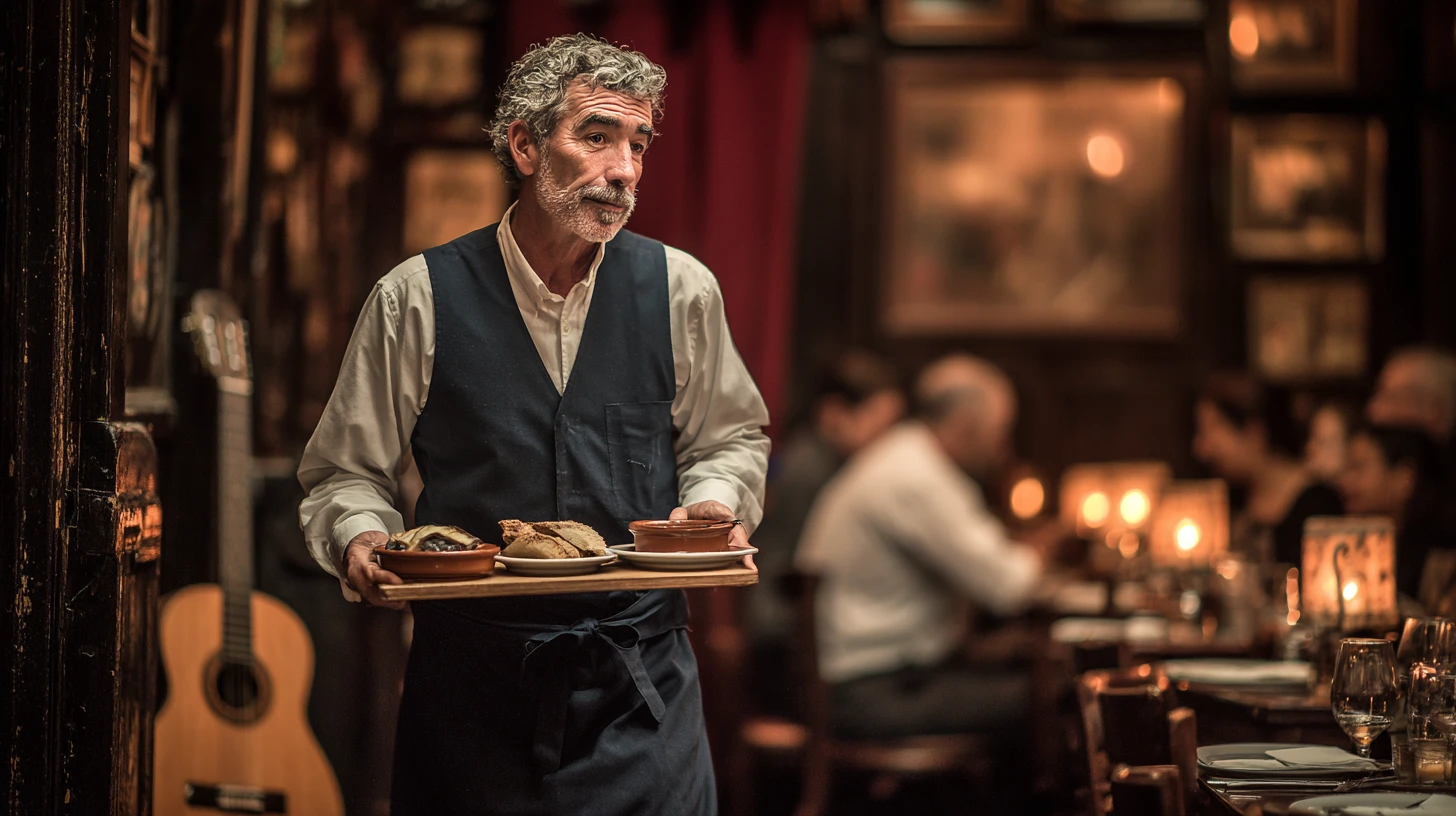
A fado-house waiter brings couvert before the music begins — in Portugal, the unrequested bread, olives, and cheese are a paid course, and declining is its own quiet etiquette.
💬
How to raise an allergy in Portuguese culture
Direct, warm, and written. Hand the card with a smile and 'alergia alimentar grave' (severe food allergy). Portuguese hospitality treats allergens as a professional concern, not a personal preference. The cultural mistake is to soften the disclosure — Portuguese servers will not press you for severity, and downplaying ('a little bit allergic') translates as 'they can probably eat around it.' For fish-allergic travelers, the second mistake is using only 'peixe' — bacalhau is its own kitchen category and needs to be named directly.
📝
Written beats verbal — every time
Even in English-fluent Lisbon and Porto, a written card outperforms a verbal disclosure. The reasons are operational: tasca service is fast, the kitchen line speaks Portuguese, and the dish moves through three hands between order and plate. A card on the table is visible to the server, the runner, and (if asked) the chef.
🍴
Petiscos sharing — flag before plates arrive
Petisco bars expect the whole table to share. If you cannot eat from shared plates because of cross-contact risk, say so at order time, before the kitchen builds the plates. Asking for individual plating mid-meal is awkward; flagging at the start is normal.
📞
Advance notice — when it helps and when it doesn't
Tascas and pastelarias: not possible, walk in. Sit-down restaurants and fado dinners: helpful, mention at booking. Chef-driven and tasting-menu venues: standard, 48 hours ahead. Calling 'telefonar antes' is welcomed; mentioning alergia alimentar grave at booking signals you take the kitchen seriously.
Tipping in Portugal: 5–10% is generous; rounding up is standard. Tipping is not a tool for allergy attention — it neither helps before the meal nor remedies a problem after.
Communication
Essential Safety Phrases
Six scenarios cover the working Portuguese language an allergic traveler needs. The card carries the formal declaration; these phrases handle the conversational follow-up. The bacalhau-vs-peixe distinction is critical — drill it before arrival.
Scenario 01
Declaring your allergy
PT
Tenho uma alergia alimentar grave. Aqui está o meu cartão.
Ténho uma alerghía alimentár grave. Aquí está o meu cartão.
I have a severe food allergy. Here is my card.
PT
Sou alérgico/a a peixe e também a bacalhau.
Sô alérghico/a a peixe i também a bacalháu.
I am allergic to fish AND also to bacalhau (salt cod).
Scenario 02
Asking about hidden bacalhau
PT
Este prato contém bacalhau?
Éshte práto contém bacalháu?
Does this dish contain bacalhau?
PT
Isto leva gema de ovo?
Íshto léva jéma de ôvo?
Does this contain egg yolk?
PT
Isto leva coentros?
Íshto léva couéntrush?
Does this contain coriander?
Scenario 03
Confirming the kitchen understood
PT
O chefe leu o meu cartão?
O shéfe léu o meu cartão?
Did the chef read my card?
PT
Sem [bacalhau / coentros / natas], por favor.
Sêng [bacalháu / couéntrush / nátash], por favór.
Without [bacalhau / coriander / cream], please.
Scenario 04
Asking about cross-contact
PT
A fritadeira é partilhada com peixe ou marisco?
A fritadéira é partilháda com peixe ou marísco?
Is the fryer shared with fish or shellfish?
PT
A grelha do piri-piri também é usada para gambas?
A grélya do píri-píri também é uzáda para gámbash?
Is the piri-piri grill also used for prawns?
Scenario 05
Replacing an EpiPen
PT
Preciso de um auto-injetor de adrenalina. Tenho receita médica.
Precízo de um auto-injetôr de adrenalína. Ténho recéita médica.
I need an adrenaline auto-injector. Here is my prescription.
Scenario 06
Emergency
PT
Anafilaxia! Já usei a minha adrenalina. Chamem o 112.
Anafiláxia! Já uséi a mínha adrenalína. Shámeng o um-um-dôish.
Anaphylaxis! I have used my adrenaline. Call 112.
PT
Preciso de uma ambulância.
Precízo de uma ambulánsia.
I need an ambulance.
Why a card matters in Portugal: Portugal does not publish a standardized government allergy communication tool comparable to Japan's CAA sheet or the US FARE chef cards. The EU FIC framework provides legal backing for on-request restaurant disclosure but no public-facing template. A well-written Portuguese-language card fills that gap.
Pre-Trip Preparation
Allergy-Specific Packing List for Portugal
Standard EU packing list with three Portugal-specific additions: a written EP-Portuguese allergy card naming bacalhau and gemas specifically; a small printed card image on the phone lockscreen for verbal-disclosure moments; and a pharmacy locator preloaded for INFARMED-registered pharmacies in your travel zone.
💊 Medical essentials
✓
{'name': 'Two adrenaline auto-injectors (carry on-person, not in checked bag)', 'rationale': 'Portuguese pharmacies require Rx and stock Anapen or Jext, not EpiPen — replacement on the same day is uncertain.'}
✓
{'name': 'Antihistamines (cetirizine, loratadine, Benadryl)', 'rationale': 'Over-the-counter in Portugal, but bringing your own avoids brand-name confusion.'}
✓
{'name': "Doctor's letter on letterhead naming medications, dosages, diagnosis", 'rationale': 'Customs is unlikely to ask, but the letter is necessary if you need a pharmacy refill mid-trip.'}
✓
{'name': 'Copy of the prescription, both English and Portuguese-translated', 'rationale': 'Some larger Lisbon and Porto pharmacies will accept a foreign Rx with translation; smaller pharmacies will not.'}
✓
{'name': 'Asthma inhaler if relevant', 'rationale': 'Pollen and sea-mist trigger asthma in Alentejo summer and Atlantic coast year-round.'}
🗂️ Communication tools
✓
{'name': 'Portuguese-language allergy card naming bacalhau, gemas, coentros explicitly', 'rationale': 'The single most useful prep item. Closes the kitchen-vocabulary gap that English allergen categories leave open.'}
✓
{'name': 'Card image saved to phone lockscreen', 'rationale': 'For walk-in pastelarias and street vendors where you cannot pull a paper card out fast enough.'}
✓
{'name': 'Audio file of your allergy declaration in Portuguese', 'rationale': 'For loud tasca service or fado-house dinners; play once, hand the card.'}
✓
{'name': "Printed pocket guide for the cities you'll visit", 'rationale': 'Offline reference for hospital addresses, pharmacies, and safe-restaurant shortlist.'}
🎯 At-destination habits
✓
{'name': 'Hand the card on arrival at every restaurant — before ordering', 'rationale': 'Portuguese tasca service is too fast for mid-meal disclosure.'}
✓
{'name': 'At pastelarias: stand back from the counter, hand the card, then order', 'rationale': 'Pastelaria queues move at 30 seconds per customer — make space for the card to be read.'}
✓
{'name': 'Book fado-house dinners by phone with allergen disclosure', 'rationale': 'Older menus, slower English, music-timed service — needs advance setup.'}
✓
{'name': 'Avoid Alfama, Bairro Alto, Madragoa on June 12–13 (Santos Populares) if sardine smoke is dangerous', 'rationale': 'Smoke is unavoidable across whole districts those two nights.'}
Emergency
Emergency Infrastructure
Portuguese emergency response is EU-standard. 112 is the universal number, dispatched through INEM (Instituto Nacional de Emergência Médica). Urban response in Lisbon and Porto is fast by EU standards; rural Alentejo, Trás-os-Montes, and outer Azores have meaningfully longer transport times — helicopter EMS is available for serious cases. Public hospitals (SNS) accept all emergencies; private hospitals are faster for non-emergency follow-up. For fish-allergic travelers presenting with anaphylaxis, name the trigger explicitly — 'peixe' or 'bacalhau' — so the receiving team understands the salt-cod-vs-fresh-fish exposure history.
112
EU-universal emergency (ambulance, police, fire)
Operators speak Portuguese and English; ask 'English, please' immediately. State 'anaphylaxis' (anafilaxia) and your location.
Other emergency numbers: INEM (medical emergency direct) (112): All medical dispatch routes through 112 — INEM is the operator, not a separate number. Linha Saúde 24 (health advice) (808 24 24 24): Non-emergency 24h health helpline. Some English; primarily Portuguese.
How the Portuguese emergency system works: Public SNS hospitals provide emergency care to all visitors; EU travelers with EHIC are covered, non-EU travelers should expect to pay (and reclaim through travel insurance). Private hospitals (CUF, Lusíadas, Luz) are faster for non-emergency follow-up but charge upfront.
Hospital de Santa Maria (Centro Hospitalar Universitário Lisboa Norte)
Av. Prof. Egas Moniz MB, 1649-028 Lisboa
Lisbon's largest public hospital — full emergency department, anaphylaxis-capable.
Lisbon
Hospital CUF Tejo
Av. 24 de Julho 171A, 1350-352 Lisboa
Modern private hospital — English-speaking staff common, faster than public for non-critical care.
Lisbon
Hospital de São João
Alameda Prof. Hernâni Monteiro, 4200-319 Porto
Porto's primary university hospital — full emergency and ICU.
Porto
Hospital Lusíadas Porto
Av. da Boavista 171, 4050-115 Porto
Private; English-fluent, central Porto.
Porto
Hospital de Faro (CHUA)
Rua Leão Penedo, 8000-386 Faro
Algarve regional public hospital — primary emergency receiving for the south coast.
Faro
Hospital Dr. Nélio Mendonça
Av. Luís de Camões, 9004-514 Funchal
Madeira's central hospital — full emergency, helicopter EMS to outer-island Madeira.
Funchal (Madeira)
Hospital do Divino Espírito Santo
Av. D. Manuel I, 9500-370 Ponta Delgada
Largest Azores hospital — São Miguel island. Outer islands route here by air for serious cases.
Ponta Delgada (Azores)
Regulation
Allergen Labeling Law
Portugal implements EU Regulation 1169/2011 (Food Information to Consumers) through Decreto-Lei 26/2016. 14 mandatory allergens on packaged-food labels, distinguished in the ingredients list. Restaurant disclosure is required on customer request — written documentation must be available, though not on the menu by default. The law lists 'peixe' as the mandatory category; it does not separately call out bacalhau, even though salt cod is functionally a distinct kitchen ingredient. This is the legal-versus-practical gap your card has to close.
Regulamento (UE) n.º 1169/2011 / Decreto-Lei n.º 26/2016 — transposing EU Regulation 1169/2011 (Food Information to Consumers). Enforced by ASAE (Autoridade de Segurança Alimentar e Económica). Restaurant disclosure required: EU FIC Article 44 requires non-prepackaged food (restaurants, bakeries, butcher counters) to disclose the 14 allergens. Disclosure on the menu is not mandatory; on-request disclosure is. ASAE (Autoridade de Segurança Alimentar e Económica) enforces.
EU FIC Annex II mandatory allergen. Must be declared on all pre-packaged foods and disclosed on request at all food-service venues (restaurante, tasca, pastelaria, mariscaria, agroturismo). Taxonomy mapping: wheat.
02. Crustaceans · Crustáceos
EU FIC Annex II mandatory allergen. Must be declared on all pre-packaged foods and disclosed on request at all food-service venues (restaurante, tasca, pastelaria, mariscaria, agroturismo). Taxonomy mapping: shellfish.
03. Eggs · Ovos
EU FIC Annex II mandatory allergen. Must be declared on all pre-packaged foods and disclosed on request at all food-service venues (restaurante, tasca, pastelaria, mariscaria, agroturismo). Taxonomy mapping: egg.
04. Fish · Peixes
EU FIC Annex II mandatory allergen. Must be declared on all pre-packaged foods and disclosed on request at all food-service venues (restaurante, tasca, pastelaria, mariscaria, agroturismo). Taxonomy mapping: fish.
05. Peanuts · Amendoins
EU FIC Annex II mandatory allergen. Must be declared on all pre-packaged foods and disclosed on request at all food-service venues (restaurante, tasca, pastelaria, mariscaria, agroturismo). Taxonomy mapping: peanut.
06. Soybeans · Soja
EU FIC Annex II mandatory allergen. Must be declared on all pre-packaged foods and disclosed on request at all food-service venues (restaurante, tasca, pastelaria, mariscaria, agroturismo). Taxonomy mapping: soy.
EU FIC Annex II mandatory allergen. Must be declared on all pre-packaged foods and disclosed on request at all food-service venues (restaurante, tasca, pastelaria, mariscaria, agroturismo). Taxonomy mapping: milk.
EU FIC Annex II mandatory allergen. Must be declared on all pre-packaged foods and disclosed on request at all food-service venues (restaurante, tasca, pastelaria, mariscaria, agroturismo). Taxonomy mapping: tree_nuts.
09. Celery · Aipo
EU FIC Annex II mandatory allergen. Must be declared on all pre-packaged foods and disclosed on request at all food-service venues (restaurante, tasca, pastelaria, mariscaria, agroturismo). Taxonomy mapping: seeds_spices.
10. Mustard · Mostarda
EU FIC Annex II mandatory allergen. Must be declared on all pre-packaged foods and disclosed on request at all food-service venues (restaurante, tasca, pastelaria, mariscaria, agroturismo). Taxonomy mapping: seeds_spices.
11. Sesame seeds · Sementes de sésamo
EU FIC Annex II mandatory allergen. Must be declared on all pre-packaged foods and disclosed on request at all food-service venues (restaurante, tasca, pastelaria, mariscaria, agroturismo). Taxonomy mapping: sesame.
12. Sulphur dioxide and sulphites >10mg/kg · Dióxido de enxofre e sulfitos
EU FIC Annex II mandatory allergen. Must be declared on all pre-packaged foods and disclosed on request at all food-service venues (restaurante, tasca, pastelaria, mariscaria, agroturismo). Taxonomy mapping: sulfites.
13. Lupin · Tremoço
EU FIC Annex II mandatory allergen. Must be declared on all pre-packaged foods and disclosed on request at all food-service venues (restaurante, tasca, pastelaria, mariscaria, agroturismo). Taxonomy mapping: legumes.
14. Molluscs · Moluscos
EU FIC Annex II mandatory allergen. Must be declared on all pre-packaged foods and disclosed on request at all food-service venues (restaurante, tasca, pastelaria, mariscaria, agroturismo). Taxonomy mapping: shellfish.
Vinho a granel (open wine, vinho da casa) and sulfite labeling: FIC sulfite disclosure (>10mg/kg) applies to packaged wine. House wine served in carafes is technically packaged at the producer level — sulfite label should still exist on the original bottle/keg. Ask 'tem sulfitos?' if sulfite-sensitive.
Port tastings — beverage-led risk, food pairings, and sulfites: Douro and Gaia port lodges (Sandeman, Taylor's, Graham's, Sogrape) run reservation-based tastings that are lower kitchen-risk than tascas: tastings are beverage-led, staff-facing, and structured. The relevant allergen exposure is fortified-wine sulfites at higher concentration than table wine, plus standard pairing trays of queijo (sheep or cow cheese), nuts (typically walnut, almond), chocolate, and dried fruit. Decline pairings or specify exclusions before the flight begins; substitutions are easy when requested in advance, awkward once the tray arrives.
Street-vendor bifanas, caracóis, and festival food: Summer street vendors selling bifanas (pork sandwiches), caracóis (snails), pipis (chicken parts), and Santos Populares specialties are technically subject to FIC on-request rules. In practice, written allergen disclosure is near-absent. Visual ingredient confirmation is the only reliable check.
DOP and PGI protected foods — what the label tells you: Portugal has dozens of EU-protected regional foods (Queijo da Serra DOP, Pastel de Tentúgal IGP, Ovos Moles de Aveiro IGP, Presunto de Barrancos DOP, Vinho do Porto DOC). DOP/IGP labels guarantee origin and method but do NOT change FIC allergen disclosure — the 14 allergens must still appear in the ingredients list.
Medication
EpiPen Import & Local Availability
EpiPen and equivalent adrenaline auto-injectors are permitted into Portugal with a prescription. INFARMED (Autoridade Nacional do Medicamento) is the national medicines authority; its INFOMED database lists current marketing authorizations. Auto-injector brand availability in Portuguese pharmacies has historically included Anapen and Jext, with EpiPen brand less consistently stocked — verify current stock directly with INFOMED or a major-chain pharmacy before travel.
Permitted with prescription: Adrenaline auto-injectors are permitted into Portugal for personal medical use. Carry the device in its original pharmacy packaging with a doctor's letter naming the medication, your diagnosis, and dosage.
01 📋
Carry both auto-injectors (recommended: two devices) in carry-on, not checked baggage.
02 ✉️
Carry a doctor's letter on letterhead naming the medication (epinephrine/adrenaline), dosage, your diagnosis, and the brand. Letter should be in English; ideally also translated.
03 🛂
Keep the device in original pharmacy packaging with the prescription label visible.
04 💊
Customs declaration is not routinely required for personal-use prescribed medication in EU travel. EU travelers from Schengen members face no border check; non-Schengen arrivals carry the documentation in case of inspection.
05 🏥
For mid-trip replacement, INFARMED-registered pharmacies in Lisbon and Porto can dispense Anapen or Jext against a Portuguese prescription. Some accept translated foreign prescriptions; smaller pharmacies will not. Plan a hospital visit if a new prescription is required. Verify current product availability on INFOMED before travel.
Adrenaline auto-injector brand landscape in Portugal: Anapen and Jext are the most commonly stocked auto-injector brands in Portugal with prescription. EpiPen brand availability varies. Stocks and marketing authorizations vary by pharmacy and over time. Verify current device, strength, and pricing on INFOMED (the INFARMED medicines database) or by calling a major-chain pharmacy in your travel city before departure. Pediatric strengths are stocked at major chains (Farmácias Holon, Farmácia Sant'Ana) but not all neighborhood pharmacies.
Confidence: MEDIUM. Verify current device availability and pricing with INFARMED or a Lisbon/Porto major-chain pharmacy before travel. Brand and stock policies change.
Regulatory authority:INFARMED — Autoridade Nacional do Medicamento e Produtos de Saúde is the Portuguese regulatory authority for medications — the national equivalent of FDA / EMA. Regulates the approval, post-marketing surveillance, and import rules for medications. The INFOMED database lists current marketing authorizations for adrenaline auto-injectors and other prescription products.
Traveler Reports
Traveler Voices — Community Reports
Illustrative composite scenarios drawn from common Prepared Travel intake patterns and public traveler reports. Initials and locations are stylized; quotes are composite, not first-person verbatim. Replace with verified community testimony once intake-ID-tagged quotes are available.
I learned 'sou alérgico a peixe E a bacalhau' the hard way after a 'potato cake' at a Cais do Sodré tasca turned out to be pastéis de bacalhau. Now it's the first thing I say.
Megan K. · Lisbon · 2024 · Fish
In Évora, every soup had coriander. I assumed açorda was bread soup. It is — it's a coriander-bread soup. I should have read about Alentejo before booking.
James R. · Évora, Alentejo · 2023 · Coriander
Porto pastelarias were the hardest part with an egg allergy. The smell alone is yolk and caramelized sugar. I found one vegan bakery in Cedofeita and ate there every morning.
Sarah P. · Porto · 2024 · Egg
References & Transparency
Sources, Citations & Data Confidence
View source citations
▼
1
European Parliament and Council. “Regulation (EU) No 1169/2011 on the provision of food information to consumers (EU FIC). Transposed in Portugal by Decreto-Lei n.º 26/2016.” 2011. eur-lex.europa.eu — Primary regulatory source for EU 14 allergen labeling. HIGH confidence.
2
Diário da República Eletrónico. “Decreto-Lei n.º 26/2016 — Portuguese transposition of FIC 1169/2011.” 2016. dre.pt — National Portuguese implementation. HIGH confidence.
3
INFARMED — Autoridade Nacional do Medicamento e Produtos de Saúde. “INFOMED medicines database — Anapen and Jext authorisations.” 2025. infarmed.pt — Portuguese national medicines authority. Confirms adrenaline auto-injector device availability. HIGH confidence.
4
Sociedade Portuguesa de Alergologia e Imunologia Clínica (SPAIC). “Clinical guidelines and patient resources for food allergy in Portuguese populations.” 2024. spaic.pt — Portuguese professional society of allergy and clinical immunology. HIGH confidence.
5
ASAE — Autoridade de Segurança Alimentar e Económica. “Food safety enforcement guidance and FIC compliance inspections.” 2024. asae.gov.pt — Portuguese food safety enforcement authority. HIGH confidence.
6
INEM — Instituto Nacional de Emergência Médica. “112 emergency medical dispatch and response benchmarks.” 2025. inem.pt — National emergency medical dispatch authority. HIGH confidence.
7
Direção-Geral da Saúde (DGS). “Public health and dietary guidance for Portugal.” 2024. dgs.pt — Portuguese national health authority. HIGH confidence.
8
Guia Michelin Portugal. “Michelin Guide Portugal 2025 — chef-tier venue allergen handling reference.” 2025. guide.michelin.com/pt — Reference for chef-tier venue allergen handling standards. HIGH confidence.
Regulation 1169/2011 + Decreto-Lei n.º 26/2016 — no Portugal-specific supplements
Restaurant on-request disclosure requirement
● HIGH
Decreto-Lei n.º 26/2016 confirmed — written documentation must exist; menu disclosure not required
EpiPen / Jext / Anapen import (unrestricted)
● HIGH
EU member state — no import controls for personal medications. INFARMED-authorised brands confirmed.
Bacalhau hidden-vehicle structural prevalence
● HIGH
Cross-referenced against EU PDO/PGI registries, SPAIC guidance, regional gastronomic literature
Coriander structural in Alentejo cuisine
● HIGH
Documented in Portuguese gastronomic literature; corroborated by traveler intake reports
Hospital addresses (all seven)
● MEDIUM
Require verification against current Lisboa/Porto/Funchal/Ponta Delgada hospital directories before publish
Difficulty score (4/10)
● MEDIUM
Editorial composite — combines structural-legal protection with cultural-practical intelligence
Language percentage data (English ~30% FOH)
● MEDIUM
Industry estimates; not census-tracked for kitchen-staff specifically
Traveler voice quotes
● MEDIUM
Illustrative composites drawn from common Prepared Travel intake patterns; not first-person verbatim until intake-ID-tagged
Phonetic transcriptions (lh, nh, ão, etc.)
● MEDIUM
Native-EP-speaker review recommended pre-publish
This page is a living document. Labeling laws change, hospitals change ownership, and allergy awareness in kitchens improves over time. Last verified May 2026.
Madeira and Azores note: Both are Portuguese autonomous regions; EU FIC and Decreto-Lei n.º 26/2016 apply identically to mainland. Allergen disclosure infrastructure tracks Funchal-tourist-corridor strength on Madeira, weakens on outer Azores islands (Flores, Corvo) with limited dining and longer emergency response times.
You've done the research. Now build your Portugal allergy card.
The pastelaria is waiting. Go prepared.
Generate your Portugal food allergy card in European Portuguese — naming bacalhau, gemas, and coentros directly, the terms that close the kitchen-vocabulary gap English categories leave open. Your Portugal allergy translation card is ready in two minutes.