Tanzania scores 7 out of 10 on the Prepared Travel difficulty scale — high, driven by three compounding factors. Karanga (ground peanut paste and peanut flour) is the structural invisible allergen in Tanzanian cuisine: it thickens mchuzi, enriches sauces, and appears in countless preparations where kitchens do not categorize it as ‘peanut’ in the allergen sense — they categorize it as a pantry staple, closer to flour than to nut. Tanzania has no restaurant allergen disclosure law. And the Northern and Southern safari circuits place travelers hours or days from any facility stocking epinephrine — the operational emergency service for the bush is AMREF Flying Doctors East Africa air evacuation, not the national 112 line. Name karanga on your card. Secure Flying Doctors membership. Brief your lodge at booking. The rest of Tanzania is one of the great travel experiences on earth.
🥘 Food & Culture
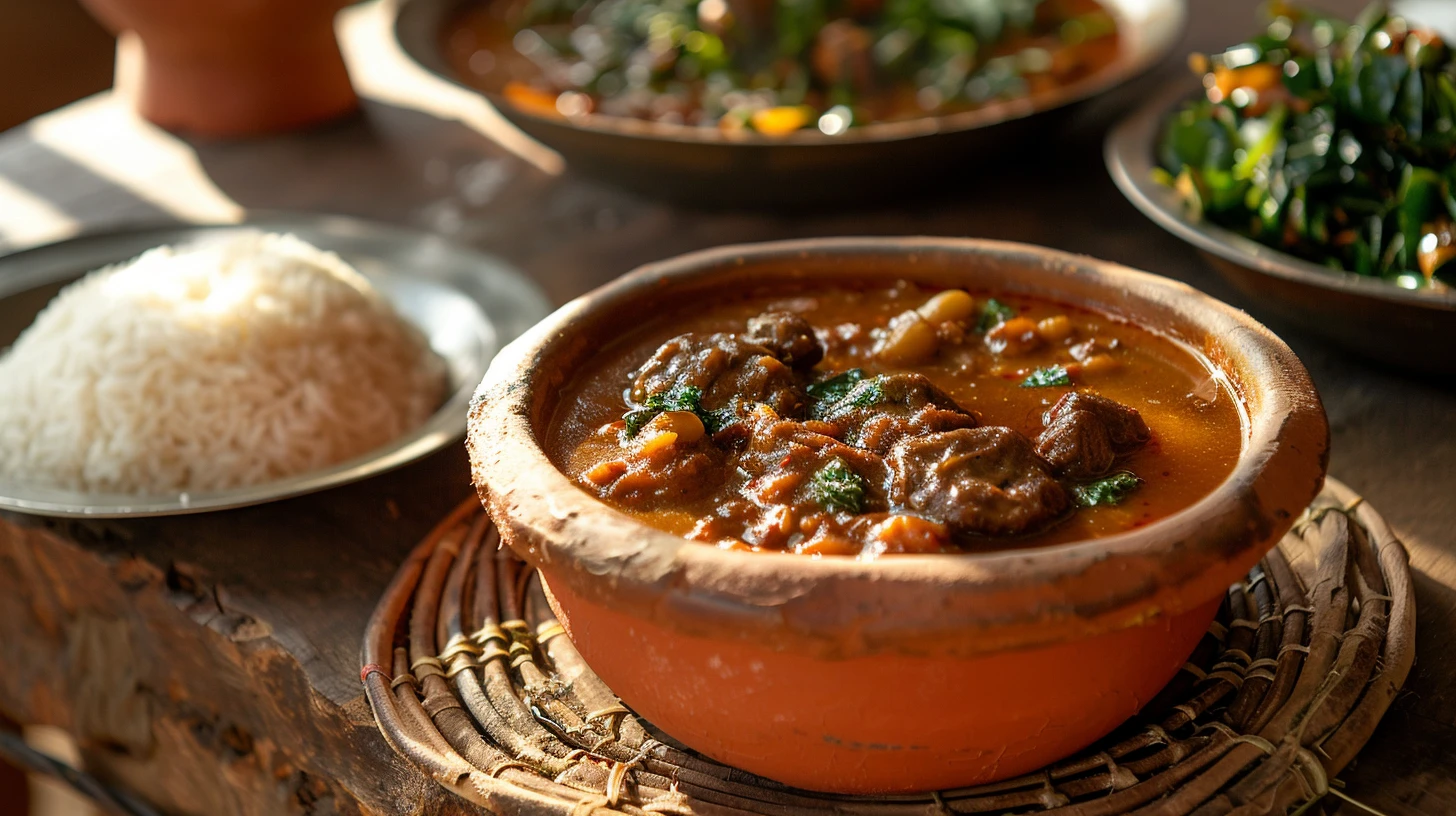
Tanzanian cuisine is the meeting point of three food cultures: the ugali-and-nyama inland mainland tradition (maize porridge and grilled meat), the coconut-rich Swahili coastal and Zanzibari tradition (pilau, biryani, the coconut-spice cooking that defines the Swahili Coast), and the Indian-influenced chapati-and-curry tradition brought by South Asian migration to the coast. Karanga (peanut) threads through all three. Nazi (coconut) defines the coast. Nyama choma (grilled meat) is the national social dish. Zanzibar’s Forodhani Gardens night market, the roadside nyama choma joints of Arusha, the hoteli of Dar es Salaam, and the lodge kitchens of the Serengeti are all serving within this framework — but with sharply different allergen profiles.
Core Safety Metrics — hover each for full explanation
Overall Allergy Travel Difficulty
7/10
High — karanga invisibility + no restaurant law + safari medical access gap
Tanzania scores 7/10 — high difficulty. Karanga (ground peanut paste) is structurally embedded in Tanzanian cuisine as a thickener that kitchens do not mentally categorize as ‘peanut’. No restaurant allergen disclosure law. The safari circuits place travelers hours or days from any facility stocking epinephrine. Moderated by high-end lodge dietary management and strong urban private hospital infrastructure in Dar es Salaam.
Allergen Labeling Law Strength
3/10
Packaged food only (TBS TZS 538) — no restaurant law
Tanzania Bureau of Standards (TBS) regulates packaged food labeling under Tanzania Standard TZS 538 — major allergen declarations required on pre-packaged food. Enforcement is inconsistent at smaller domestic producers. No restaurant or street-food allergen disclosure law exists. Imported packaged foods in upscale supermarkets often carry EU or South African labels that are more readable than domestic TBS labels.1
Kitchen Allergen Awareness
4/10
High at safari lodges, minimal at informal hoteli and street stalls
Allergen awareness is concentrated at the top of the venue hierarchy: international safari lodges, luxury hotels in Dar es Salaam and Zanzibar, and high-end restaurants in Arusha and Stone Town have trained kitchens and dietary-notification protocols. Mid-tier restaurants, hoteli, mama ntilie, and street stalls operate without any allergen awareness framework. Karanga is ‘flour’ in the kitchen vocabulary, not a regulated allergen.
Cultural Modification Flexibility
7/10
Exceptional at lodges, limited at hoteli prep-ahead venues
Swahili kitchen culture is genuinely hospitality-oriented — karibu (welcome) is the structural greeting. At safari lodges with small guest counts, modification flexibility is exceptional: menus are rewritten around dietary requirements notified at booking. The structural limitation is street food and hoteli, where dishes are pre-made in bulk and modification means choosing a different dish rather than remaking an existing one.
Emergency Medical Reliability
4/10
Strong in Dar/Arusha — bush requires AMREF Flying Doctors air evacuation
Dar es Salaam’s Aga Khan Hospital and Muhimbili National Hospital provide international-standard emergency care. Arusha Lutheran Medical Centre and KCMC Moshi serve the Northern Circuit base and Kilimanjaro climbers. Outside these three urban poles, medical infrastructure degrades sharply. Safari circuits depend on AMREF Flying Doctors East Africa air evacuation; the national 112 line will not produce an ambulance in any clinically useful timeframe.2,4
Difficulty in context — how Tanzania compares globally7 / 10 High
🇩🇰 Denmark 2🇦🇺 Australia 3🇿🇦 South Africa 6🇹🇿 Tanzania 7🇮🇳 India 9
🦒
On the Ground
Tanzania’s 7/10 is not a warning to stay home — it is a map of what to prepare. The primary challenge is vocabulary: ‘peanut’ in English does not reach the Swahili kitchen concept of karanga, and your card must close that gap. The secondary challenge is medical access: in Dar es Salaam and Arusha, emergency care is functional and fast; on the Serengeti, it is an AMREF Flying Doctors air evacuation. The paradox of the score is that the country’s most famous travel experience — the safari — is often safer than its everyday dining because lodges cook to order for small groups and brief chefs on dietary requirements at booking. A prepared traveler who names karanga in Swahili, notifies lodges at booking, and carries Flying Doctors membership can experience Tanzania with real confidence.
Safari njema is waiting — is your Swahili allergy translation card ready?
Generate your Tanzania food allergy card in Swahili — naming karangaGenerate card in Swahili → Create now and unga wa karangaPeanut flour — the hidden thickener Build your card alongside your specific allergens. Your Tanzania allergy translation card, in the vocabulary the Swahili kitchen recognizes.
🏔 Mount Kilimanjaro — tap to see the full picture🥜 Mchuzi wa karanga — tap to understand the hidden risk🏯 Forodhani Gardens — tap to plan your Zanzibar approach
Allergen Risk
Allergen Prevalence Index
This index scores two dimensions: supply prevalence (how embedded an allergen is in the cuisine) and hidden risk (how likely it is to appear without disclosure). Tanzania’s defining editorial fact: karanga (ground peanut paste) scores 10/10 on both dimensions not because Tanzania uses more peanut than other peanut-heavy cuisines, but because Tanzanian kitchens do not categorize karanga as ‘peanut’ in the allergen sense — they categorize it as a pantry staple. The structural invisibility is what creates the risk. Secondary vehicles are region-specific: nazi (coconut) on the Swahili coast and Zanzibar, dagaa (dried small fish) in lake regions, korosho (cashew) in the Mtwara-Lindi south.5,9
Filter by your allergen to highlight relevant rows
Filter by allergen:
Allergen
Supply Prevalence
Hidden Risk
Cross-Contact
Restaurant Risk
Peanut / karangaGround peanut paste in mchuzi and sauces, unga wa karanga (peanut flour) as thickener — kitchens categorize as staple, not allergen
10
10!
8!
10!
⚠ Vocabulary gap alert:Karanga is the Swahili kitchen word for peanut — ground paste, flour, and whole. Naming ‘peanut’ in English is functionally insufficient in Tanzania. Your card must name karanga, unga wa karanga (peanut flour), and njugu (alternate regional term) to activate the kitchen category the cook actually uses. Cooks thinking ‘no peanuts’ may still hand you a stew thickened with unga wa karanga.9
Tree Nuts / korosho · naziKorosho (cashew) from Mtwara south coast; nazi (coconut) structural on Swahili coast & Zanzibar — coconut not categorized as tree nut by cooks
9
9!
7
8!
⚠ Coconut is not a tree nut to a Tanzanian cook: On the Swahili coast and across Zanzibar, nazi (coconut) is the structural sauce base — in every pilau, biryani, mchuzi wa nazi, and maharage ya nazi. Tanzanian kitchens mentally categorize nazi as a fruit and cooking medium, not as a nut. A ‘tree nut’ question will not prompt mention of coconut. Name nazi and tui la nazi (coconut milk) separately on your card. Also name korosho (cashew) — Tanzania is one of Africa’s largest cashew producers.
Fish / samaki · dagaaSamaki = fresh fish; dagaa = dried small fish (silver cyprinid from Lake Victoria) — cooks categorize dagaa as seasoning, not fish
9
8!
8!
8!
Dagaa is fish, even when the cook says it isn’t:Dagaa are small dried freshwater fish that are a structural seasoning ingredient across inland Tanzania, particularly around Lake Victoria. Ground into spice blends, added whole to relishes, simmered into sauces. Fish-allergic travelers who ask only about samaki may receive dishes containing dagaa. Card must name dagaa explicitly and phrase the allergen as ‘samaki wa aina yoyote — pamoja na dagaa’ (fish of any kind — including dagaa).
Shellfish / kamba · kaa · pwezaCoast and Zanzibar only — Forodhani Gardens peak cross-contact environment. Inland safari circuits have minimal shellfish exposure
7
6
9!
8
Dairy / maziwaChai ya maziwa (spiced milk tea) ubiquitous. Maziwa ya mgando (fermented milk) in Maasai/Sukuma pastoralist culture. Indian-coastal paneer and ghee dishes
6
4
3
5
Egg / mayaiChipsi mayai (Tanzania’s signature street food omelette) structural egg. Mandazi and vitumbua often contain egg
7
5
5
6
Wheat / nganoChapati, mandazi, mkate, bhajia (Indian-influenced coastal cuisine). Ugali (maize) and wali (rice) are naturally wheat-free alternatives
8
5
6
6
Positive attribute for wheat-allergic travelers:Ugali (maize porridge) is Tanzania’s national staple and is naturally wheat-free. Wali (rice) is the coastal and Zanzibari staple. Grilled meats (nyama choma), maharage (beans), and most mchuzi preparations are wheat-free. Wheat risk concentrates at Indian-influenced restaurants and at breakfast (chapati, mandazi) — the rest of the cuisine offers substantial naturally-gluten-free options.
Spices / viungo · bizariPilau masala (cumin, coriander, cardamom, cinnamon, clove). Commercial blends may include peanut flour or sesame as carriers. Zanzibar spice island heritage
9
6
5
7
Garlic & Onion / vitunguu · kitunguu saumuStructural flavor base of virtually every mchuzi, pilau, biryani, and curry — no traditional savory preparation begins without fried onion
10
7
4
8
Sesame / ufutaKashata ya ufuta (sesame-coconut brittle) Zanzibar specialty. Spice blends, bread toppings. Not mandatory on TBS label list
4
4
3
4
Legumes / maharage · kunde · denguRed kidney beans, cowpeas, lentils, green gram. Indian-coastal bhajia and samosas for chickpea cross-reactivity concerns
8
4
4
5
Soy / soyaMinor in traditional cuisine. Chinese restaurants in Dar/Arusha, commercial spice blends, packaged snacks
3
3
2
3
Cuisine
Dish Allergen Map
Tanzanian dishes split along the STRUCTURAL vs INCIDENTAL axis — but the editorial through-line means the STRUCTURAL peanut risk is invisible in many preparations. Mchuzi wa karanga names the peanut in its title; countless other stews and sauces use karanga as a thickener without naming it. The second axis is coast vs. inland: Zanzibari and coastal dishes are built on coconut (nazi); inland dishes on tomato-onion mchuzi and peanut thickener. SAUCE WARNING: Always ask ‘Je, mchuzi huu una karanga?’ for every sauce dish, not just dishes that name peanut in the title.
Safest options: Ugali (plain maize porridge — naturally wheat-free, dairy-free, peanut-free). Wali (plain rice, not coconut rice). Nyama choma (plain grilled meat, no marinade, confirm grill not shared with fish). Fresh whole fruit — embe (mango), papai (papaya), nanasi (pineapple), ndizi (banana). Coconut warning (coast/Zanzibar): confirm ‘Iko na nazi?’ — even plain-looking rice may be coconut rice.
Dish
Allergens
Hidden Risk Notes
Risk
Mchuzi wa KarangaPeanut stew with onion, tomato, often coconut milk
STRUCTURAL (peanut) — Karanga is the defining ingredient — entire flavor and texture comes from ground peanut. On the coast, tui la nazi often included. CRITICAL: the un-named mchuzi served with ugali or rice at a hoteli may also be thickened with unga wa karanga. Ask about karanga in every sauce, not just those that name it.
● HIGH
UgaliStiff maize porridge — national staple
NO STRUCTURAL ALLERGENS
POSITIVE ATTRIBUTE — Maize flour (unga wa mahindi) and water. Naturally wheat-free, dairy-free, peanut-free. The plate is safe; the sauce on the same plate is the variable. Order ugali separately first, then verify each sauce. Rare incidental: lower-cost commercial flour blends may include wheat as extender.
● LOW
PilauSpiced rice with meat — pilau masala + often coconut
STRUCTURAL (spice blend) + INCIDENTAL (HIGH PROB) — Commercial pilau masala blends frequently include unga wa karanga as bulking agent. Content varies by brand purchased. Ask: ‘Bizari ya pilau ina unga wa karanga au ufuta?’ Coastal pilau also uses coconut milk.
● HIGH
Nyama ChomaGrilled meat — national social dish
PLAIN — NO STRUCTURALMARINADE — INCIDENTAL
POSITIVE ATTRIBUTE — Plainest form is grilled meat with salt and pepper over charcoal. One of the most allergen-transparent proteins. INCIDENTAL: marinated versions may use pilipili masala containing peanut flour or sesame. Request plain: ‘Nyama choma bila marinade, bila viungo’. Cross-contact risk if grill shared with samaki.
● LOW
Chipsi MayaiFries cooked into an omelette — national street food
STRUCTURAL (egg) — Mayai is the binding. Cannot be modified. CROSS-CONTACT — Street stalls use a single pot of oil all day for samaki, bhajia, and whatever else is fried. Every chipsi mayai carries that accumulation. Ask: ‘Mafuta haya yanatumiwa kukaanga samaki au karanga?’
● HIGH
Samaki wa KupakaGrilled fish in coconut curry — Swahili coast signature
FISH — STRUCTURALCOCONUT — STRUCTURALGARLIC & ONION — STRUCTURAL
STRUCTURAL — ‘Kupaka’ means ‘painted’ — fish grilled then coated with tui la nazi curry. No coconut, no kupaka. Spice blend may contain peanut flour. Mainland variants may add dagaa to the curry base as flavor enhancer.
● HIGH
Maharage ya NaziRed kidney beans in coconut milk — coastal staple
STRUCTURAL — Tui la nazi is the sauce medium. Inland equivalent is plain maharage (no coconut) — useful coconut-free substitute for coastal travelers. INCIDENTAL: some kitchens add unga wa karanga as additional thickener. Request plain: ‘Maharage bila nazi, bila karanga’.
● HIGH
Ndizi na NyamaGreen plantain and beef stew — Kilimanjaro/Chagga signature
Green bananas and beef in onion-tomato stew base. INCIDENTAL (regional) — In Chagga-region cooking (Moshi area), stew sauce frequently thickened with unga wa karanga. Safari lodge interpretations more likely peanut-free. Always confirm at any Chagga/Kilimanjaro-region venue.
STRUCTURAL (wheat) — Wheat flour dough. INCIDENTAL — Some preparations use ghee (siagi) for dairy; commercial street chapati uses vegetable oil. Cross-contact concern: cooked on tawa (griddle) sometimes shared with egg dishes. Ask: ‘Imepikwa kwa siagi au mafuta?’
STRUCTURAL (wheat/egg) + coastal coconut — Zanzibari mandazi often include nazi in dough. Deep-fried in shared oil at street stalls — same pot as bhajia, samosas, peanut snacks. Shared-oil cross-contact near-certain.
● HIGH
Pweza wa KupakaGrilled octopus in coconut curry — Forodhani/Zanzibar signature
STRUCTURAL — Pweza is classified as mollusc (not crustacean) under EU FIC — verify your allergy scope. At Forodhani, pweza stalls share grills with samaki and kamba stalls; cutting surfaces shared across the evening’s seafood service.
● HIGH
Chai ya MaziwaSpiced tea brewed with milk
DAIRY — STRUCTURAL
STRUCTURAL (dairy) — Maziwa defines the dish. Default chai in Tanzania is milk tea. Black tea version: request ‘chai kavu’ or ‘chai ya rangi’. Plant-milk substitutes typically only available at lodges and upscale hotels.
● MODERATE
Geography
Regional Allergen Risk Map
Tanzania’s regional allergen variance is shaped by two axes: coast vs. inland (coconut-and-seafood Swahili cuisine vs. peanut-and-ugali mainland), and urban vs. safari remote (Dar es Salaam’s hospitals vs. Serengeti’s Flying Doctors evacuation). The paradox of the regional picture: high-end safari lodges often provide safer dining than urban hoteli, but the remote medical access is where the risk concentrates. Trade venue tier up for allergen safety; trade distance from hospitals for Flying Doctors coverage.
Loading map…
Hover a region for allergen detail · click to build your card
🏛 Dar es Salaam & Coastal Mainland MODERATE
Tanzania’s commercial capital and best urban medical pole (Aga Khan, Muhimbili). Coastal Swahili cuisine with heavy nazi use. Indian-Tanzanian community creates chapati, samosa, biryani exposure. Karanga ubiquitous. Best international hotel tier in country.
Coconut in every sauce — Zanzibari cuisine is structurally coconut-based. Spice island heritage (cloves, cardamom, cinnamon). Forodhani Gardens night market: shared grills, shared oil, high cross-contact. Mnazi Mmoja Hospital regional reference; serious cases evac to Dar or Nairobi. Pemba has minimal medical access.
↑ Nazi (universal) · Pweza/kamba · Pilau masala · Seafood density highest
⛰ Arusha & Moshi — Safari Gateway MODERATE
Gateway for Northern Safari Circuit and Kilimanjaro climbs. ALMC (Arusha Lutheran) and KCMC (Moshi) regional medical references. Inland cuisine with heavy karanga thickener use — particularly Chagga country around Moshi. Ndizi na nyama regional specialty. Last reliable medical pole before the bush. Confirm AMREF membership and lodge dietary notifications here.
↑ Karanga thickener (Chagga) · Last reliable hospitals · AMREF base
🦂 Northern Safari Circuit HIGH
Serengeti, Ngorongoro, Tarangire, Lake Manyara — Tanzania’s most famous parks, route of the Great Migration. High-end lodges (Singita, andBeyond, Asilia, Sanctuary, Four Seasons) world-class for allergen management. CRITICAL: Medical access via AMREF Flying Doctors air evacuation only. Nearest hospital with epinephrine is hours by vehicle.
↑ Lodge food safest in country · AMREF required · No 112 ambulance
⛰ Mount Kilimanjaro — The Climb HIGH
5–9 day hike with porter-cooked meals at camp. Menu planned/sourced in Moshi before departure — no restocking on mountain. Karanga ubiquitous in trek nutrition. Altitude sickness symptoms overlap with anaphylaxis — both climbers and guides must distinguish. Evacuation slow: porter stretcher to lower camps, then vehicle to KCMC Moshi.
Tanzania’s political capital (since 1996) and geographic center. Minimal tourist infrastructure — Dodoma is government/administrative, not traveler destination. Groundnut production heartland — karanga particularly prevalent in regional cuisine. Limited medical access outside Dodoma city. Venue-tier sensitive: modern hotels adequate; hoteli carry full inland peanut exposure.
↑ Karanga production heartland · Minimal tourism · Limited medical outside city
Where to Eat
Venue Safety Profile
Tanzania’s venue risk picture is defined by a paradox: the country’s most famous travel experience — the high-end safari — often delivers the safest dining in the country, while the everyday hoteli serving the working population operates with no allergen awareness infrastructure at all. The gradient runs from international safari lodges (allergen protocols at booking, cook-to-order for 12–20 guests) through international hotels and upscale restaurants in Dar es Salaam and Arusha, down through tourist-corridor restaurants, and ending at mama ntilie (informal street vendors) and rural hoteli where allergen communication is entirely dependent on cook willingness. Venue quality correlates strongly with safety — there is no reliable hidden-gem hoteli that manages allergies perfectly. Trade up the venue tier.
The single most effective step: advance notification at safari lodge and hotel booking by email to reservations — not the booking-form dietary-notes field. Name karanga (peanut paste) alongside your Western-framed allergens. Request written confirmation that the chef has been briefed. High-end lodges build this into kitchen planning as standard practice.
⚠ Mama ntilie warning: Informal street vendors and small hoteli operate without any allergen infrastructure. The honest answer from the cook may be ‘siwezi’ (I cannot). This is not hostility — it is structural reality. Respect it and eat elsewhere.
Higher Risk
Lower Risk
🍲Mama ntilie (informal street vendors)
Informal cooked-food vendors at roadsides, markets, workplaces. Single pots of mchuzi, wali, maharage, ugali made in bulk each morning. No menus, no ingredient lists, no allergen framework. Cook serves and prepares simultaneously. Not the tier where allergic travelers should eat.
If at one by circumstance: plain ugali without sauce, plain rice, whole fruit from adjacent vendor. Do not navigate the mchuzi pots.
HIGH
🏯Forodhani Gardens & coastal night markets
Forodhani Gardens in Stone Town is Tanzania’s most famous food market — nightly gathering of dozens of stalls cooking seafood, pilau, mishkaki, coconut curries. Every coastal city has smaller equivalent. Service model creates structural cross-contact: shared grills, shared oil, shared serving utensils. Environmental cross-contact no card can fully mitigate.
Arrive at stall opening (∼18:00). Walk full market before ordering — single-item stalls (grilled meat only, sugarcane juice only) carry less cross-contact. Carry auto-injector, know route to Mnazi Mmoja.
HIGH
🏡Hoteli (local Swahili eateries)
In Swahili, hoteli = local restaurant, not accommodation (English ‘hotel’ is a false cognate). Rotating mchuzi, pilau, wali, ugali, maharage prepared in bulk for lunch. Kitchen English minimal — Swahili card is only viable tool. Cook stationary in back, can be shown card via server. Awareness varies: some cooks engage seriously, others say ‘no problem’ to end the conversation.
Show Swahili card to cook directly when possible. Ask cook to point to which mchuzi is safe: ‘Mchuzi gani hauna karanga?’ Hesitation is the answer — eat elsewhere.
HIGH
🍽️Tourist-corridor restaurants — Stone Town, Arusha, Moshi
English menus and English-speaking front-of-house staff. Awareness higher than at hoteli but inconsistent — server may verbally confirm ‘no peanut’ while kitchen continues thickening sauces with unga wa karanga. Communication gap is front-of-house vs. back-of-house: the server speaks English, the cook speaks Swahili.
Do not rely on English menu or verbal confirmation alone. Ask server to take Swahili card to cook in kitchen. Confirm at delivery: ‘Je, mchuzi huu una karanga?’ Hesitation = check with cook again.
MODERATE
🏨International hotels — Dar es Salaam, Arusha, Zanzibar
Serena, Hyatt, Ramada, Radisson Blu, Sea Cliff, Southern Sun — trained kitchen staff, allergen notification protocols, English-speaking management. À la carte dietary requirements reliable with advance notice. Primary risk is the breakfast buffet — shared utensils, adjacent dishes, inconsistent labeling undermine the hotel’s otherwise strong protocols.
Notify at booking (not check-in). Request à la carte breakfast instead of buffet — standard accommodation at international tier, bypasses cross-contact. Call restaurant manager before dinner.
MODERATE
🦁Safari lodges and tented camps
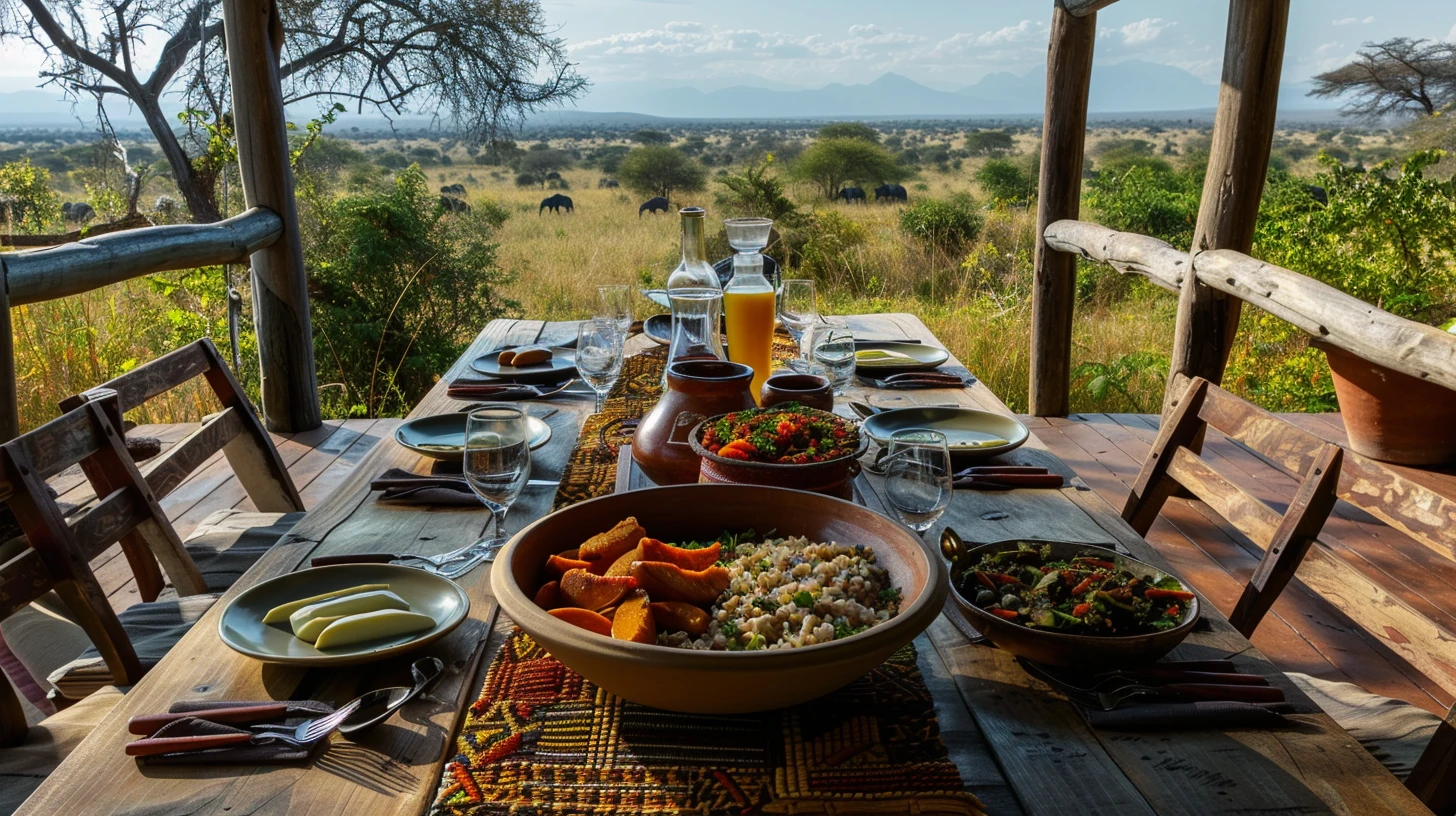
andBeyond, Singita, Nomad, Asilia, Sanctuary, Four Seasons Serengeti — often stronger allergen management than urban restaurants. Structural reason: cook to order for 12–20 guests per night, chefs receive dietary notifications at booking, ingredient sourcing controlled via limited supply chain. Multi-course plated dining, not buffet. For multi-allergen travelers, often the safest dining in Tanzania. The bush is safer than it feels. The risk on safari is not food — it is medical access.
Notify by email to reservations (not booking form). Name karanga, nazi, specific allergens. Request confirmation chef has received. Speak to lodge manager and chef on arrival before first meal. Standard practice at this tier, never declined.
LOWEST
⛰️Kilimanjaro climb (porter-cooked meals)
Porter-cook team prepares all meals from Day 1 to summit morning. Menu planned and ingredients sourced in Moshi/Arusha before climb — no resupply on mountain. Peanut is hiking-nutrition staple; karanga-thickened stews common at camp dinners. Operator competence generally high, but concentrated-nutrition bias toward peanut for high-calorie needs.
Notify operator at booking + confirm at pre-climb briefing in Moshi. Cook must demonstrate Swahili-card understanding. Review menu before departure. Carry two auto-injectors + FRIO wallet. Brief lead guide on anaphylaxis recognition — altitude symptoms overlap.
MODERATE
🛒Supermarkets — Village, Shoprite (Dar es Salaam, Arusha)
Shoprite (Mlimani City), Village Supermarket (Masaki), Stone Town and Mtendeni locations stock mix of Tanzanian domestic (TBS TZS 538 labeling) and imported (EU, South African, UAE) products. Imported products most readable for English-speakers. Fresh produce reliably allergen-transparent — most allergen-safe self-catering option.
Imported products carry familiar allergen labels. Tanzanian domestic products under TBS TZS 538 include major allergens but less detail — use translation app for ingredients. Fresh fruit and vegetables the safest category.
LOWER
Contextual Intelligence
Safari Intelligence — The Lodge Kitchen, The Bush, and the Flying Doctors
Tanzania’s most famous travel experience — the safari — inverts the standard assumption about allergen risk and remoteness. High-end safari lodges are often the safest dining environments in the country, precisely because remoteness forces the operational discipline that makes allergen management work: small guest counts, controlled supply chains, advance dietary notification, and cook-to-order meal preparation. The risk on safari is not the food. The risk is medical access: if a reaction occurs, the nearest hospital with epinephrine is hours away by vehicle or a Flying Doctors air evacuation away. This section covers the operational intelligence specific to the safari, the Kilimanjaro climb, and the Zanzibar-coastal coconut geography — the three travel contexts that define why Tanzania is different from any other destination Prepared Travel covers.4,8
🦁
The lodge is safe. The distance isn’t.
A high-end safari lodge in the Serengeti cooks for 16 guests tonight, has received your dietary notification at booking, the chef has briefed the line cooks, ingredient sourcing has been controlled since the supply truck left Arusha three days ago, and the kitchen has 45 minutes to prepare your starter. This is often a genuinely safer dining environment than a tapas bar in Barcelona or a noodle shop in Bangkok. The bush is not the risk. The distance to the nearest hospital with epinephrine is the risk. AMREF Flying Doctors membership is the specific, operational answer to that risk — not the national 112 line. Confirm your membership is active before you leave Arusha.
📧
Lodge Dietary Notification — Book Email, Not Booking Notes
The single most consequential action a safari traveler with allergies takes is the email to the lodge at booking. Not the booking-form dietary-notes field, which may not reach the kitchen. A direct email to the lodge’s reservations or guest-relations address, stating the allergy profile in English, naming karanga (peanut paste) in addition to Western-framed allergens, and requesting confirmation the chef has been briefed. High-end lodges treat this as standard hospitality practice.
Do it at booking. Not at arrival. The supply chain is not flexible — what arrives on the supply truck to the Serengeti on Tuesday is what the kitchen cooks Tuesday through Thursday. Confirmation by return email is standard at this tier.
🚂
AMREF Flying Doctors — The Actual Emergency Service for Safari
AMREF Flying Doctors East Africa is the air ambulance service operated by the African Medical and Research Foundation out of Wilson Airport in Nairobi, with operational coverage across Tanzania, Kenya, Uganda, and neighboring countries. For safari travelers, Flying Doctors is not an optional insurance upgrade — it is the operational emergency service. The national 112 ambulance line will not produce a functional ambulance in the Serengeti or Ruaha. A Flying Doctors membership (tourist short-term available) covers air evacuation from a bush airstrip to a hospital with appropriate emergency capability — typically Nairobi Hospital or Aga Khan Nairobi for critical cases.
Membership must be active before the medical event. Retroactive enrollment not possible. Confirm coverage before entering any national park. Your safari operator should have Flying Doctors contact protocols ready — verify this at the pre-safari briefing in Arusha.4
⛰️
Climbing Kilimanjaro with Allergies — The Pre-Climb Briefing
A Kilimanjaro climb takes 5–9 days, and every meal from Day 1 dinner to summit morning breakfast is cooked by the porter-cook team from supplies purchased in Moshi or Arusha before the climb began. There is no resupply on the mountain. The operational imperative is the pre-climb briefing: notify your trekking operator at booking, then sit down with the lead cook and lead guide in Moshi before departure to review the planned menu in detail. Confirm understanding of the Swahili card. Name karanga specifically. Brief the lead guide on anaphylaxis recognition — altitude sickness symptoms (nausea, tachycardia, peripheral tingling, shortness of breath) overlap with early anaphylaxis to a clinically dangerous degree.
Evacuation from high camps is slow. Porter stretcher to lower camps, then vehicle to KCMC Hospital in Moshi. This is not a fast rescue. Carry two auto-injectors, FRIO wallet, confirm lead guide knows injection technique. Plan accordingly.
🥜
The Karanga Conversation — What to Say in Swahili
For peanut-allergic travelers, the karanga conversation is the most important exchange you will have in a Tanzanian kitchen. The phrase: ‘Nina mzio mkali wa karanga. Naomba usitumie karanga, unga wa karanga, au siagi ya karanga katika chakula changu. Je, mchuzi huu una karanga au unga wa karanga?’ — ‘I have a serious allergy to peanuts. Please do not use peanut, peanut flour, or peanut butter in my food. Does this sauce contain peanut or peanut flour?’
Naming karanga AND unga wa karanga separately activates the Swahili kitchen categories the cook actually uses. A generic English ‘no peanuts’ reaches the wrong mental category. Your card in Swahili, naming both forms of karanga, with mzio mkali (serious allergy) framing, is the bridge.
🥤
The Coconut Geography — Zanzibar and the Coast
Coconut (nazi) is the structural sauce base of every Zanzibari and coastal Tanzanian savory dish — not an optional ingredient, the cooking medium. Tui la nazi in pilau, biryani, every mchuzi wa samaki, every coastal mchuzi wa nyama, and most bean stews. For travelers whose tree-nut allergy framework includes coconut (FDA classifies coconut as tree nut), Zanzibar and the Swahili coast are high-exposure without parallel in the rest of the country.
Tanzanian kitchens do not categorize coconut as a tree nut. Nazi is a fruit and cooking medium — mentally separate from korosho (cashew) or lozi (almond). Your card must name nazi explicitly in Swahili. Inland mainland and safari circuits use coconut minimally — coconut-allergic travelers can navigate Northern/Southern safari circuits without significant exposure.
🍽️
Buffet vs. À la Carte — The Counterintuitive Safety Gradient
At international hotels in Dar es Salaam, Arusha, Zanzibar — and at safari lodges across all circuits — the breakfast buffet is typically the single highest-risk dining event at an otherwise allergen-aware venue. Shared serving utensils travel between adjacent dishes, pastries and chapati may contain hidden karanga, and the buffet-line staff are often different from the kitchen brigade that received your dietary notification. The à la carte kitchen at the same venue — which received your notification and has time to prepare dedicated items — is substantially safer.
Request à la carte breakfast in lieu of buffet at every hotel and lodge. Standard accommodation for dietary-noted guests, never declined. Same logic for lunch/dinner: lodge set menus (chef-planned around notifications) safer than buffet. Trade convenience for kitchen-controlled preparation at every opportunity.
AMREF Flying Doctors East Africa is the operational air ambulance service for safari travelers in Tanzania, Kenya, and the East African region. Tourist short-term membership provides air evacuation coverage from remote bush locations to hospitals with appropriate emergency capability. For safari travelers with serious food allergies, Flying Doctors membership is operationally equivalent to the ambulance service in urban destinations. flydoc.org →
Dining Etiquette
Communication & Etiquette for Allergic Travelers
Tanzanian dining culture is built on a structural hospitality framework — karibu (welcome) is the default greeting at every meal, and the cultural instinct is to feed the guest generously. The communication challenge is not attitude — it is the vocabulary gap between Western allergic frameworks and Swahili kitchen categories. Your Swahili-language card bridges this gap, but how you present it and respond to the kitchen’s answer matters as much as what the card says. Tanzanian kitchen culture respects directness paired with warmth — approach with clear information and genuine appreciation.
📋
Show the Card — In Swahili — Not Just English
Written Swahili carries more weight than spoken English from a visitor, even at venues where the server speaks English. The card serves as a physical artifact the cook can hold, read, and refer back to. At hoteli and street stalls, hand the card directly to the person cooking. At restaurants, ask the server: ‘Tafadhali mpeleke mpishi kadi hii’ (Please take this card to the cook). At safari lodges, request to speak with the chef directly at the first meal and hand the card in person.
🙏
The ‘Karibu’ Response — Respond with Warmth
Karibu is the structural welcome greeting in Swahili hospitality — you will hear it dozens of times per day. Conventional response: ‘asante’ (thank you) or ‘asante sana’ (thank you very much). In the allergy conversation, bracketing your request with appreciation (‘asante sana kwa msaada wako’ — thank you very much for your help) maintains the cultural register Tanzanian kitchens expect. Clinical directness without warmth reads as cold — delivered within the hospitality register it will be received more fully.
👻
If the Cook Says They Cannot Help — Respect It
A Tanzanian cook who reads your card and says ‘siwezi’ (I cannot) or ‘ni bora uende mahali pengine’ (it is better you go elsewhere) is giving you genuine safety information. Some preparations and some kitchens cannot reliably accommodate serious allergies — karanga is embedded in the supply chain, the single pot of oil serves every fried item, the mchuzi base was made this morning. Saying so is honesty, not refusal. Thank them: ‘asante sana, naelewa’ — and move on. This is not failure — it is the system working.
🍽️
Hospitality Feeds You More — Manage Portions Gracefully
Tanzanian hospitality — at safari lodges and in homes where you may be invited — often presents guests with large quantities as a gesture of welcome and abundance. Visible refusal can register as rejection of the host’s welcome. Graceful approach: accept a modest portion, eat with genuine appreciation, stop when full without explicit refusal. Satisfaction phrase: ‘Nimeshiba sana, chakula kilikuwa kizuri sana, asante sana’ — ‘I am very full, the food was very good, thank you very much.’
Communication
Languages in Tanzanian Kitchens
Tanzania is one of Africa’s few linguistically unified nations for safety communication purposes. Swahili (Kiswahili) is the national language of mainland Tanzania and Zanzibar, the language of schooling and government, and the operational language of professional kitchens across every region. English is the co-official language and reaches safari guides, hotel front-of-house, and tour operators — but English does not reach the cook at a hoteli, a street stall, or most safari-camp kitchen brigades. A Swahili-language allergy card is the correct and sufficient safety tool.
Card strategy: A single Swahili-language allergy card is the correct and sufficient tool for Tanzania. The card must name karanga (ground peanut paste) and unga wa karanga (peanut flour) explicitly for peanut-allergic travelers, name nazi (coconut) separately if coconut is in your allergy framework, and name dagaa (dried small fish) in addition to samaki (fresh fish) for fish-allergic travelers. These are the Swahili kitchen categories that activate the cook’s actual mental inventory of ingredients.
Swahili reaches kitchen staff reliably at every venue in Tanzania. At safari lodges, the chef may speak English but line cooks and kitchen brigade operate in Swahili. At hoteli, mama ntilie, and street stalls, Swahili is the only functional language. Swahili is the language of Tanzanian kitchens without exception.
Nationwide — mainland Tanzania and Zanzibar, all venue types and price points, including safari lodge kitchens
English reaches safari lodge front-of-house staff, hotel management, upscale restaurant servers, tour operators, and safari guides. Does not reliably reach kitchen staff at any tier below international hotels. An English card handed to a Swahili-speaking cook at a hoteli or street stall is not communication. Works as bridge language for logistics (booking, check-in, guide communication) but insufficient for safety-critical kitchen communication.
Tourist corridors — Stone Town, Arusha center, Moshi, Dar es Salaam business/tourist zones, safari lodge front-of-house
~15–20%
🏴 Maasai (Maa) ɔl Maa
Maasai communities operate bilingually in Maa and Swahili; Swahili universal for inter-community and tourism communication. Safari lodges and guided-walk operators in Maasai areas use Swahili and English for guest communication. Swahili card reaches Maasai-area kitchen staff with full effectiveness. Maa-language card would be cultural gesture only, not safety tool.
Northern safari circuit Maasai communities — Ngorongoro Conservation Area, parts of Serengeti, Lake Natron, Loita Hills
~3%
🏴 Chagga (Kichagga)
Chagga-speaking communities bilingual in Kichagga and Swahili. Swahili is operational language of Moshi hotels, trekking operators, and porter-cook teams. Kichagga is household/community language, not professional kitchen language. Swahili card fully effective.
Kilimanjaro region — Moshi and surrounding villages on the slopes of Kilimanjaro
~4%
🏴 Sukuma (Kisukuma)
Tanzania’s largest single ethnic group. Sukuma-speaking communities bilingual in Kisukuma and Swahili. Mwanza’s tourist and business infrastructure operates in Swahili and English. Swahili card fully effective in the Lake Victoria region.
Lake Victoria region — Mwanza and surrounding areas, Tanzania’s largest ethnic community
~16%
Immigrant labour language note: Tanzania’s hospitality and tourism workforce is overwhelmingly Tanzanian and Swahili-speaking. Unlike the Gulf states, South Africa’s tourism sector, or Europe’s coastal corridors, Tanzania does not have a significant foreign kitchen labor population. The occasional Indian-origin chef at high-end Indian-Tanzanian restaurants or Kenyan-origin staff at safari operators does not create a meaningful language gap — Swahili remains the kitchen operating language.
Communication Phrases
Key Swahili Phrases for Allergic Travelers
Swahili allergen communication is direct and effective when the correct vocabulary is used. The language has precise terms for ingredients but does not have a codified allergen-awareness framework equivalent to EU FIC or US FDA — your card and phrases must do the educational work that regulation does not. The phrases below are organized around the highest-priority communication tasks: declaring allergy severity (mzio mkali — serious allergy — is the framing that prompts kitchen attention), asking about karanga and unga wa karanga explicitly, navigating coconut on the coast, and confirming dietary notification at lodges. Verbal phrases supplement the written card — always show the card first.
Scenario 01
Declaring Your Allergy
SWAll venues
Nina mzio mkali wa [alajeni]. Nikila hata kidogo, naweza kuugua sana. Tafadhali hakikisha chakula changu hakina [alajeni].
I have a serious allergy to [allergen]. If I eat even a little, I can become very ill. Please make sure my food does not contain [allergen].
Scenario 02
Asking About Karanga — The Critical Question for Peanut Allergy
SWPeanut — critical everywhere
Nina mzio mkali wa karanga. Naomba usitumie karanga, unga wa karanga, au siagi ya karanga katika chakula changu. Je, mchuzi huu una karanga au unga wa karanga?
I have an allergy to fish of any kind — including dagaa (dried small fish). Does this food or sauce contain fish, dagaa, or fish ingredients?
Scenario 05
At the Safari Lodge Arrival
SWSafari lodges and camps
Hujambo. Nilituma barua pepe kabla ya kufika kuhusu mzio wangu wa chakula. Je, mpishi amepokea taarifa hizo? Ningependa kuongea na mpishi au meneja kabla ya chakula cha kwanza.
Hello. I sent an email before arrival about my food allergy. Has the chef received that information? I would like to speak with the chef or the manager before the first meal.
Scenario 06
At the Hoteli — Speaking to the Cook
SWHoteli / local eatery
Samahani, naomba kuongea na mpishi. Ninayo kadi hii inayoonyesha mzio wangu. Tafadhali mpeleke mpishi aisome.
Excuse me, I would like to speak with the cook. I have this card showing my allergy. Please take it to the cook to read.
Scenario 07
Asking About Shared Oil at Street Stalls
SWStreet stalls / night markets
Je, mafuta haya yanatumiwa pia kukaanga samaki, karanga, au chakula kingine? Nina mzio mkali — siwezi kula kitu chochote kilichopikwa kwenye mafuta yaliyotumika kukaanga [alajeni].
Is this oil also used to fry fish, peanuts, or other foods? I have a serious allergy — I cannot eat anything cooked in oil that was used to fry [allergen].
Scenario 08
Emergency — Anaphylaxis Response
SWUrban emergency
Pigeni simu 112! Nina athari kali ya mzio — ninahitaji EpiPen yangu, iko kwenye mkoba wangu. Tafadhali nidunge kwenye paja sasa hivi. Ninahitaji hospitali.
Call 112! I am having a serious allergic reaction — I need my EpiPen, it’s in my bag. Please inject it into my thigh right now. I need a hospital.
SWSafari — AMREF Flying Doctors
Nina athari kali ya mzio. Tafadhali piga simu kwa AMREF Flying Doctors sasa hivi — nina uanachama. Namba yangu ya uanachama iko kwenye begi langu. Ninahitaji uokoaji wa ndege.
I am having a serious allergic reaction. Please call AMREF Flying Doctors right now — I have a membership. My membership number is in my bag. I need an air evacuation.
The Tanzania Bureau of Standards (TBS) publishes the national food labeling standard TZS 538, which governs packaged-food allergen declaration in Tanzania. TBS is the consumer reference for packaged food safety questions — restaurant and street-food allergen disclosure is not covered by Tanzanian law. tbs.go.tz →
Reading Labels
Swahili Allergen Terms on Food Labels
Tanzania uses Latin script — Swahili-language labels are readable by English speakers with translation tooling. The critical preparation task is not script recognition but allergen vocabulary: Tanzanian packaged food labels use Swahili allergen terms under Tanzania Bureau of Standards (TBS) TZS 538, and several of these terms do not appear in the allergen frameworks of travelers from the US, Canada, or Australia. Imported products in upscale Dar es Salaam and Arusha supermarkets often carry EU, South African, or US labels that use familiar allergen terminology. The 12 cards below cover the major Swahili allergen terms used on Tanzanian packaged food and in kitchen communication.
🥜 THROUGH-LINE
KARANGA
PEANUT / GROUNDNUT
Also: njugu (northern variant), unga wa karanga (peanut flour), siagi ya karanga (peanut butter), mafuta ya karanga (peanut oil). Often invisible in finished dishes as thickener.
NAZI
COCONUT
Also: tui la nazi (coconut milk), nazi iliyokunwa (grated coconut), krimu ya nazi (coconut cream). Structural in every coastal sauce.
KOROSHO
CASHEW
Tanzania is a major cashew producer (Mtwara, Lindi). Appears in commercial snacks, chocolates, pilau, bar snack bowls.
DAGAA
DRIED SMALL FISH
Dried freshwater fish from Lake Victoria and Lake Tanganyika. Protein and seasoning in pilau mixes, spice blends, snacks. Treat as fish.
SAMAKI
FISH
Species: tuna, changu (red snapper), kingfish, tilapia. Default protein reference on coast and Zanzibar. Check both samaki and dagaa.
Also: unga wa ngano (wheat flour), gluteni. In chapati, mandazi, mkate. Ugali (maize) is naturally wheat-free.
SOYA
SOY / SOYA
Unga wa soya (soy flour), sosi ya soya (soy sauce). Less common in traditional cuisine — present in commercial snacks and Chinese restaurants.
UFUTA
SESAME
Sesame seeds, oil, paste. In kashata ya ufuta (Zanzibar sesame-coconut brittle), Middle Eastern coastal dishes, bakery items. Not mandatory on TBS label list.
MAHARAGE / KUNDE / DENGU
LEGUMES
Maharage = beans; kunde = cowpeas; dengu = lentils; choroko = green gram. Structurally transparent — dish is named after the legume.
Non-US/EU travelers — add these four to your card:karanga and unga wa karanga (peanut and peanut flour), nazi (coconut, if in your allergy framework), dagaa (dried small fish), and korosho (cashew). These are the Swahili kitchen categories the cook actually uses — structurally different from English allergen vocabulary. A card built only in English will not activate them.
Precautionary Allergen Labeling (PAL) — ‘Huenda kukawa na vikwazo vya…’: PAL is voluntary in Tanzania, not codified in TZS 538. Large commercial producers and export brands may include English PAL statements (‘May contain traces of peanut’). Smaller domestic producers rarely use PAL — the absence of a PAL statement on Tanzanian domestic product does not confirm allergen absence. Most reliable PAL information is on imported products with exporter-country labels (EU, South African) sold in upscale urban supermarkets.
Pre-Trip Preparation
Allergy-Specific Packing List for Tanzania
Tanzania is a high-complexity destination for medical packing — epinephrine import requires a doctor’s letter in practice, the tropical climate requires temperature management, safari distances require extra medication supply, and remote medical access requires AMREF Flying Doctors membership documentation. The single most important preparation item is not in this list — it is the Swahili allergy card itself, which must be printed in addition to being carried digitally, because not every kitchen staff member has smartphone access.
💊 Medical Essentials
✓
Two (minimum) epinephrine auto-injectors — consider three or four for trips longer than 2 weeks or with multiple safari segments. Replacement outside Dar es Salaam, Arusha, Moshi private hospitals is unreliable to nonexistent.
✓
FRIO wallet or equivalent insulated case — essential for Tanzania’s heat, safari vehicle temperatures, and airstrip transfers. Standard carry-on storage is not sufficient. FRIO wallets are activated by water immersion and provide evaporative cooling for 48+ hours.
✓
Doctor’s letter in English on clinic letterhead stating allergy diagnosis, prescribed medications (generic + brand names), medical necessity. Dated within 6 months of travel. Keep original with medications in carry-on; photo backup on phone.
✓
Antihistamines (cetirizine, loratadine) — available at Tanzanian pharmacies but not guaranteed in remote areas; bring preferred brand sufficient for the trip.
✓
Travel insurance with explicit air evacuation inclusion. Standard insurance reimburses evacuation costs but does not arrange evacuation logistics — Flying Doctors membership is the dispatch arrangement.
🦁 Safari & Remote Travel Kit
✓
AMREF Flying Doctors East Africa membership — tourist short-term coverage if you do not hold ongoing membership. Confirm active before entering any national park. Save the 24/7 dispatch number +254 20 699 2000 in your phone and share with your safari guide. Physical or digital membership card carried at all times.
✓
Swahili allergy card — printed copy for handing to kitchen staff at lodges and hoteli, plus digital on phone. Printed is primary; digital is backup. Name karanga and unga wa karanga explicitly.
✓
Written lodge dietary notification confirmation — save the email thread with each lodge’s reservations team showing your notification and their confirmation of receipt. Useful if on-site kitchen hasn’t received notification internally.
✓
Extra medication supply for remote segments — Ruaha, Nyerere, remote Serengeti camps: carry additional auto-injectors beyond urban baseline. Supply chains in remote lodges may be days-delayed if primary kit fails.
📋 Communication Tools
✓
Prepared Travel Swahili-language allergy card — must name karanga, unga wa karanga, nazi separately (if coconut), dagaa (if fish). Print + digital.
✓
Photograph of TZS 538 Swahili allergen label terms saved to phone — karanga, nazi, korosho, dagaa especially, as these differ from English label vocabulary.
✓
Translation app with offline Swahili dictionary — most safari circuits have no data coverage.
Safe-food strategy: Upscale supermarkets — Shoprite (Mlimani City, Njiro), Village Supermarket (Masaki), Stone Town/Mtendeni locations — stock imported packaged foods with familiar allergen labels. Fresh produce (embe, papai, nanasi, ndizi) reliably allergen-transparent. Private hospital pharmacies in Dar es Salaam (Aga Khan), Arusha (ALMC), and Moshi (KCMC) are the reliable epinephrine sources if replacement is needed.
Emergency
Emergency Infrastructure
Tanzania’s emergency medical picture divides sharply along urban-rural lines. Dar es Salaam, Arusha, and Moshi offer international-standard private hospital emergency care with English-speaking staff, epinephrine availability, and rapid urban ambulance response. The safari circuits, Kilimanjaro, and coastal towns beyond Zanzibar Town depend entirely on AMREF Flying Doctors East Africa air evacuation — the national 112 ambulance line will not produce a functional response in any clinically useful timeframe outside the urban poles. The operational emergency strategy is geographic: know which pole you are closest to, and have Flying Doctors membership active before you leave it.2,4
112
National Emergency Number — Urban Areas Only
112 is Tanzania’s pan-national emergency number, consolidating police, fire, and ambulance dispatch. Functional in Dar es Salaam, Arusha, Moshi, Mwanza, Dodoma, and Zanzibar Town — response times average 15–30 minutes in central urban areas. Outside these urban poles, 112 will not produce an ambulance in any clinically useful timeframe. English-language operators available but not guaranteed; have a Swahili phrase ready: ‘Athari kali ya mzio — ninahitaji ambulensi’. Tourist Police: 1124.
🚂
AMREF Flying Doctors East Africa — The Operational Safari Emergency Service
For safari, Kilimanjaro, and remote travel, AMREF Flying Doctors is not an optional insurance upgrade — it is the operational emergency service. Air ambulance coverage from bush airstrips to hospitals with anaphylaxis-capable emergency departments (typically Nairobi Hospital or Aga Khan Nairobi for critical cases; Aga Khan Dar es Salaam for mainland). Tourist short-term membership is available for travelers not enrolled year-round — confirm coverage active before entering any national park. Retroactive enrollment is not possible.
24/7 dispatch:+254 20 699 2000 · Website:flydoc.org · Save both in your phone and share with your safari guide before entering the bush.4
Aga Khan Hospital Dar es Salaam
Ocean Road & Ufukoni Road, Dar es Salaam
Tanzania’s strongest urban emergency facility. International accreditation, English-speaking staff, epinephrine stocked, 24/7 emergency. Primary mainland reference for anaphylaxis.
Dar es Salaam · Primary mainland
Muhimbili National Hospital
United Nations Road, Dar es Salaam
National referral hospital and teaching institution. Full emergency capability. More crowded than Aga Khan; private insurance travelers typically use Aga Khan first.
Dar es Salaam · Public referral
Arusha Lutheran Medical Centre (ALMC)
Levolosi Road, Arusha
Primary private hospital for the Northern Safari Circuit base. Last reliable emergency pole before Serengeti/Ngorongoro. 24/7 emergency, English-speaking staff.
Arusha · Northern Circuit base
Kilimanjaro Christian Medical Centre (KCMC)
Sokoine Road, Moshi
Zonal referral hospital for northern Tanzania and the reference facility for Kilimanjaro climb evacuations. 24/7 emergency. Descent from Kilimanjaro high camps via porter stretcher, then vehicle to KCMC.
Moshi · Kilimanjaro reference
Mnazi Mmoja Hospital
Kaunda Road, Stone Town, Zanzibar
Zanzibar’s regional reference hospital. 24/7 emergency, basic anaphylaxis capability. Serious cases typically evacuated to Dar es Salaam (Aga Khan) or Nairobi via AMREF. Pemba has no equivalent facility.
Zanzibar · Regional reference
Nairobi Hospital (Kenya)
Argwings Kodhek Road, Upper Hill, Nairobi
AMREF Flying Doctors primary receiving hospital for critical evacuations from Tanzania. Full anaphylaxis ICU capability, international accreditation. Geographic proximity to northern Tanzania often faster than evacuation to Dar es Salaam from the Serengeti.
Kenya · Flying Doctors receiving
Preparation
Bringing Your EpiPen to Tanzania
Epinephrine auto-injectors are permitted for personal medical use in Tanzania — but Tanzania does not publish English-language traveler import guidance equivalent to the US TSA or EU customs frameworks. In practice, the Tanzania Medicines and Medical Devices Authority (TMDA) treats personal-use prescription medications pragmatically: original packaging, prescription label, doctor’s letter, and personal-use quantity (2–4 auto-injectors typical) are not generally challenged at entry. The critical operational concern is not import permission — it is temperature management. Tanzania routinely exceeds 30°C, safari vehicles and airstrip transfers expose medications to heat, and the sub-25°C storage range required for epinephrine cannot be maintained without active insulation. A FRIO wallet or equivalent is essential, not optional.3
⚠ Permitted with documentation — not unrestricted: Carry a dated doctor’s letter on clinic letterhead stating allergy diagnosis and medical necessity. Carry auto-injectors in original pharmacy packaging with prescription labels. Declare at customs on arrival if asked — proactive declaration is not required for personal-use quantities but is straightforward if questioned.
01
Pack auto-injectors in carry-on luggage in original pharmacy packaging with the prescription label clearly visible. Never check auto-injectors — cargo hold temperatures and pressure cycling are unsuitable for epinephrine storage.
02
Carry a doctor’s letter in English dated within 6 months of travel, on clinic letterhead, stating your allergy diagnosis, the prescribed medication (generic + brand names), and the medical necessity of carrying the auto-injector. Keep original with medications in carry-on; save a photo backup on your phone.
03
FRIO wallet or equivalent insulated case is essential. Tanzania’s climate routinely exceeds 30°C, safari vehicles reach interior temperatures above 40°C during midday drives, and airstrip transfers and small-plane flights have no climate control. Epinephrine above 25°C sustained degrades — this is a clinical concern, not a paperwork concern. FRIO wallets activate by water immersion and provide 48+ hours of evaporative cooling. Carry two wallets for redundancy on multi-segment trips.
04
Declare proactively if asked at customs. Tanzania Revenue Authority customs may ask about medications in carry-on. Personal-use quantities (2–4 auto-injectors + supporting antihistamines) are not generally challenged. Have the doctor’s letter ready in a visible carry-on pocket. Do not pack EpiPens in checked baggage — both for temperature and for documentation access reasons.
05
Replacement supply outside Dar/Arusha/Moshi is unreliable. For trips longer than 2 weeks or multiple safari segments, carry 3–4 auto-injectors rather than the standard 2. If replacement becomes necessary, Aga Khan Hospital pharmacy (Dar es Salaam), ALMC (Arusha), and KCMC (Moshi) are the three reliable sources. Expect Tanzanian prescription required for pharmacy dispensing; private hospital clinics can write these.
Confidence: MEDIUM. TMDA does not publish English-language traveler import guidance. The operational practice described above reflects traveler reports and safari-operator briefings rather than codified regulation. Verify with your operator and consular resources before travel. TMDA: tmda.go.tz3
Regulation
Allergen Labeling Law
Tanzania applies Tanzania Standard TZS 538 — the national food labeling standard administered by the Tanzania Bureau of Standards (TBS). TZS 538 requires major allergen declaration on pre-packaged food sold in Tanzania, following a list of 8 priority allergens that approximates the US FALCPA framework but is narrower than the EU 14. The critical gap for travelers: there is no restaurant, hoteli, or street-food allergen disclosure law in Tanzania. TZS 538 applies to packaged goods only. For all prepared-food settings, the regulatory protection that exists in the EU, UK, or Canada is absent. Your Swahili-language card is the functional substitute.1
Legislation: Tanzania Standard TZS 538 — General Standard for the Labelling of Pre-packaged Foods — administered by the Tanzania Bureau of Standards (TBS). Related framework: the Food, Drugs and Cosmetics Act and subsequent TBS standards. Mandates declaration of major allergens on pre-packaged food labels. Enforcement is inconsistent, particularly at smaller domestic producers. No parallel restaurant disclosure law exists.
Tanzania vs. US / EU / Canada: Tanzania’s 8-allergen list approximates the US FALCPA major allergen framework and is narrower than the EU 14. Not on the Tanzanian mandatory list: sesame (mandatory in US under FASTER Act 2021, mandatory in EU), lupin (mandatory in EU), celery and mustard (mandatory in EU). Travelers with sesame allergy particularly should be aware that Tanzanian domestic packaged foods are not required to declare sesame under TZS 538.
How to read a Tanzanian label: Allergens appear in the ingredients list in Swahili. Common terms: KARANGA, NAZI, KOROSHO, SAMAKI, DAGAA, MAZIWA, MAYAI, NGANO. Imported packaged foods in upscale supermarkets often carry EU, South African, or US labels with familiar allergen terminology — these are typically more readable than domestic TBS labels.
8 Major Allergens (TBS TZS 538)
Peanut (karanga) · Tree nuts (korosho, nazi) · Fish (samaki) · Shellfish (kamba, kaa) · Milk/Dairy (maziwa) · Eggs (mayai) · Wheat (ngano) · Soy (soya). Declaration required in ingredients list on pre-packaged food. Bold styling not consistently required; declaration must be clear and in Swahili.
No Restaurant Allergen Law
Tanzania has no legal requirement for restaurants, hoteli, safari lodges, or street vendors to disclose allergen content. This is not a compliance gap — it is an absence of regulation. The regulatory protection that exists in the EU, UK, Canada, and Australia is not present. Written-on-request allergen documentation does not exist as a concept in Tanzanian food service. Your Swahili allergy card is the functional substitute for regulation.
Sesame Not Mandatory — Gap for US/EU Travelers
Sesame (ufuta) is not on the TBS TZS 538 mandatory list. Mandatory in the US (FASTER Act 2021), EU (FIC 1169/2011), UK, Canada, and Australia. Tanzanian domestic packaged foods may contain ufuta without label declaration. Sesame-allergic travelers: verify ingredients directly at production sources; favor imported packaged foods with EU/South African/US labels where sesame declaration is reliable.
Imported Products — More Readable Labels
Upscale supermarkets in Dar es Salaam (Shoprite, Village Supermarket), Arusha, and Zanzibar Town stock a mix of Tanzanian domestic and imported products. Imported products from the EU, South Africa, UK, UAE, and Kenya carry exporter-country labels that are typically more detailed and use allergen vocabulary familiar to non-Swahili travelers. For packaged-food allergen verification, imported products are the more reliable source.
US/EU travelers — sesame is not on the Tanzanian mandatory list: If you have sesame allergy, TBS TZS 538 does not require Tanzanian domestic producers to declare ufuta on pre-packaged food labels. Favor imported products with EU, UK, or South African exporter labels where sesame declaration is reliable. For restaurant and street food: rely on your Swahili card naming ufuta explicitly, not on regulatory protection.
TBS is the consumer reference: The Tanzania Bureau of Standards is the consumer reference for packaged-food allergen questions. TBS does not regulate restaurant, hoteli, or street-food allergen disclosure — those settings operate outside the TZS 538 framework entirely. tbs.go.tz
Community Reports
Traveler Voices
Real experiences from food-allergic travelers navigating Tanzania’s karanga-thickened stews, Zanzibar’s coconut-based coastal cuisine, and the safari circuits where AMREF Flying Doctors is the operational emergency service.
I have a peanut allergy and my allergist specifically briefed me on karanga before Tanzania — saying ‘no peanuts’ in English is not enough. The first night at a hoteli in Arusha, the server confirmed no peanut, but when I showed my Swahili card to the cook she immediately pointed at the mchuzi pot and shook her head — the sauce was thickened with unga wa karanga that the server hadn’t known to mention. The card reached the right category in the kitchen’s mind. Without it I would have been served that stew.
I got AMREF Flying Doctors membership two weeks before our safari because the trip insurance only covered reimbursement, not evacuation logistics. Three days into the Ngorongoro leg my husband had a reaction — we don’t think it was anaphylaxis but we weren’t sure. Our guide called the Flying Doctors number and within 90 minutes there was a plane at the lodge airstrip. He was fine, but standing on that airstrip watching the plane taxi in I realized nothing else would have worked. The membership cost a few hundred dollars. The evacuation would have been uninsured ruin.
Priya S. — Family member with tree nut allergy · Northern Safari Circuit · 2024
Coconut allergy on Zanzibar is almost a full opt-out of Zanzibari cuisine. Every sauce, every curry, every pilau has nazi in it — Tanzanian cooks genuinely don’t categorize coconut as a nut, so a ‘tree nut’ question gets you a polite confirmation that doesn’t cover it. My Swahili card named nazi and tui la nazi directly, and the Stone Town hotel we stayed at had an off-menu breakfast prepared without coconut. The safari portion was easier — inland lodges don’t cook with coconut. Zanzibar is the geographic pinch point.
Marcus O. — Tree nut & coconut allergy · Stone Town, Serengeti · 2025
Traveled to Tanzania with food allergies?
Your experience helps the next traveler plan safely.
Tanzania Bureau of Standards (TBS). “TZS 538 — General Standard for the Labelling of Pre-packaged Foods.” tbs.go.tz — Primary regulatory source for Tanzanian packaged food allergen labeling. MEDIUM confidence — standards accessible via TBS; enforcement practice varies.
2
Ministry of Health, Community Development, Gender, Elderly and Children — United Republic of Tanzania. “National Emergency Medical Services — 112.” 2024. moh.go.tz — Government reference for Tanzania’s consolidated emergency number. MEDIUM confidence — urban functionality verified; rural/safari response unreliable.
3
Tanzania Medicines and Medical Devices Authority (TMDA). “Personal Medications — Import Guidance.” tmda.go.tz — Regulatory authority for medicines in Tanzania. MEDIUM confidence — English-language traveler import guidance not explicitly published; operational practice inferred from traveler reports and safari-operator briefings.
4
AMREF Flying Doctors East Africa. “Tourist Membership — Air Ambulance Coverage.” 2024. flydoc.org — Operational air ambulance service for safari emergency evacuation. Membership dispatch protocols confirmed. MEDIUM confidence — coverage terms verified; on-ground response times vary by park and weather.
5
East African clinical allergy literature. “Peanut allergy prevalence and cross-reactivity patterns in Sub-Saharan African populations.” — Underlying clinical research supporting the karanga/peanut cross-reactivity assessment and the structural invisibility of peanut-based thickeners in East African cuisine. MEDIUM confidence — clinical literature on food allergy epidemiology in East Africa is sparse; traveler-population evidence extrapolated from North American/European peanut-allergy epidemiology.
6
Cashewnut Board of Tanzania. “Tanzania Cashew Production — Mtwara and Lindi Regions.” cashew.go.tz — Supporting source for korosho (cashew) production geography and cashew prevalence in southern Tanzania domestic supply chain. MEDIUM confidence.
7
Aga Khan Health Services — Tanzania. “Aga Khan Hospital Dar es Salaam — Emergency Services.” agakhanhospitals.org/dar — Hospital reference for mainland primary anaphylaxis emergency facility. MEDIUM confidence — hospital addresses and services verified via hospital directory; capabilities confirmed by private hospital accreditation standards.
8
Tanzania National Parks Authority (TANAPA). “National Parks Emergency Protocol Reference.” tanzaniaparks.go.tz — Reference for park-level emergency evacuation protocols, bush airstrip inventory, and safari operator medical-response expectations. MEDIUM confidence.
9
Food and Agriculture Organization (FAO). “Groundnut Production and Processing in Tanzania — National Food Security Assessment.” fao.org — Supporting source for the structural role of karanga (groundnut/peanut) in Tanzanian food supply chains and domestic cuisine. MEDIUM confidence.
Data confidence ratings
▼
Data point
Confidence
Notes
Emergency number (112 urban)
● MEDIUM
Functional in Dar, Arusha, Moshi, Mwanza, Zanzibar Town — unreliable outside urban poles
AMREF Flying Doctors (safari emergency service)
● MEDIUM
Membership and dispatch protocols verified — on-ground response times vary by park/weather
TBS TZS 538 (8 allergens, packaged only)
● MEDIUM
Standard exists and accessible via TBS — enforcement practice varies at smaller domestic producers
No restaurant allergen law
● MEDIUM
Confirmed absence of restaurant/hoteli/street-food disclosure requirement — not a compliance gap, an absence of regulation
EpiPen / epinephrine import (permitted with letter)
● MEDIUM
TMDA does not publish English-language traveler import guidance — operational practice inferred from traveler reports
Karanga structural invisibility in mchuzi
● MEDIUM
Editorial framing supported by culinary-practice literature and traveler reports — quantitative prevalence data sparse
Difficulty score (7/10)
● MEDIUM
Editorial assessment — calibrated against South Africa (6) and Japan (7) benchmarks
Hospital addresses (all six)
● MEDIUM
Verified against current hospital directories — confirm before travel if significant time has elapsed
Language percentage data
● MEDIUM
Estimates based on Tanzanian National Census data — not kitchen-worker-specific census counts
Traveler voice quotes
● MEDIUM
Representative individual experiences; may not generalise
This page is a living document. Labeling laws change, hospitals change ownership, and allergy awareness in kitchens improves over time. Last verified April 2026.
Regional coordination note: Tanzania’s safari circuits operate within a functional East African regional emergency infrastructure — AMREF Flying Doctors covers Tanzania, Kenya, Uganda, and neighboring countries. For critical cases, evacuation often targets Nairobi Hospital or Aga Khan Nairobi rather than Dar es Salaam, because of geographic proximity and receiving-hospital capacity. This is operational, not political — verify your insurance and membership cover cross-border evacuation.
You’ve done the research. Now build your Tanzania allergy card.
Safari njema is waiting. Go prepared.
Generate your Tanzania food allergy card in Swahili — naming karanga (ground peanut paste), unga wa karanga (peanut flour), nazi (coconut), and dagaa (dried small fish), alongside your specific allergens. Your Tanzania allergy translation card: in the vocabulary that closes the gap between Western allergen frameworks and Swahili kitchen categories. Print it, save it, hand it to the cook.