Thailand scores 6 out of 10 on the Prepared Travel difficulty scale — a moderate-high challenge driven by a single structural reality: fish sauce (น้ำปลา / nam pla) is cooked into the base of virtually every savory Thai dish, and it cannot be removed on request. There is no restaurant allergen disclosure law, street food vendors operate without menus or ingredient lists, and Thai script makes packaged food labels unreadable without specific preparation. Thailand’s saving graces are real — nam jai (น้ำใจ) hospitality means a cook who understands your allergy will genuinely try to help, Bangkok’s private hospitals rival the best in Southeast Asia for anaphylaxis response, and the wok-cooking culture is inherently flexible when the communication reaches the right person. Your Thai-language allergy card is the single most important tool you will carry.
🍜 Food & Culture
Thai cuisine is one of the world’s great culinary traditions — and one of the most allergen-complex. The five-flavor balance (sweet, sour, salty, bitter, spicy) that defines Thai cooking relies on fish sauce for salt, tamarind for sour, palm sugar for sweet, and a rotating cast of chili, shrimp paste, and aromatics for depth. Every dish is a composition, and the composition was designed before allergen categories existed as a concept. Street food — served from carts, shophouses, and night markets — accounts for a vast share of the Thai dining experience and operates entirely outside any regulatory framework. The food is extraordinary. The preparation is opaque.
Core Safety Metrics — hover each for full explanation
Overall Allergy Travel Difficulty
6/10
Moderate-High — fish sauce structural, no restaurant law, non-Latin script
Thailand scores 6/10 — fish sauce is structurally invisible, there is no restaurant allergen law, Thai script is inaccessible without preparation, and street food operates without ingredient lists. Score is moderated by genuine Thai hospitality, strong Bangkok hospital infrastructure, and modification-flexible wok cooking.
Allergen Labeling Law Strength
4/10
Packaged only — narrow mandatory list, no restaurant obligation
Thailand’s Food Act B.E. 2522 and subsequent Thai FDA Notifications require allergen labeling on packaged foods, but enforcement is inconsistent and the mandatory allergen list is narrower than the EU 14. No restaurant disclosure law exists. Street food and night market vendors are entirely unregulated for allergen communication.1
Kitchen Allergen Awareness
3/10
Low outside international hotels — “allergen” has no kitchen vocabulary
Allergen awareness as a category of concern has limited penetration in Thai kitchens outside international hotels. Most Thai cooks have never encountered a formal allergen request. Fish sauce and shrimp paste are so ubiquitous that kitchen staff may not consider them ‘ingredients’ worthy of disclosure. The concept of cross-contact is essentially absent outside hotel-grade kitchens.
Cultural Modification Flexibility
5/10
Flexible for toppings — not for base condiments like fish sauce
Thai wok cooking is inherently flexible — dishes are prepared to order, and a cook who understands the request can often modify. However, curry pastes are pre-made with shrimp paste already incorporated, fish sauce is added reflexively, and shared wok surfaces make cross-contact a baseline. Modification works for toppings (hold the peanuts, skip the egg) but not for structural condiments (fish sauce, soy sauce).
Emergency Medical Reliability
5/10
World-class in Bangkok — variable to poor outside the capital
Bangkok’s private hospitals (Bumrungrad, BNH, Samitivej) are world-class — English-speaking staff, epinephrine on hand, sub-20-minute ambulance response. Outside Bangkok, infrastructure degrades rapidly: rural ambulance response can exceed 45 minutes, island clinics may lack epinephrine, and air evacuation from islands may be required. The urban-rural divide is the sharpest in Southeast Asia.2
Difficulty in context — how Thailand compares globally6 / 10 Moderate
🇩🇰 Denmark 2🇦🇺 Australia 3🇹🇭 Thailand 6🇯🇵 Japan 7🇮🇳 India 9
🍜
On the Ground
Thailand’s difficulty score captures structure, not attitude. Thai people are among the most gracious and accommodating hosts on earth — น้ำใจ (nam jai) is not a marketing line, it is lived culture. The difficulty is mechanical: fish sauce was in the pan before you arrived, the curry paste was made yesterday with shrimp paste already pounded in, and the cook has never heard the word ‘allergen’ in any language. The score reflects that your safety depends on a Thai-language card reaching the person who controls the wok — and on understanding which dishes can be modified and which cannot.
🛡️ The wok is heating — is your card in your pocket?
Generate your Thailand allergy card in ThaiGenerate card in Thai → Create now with น้ำปลา (fish sauce) and กะปิ (shrimp paste) named explicitly — not just the allergen category. That specificity is the difference between a question and a collision.
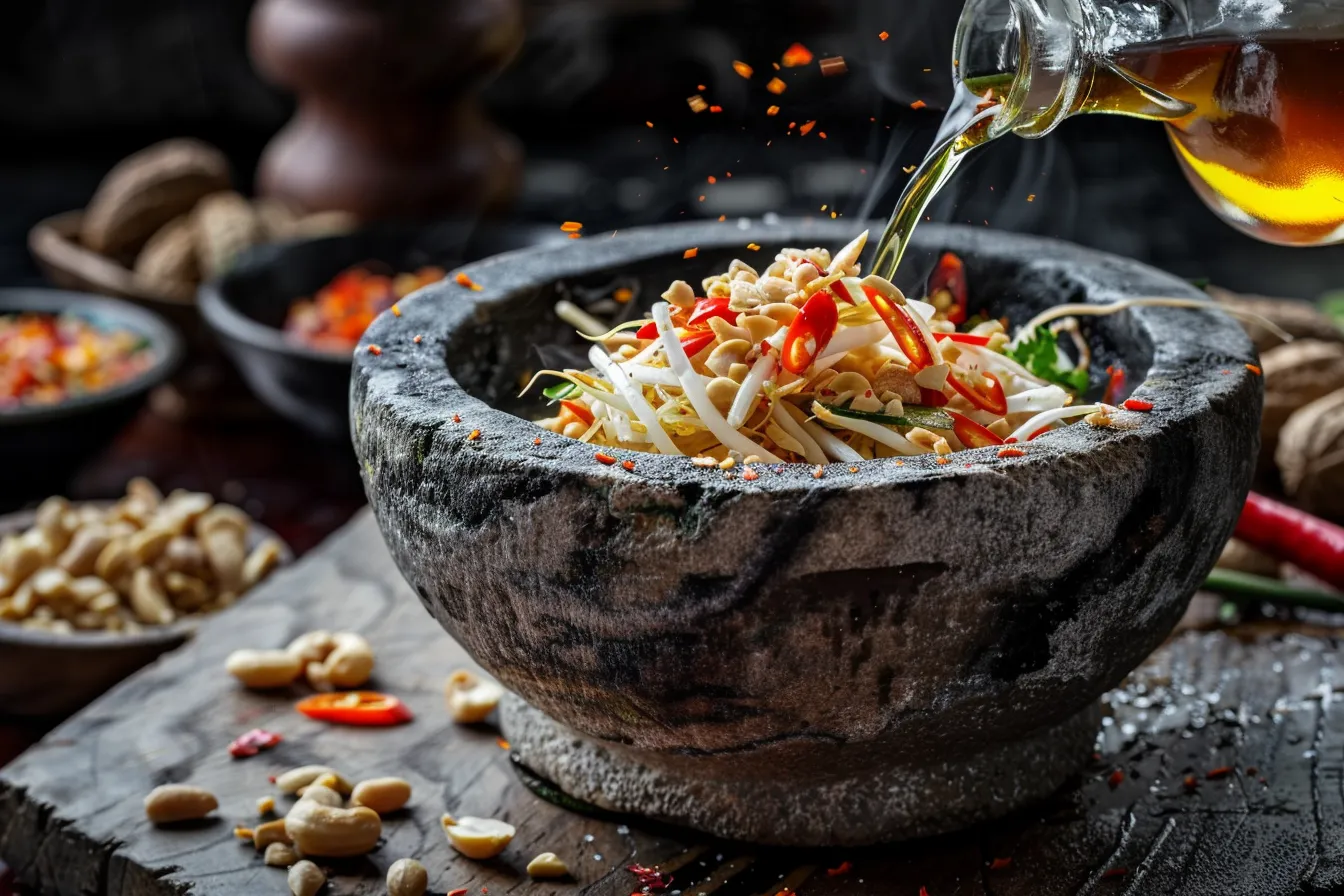
🏛️ Wat Pho, Bangkok — tap to see the full picture🐟 Som tam & น้ำปลา — tap to understand the risk🪷 Loy Krathong — the festival foods that matter
Allergen Risk
Allergen Prevalence Index
This index scores two dimensions: supply prevalence (how embedded an allergen is in the cuisine) and hidden risk (how likely it is to appear without disclosure). Thailand’s defining editorial fact: fish sauce (น้ำปลา / nam pla) scores 10/10 on both supply prevalence and hidden risk — it is the structural salt of Thai cuisine, added to the wok before the order is placed. Clinical prevalence data from Thai populations shows shrimp as the most common IgE-mediated food allergy in Thai children, followed by cow’s milk and egg — a pattern that diverges from the supply data where fish sauce dominates.4
Filter by your allergen to highlight relevant rows
Filter by allergen:
Allergen
Supply Prevalence
Hidden Risk
Cross-Contact
Restaurant Risk
Fish / น้ำปลา (nam pla)Fish sauce, fermented fish (ปลาร้า / pla ra) — structural backbone of Thai cuisine
10!
10!
9
10!
⚠ Structural alert:น้ำปลา (nam pla / fish sauce) is not a condiment in Thai cooking — it is the structural salt of the cuisine. It is added to the wok, the mortar, and the curry pot before the dish is assembled. Asking to ‘leave out the fish sauce’ is functionally asking the cook to make a different dish. Your card must name น้ำปลา explicitly.
⚠ Curry paste alert:กะปิ (kapi / shrimp paste) is already inside the curry paste before the curry is cooked. Ordering a curry ‘without shrimp’ does not remove the shrimp paste — it was pounded into the paste hours or days ago. Your card must name กะปิ (shrimp paste) separately from กุ้ง (shrimp).
Peanut / ถั่วลิสงCrushed peanuts (ถั่วป่น) on pad thai and som tam, satay peanut sauce (น้ำจิ้มสะเต๊ะ)
8
7!
7
8
Reflexive topping: Crushed peanuts (ถั่วป่น) are a reflexive topping — pad thai and som tam are served with a sprinkle of ถั่วป่น by default. The peanuts are often added before the dish leaves the station. Ask ‘ไม่ใส่ถั่ว’ (mai sai thua — no peanuts) explicitly before the dish is prepared.
Soy / ซีอิ๊ว (si-ew)Soy sauce in all wok-cooked dishes, tofu (เต้าหู้), fermented soybean paste (เต้าเจี้ยว)
8
7
7
8
Egg / ไข่ (khai)Cracked into pad thai and fried rice, Thai omelette (ไข่เจียว)
Tree Nuts / มะม่วงหิมพานต์Cashews in stir-fries, coconut (classified as tree nut) in curries and desserts
6
5
5
5
🥥 Coconut / tree nut distinction: The US FDA classifies coconut as a tree nut. In Thailand, coconut (มะพร้าว / ma-phrao) and tree nuts (ถั่วเปลือกแข็ง) are considered entirely different categories. If your card says only ‘Tree Nuts’ (ถั่วเปลือกแข็ง), a Thai cook will almost certainly assume you are fine with coconut. You must explicitly list กะทิ (kathi — coconut milk) and มะพร้าว (ma-phrao — coconut) as separate items on your card if you are allergic to coconut.
Thai cuisine is a masterclass in layered allergen complexity — and the STRUCTURAL vs INCIDENTAL distinction is the most important tool for navigating it. A dish like green curry has fish sauce, shrimp paste, and coconut milk as STRUCTURAL allergens — they cannot be removed because they are the dish. A dish like pad thai has peanuts as an INCIDENTAL topping that can be omitted. Two additional warnings: clear-looking noodle broths are not simple — a ‘clear soup’ (น้ำใส) is typically seasoned with fish sauce, soy sauce, and commercial seasoning powders containing fish, shellfish, soy, and wheat derivatives. And Thai drinks and desserts have their own hidden-risk layer — condensed milk in Thai iced tea, coconut milk in virtually all sweets, and peanut or sesame toppings on festival desserts.
Vegetarian ≠ allergen-safe: Thailand has two vegetarian frameworks. เจ (jay) food — marked with a yellow flag or red จ symbol — follows strict rules and excludes fish sauce, oyster sauce, and shrimp paste. มังสวิรัติ (mangsawirat) food is a looser label that may still contain fish sauce. For fish and shellfish allergies, jay food is a genuine safety tool; mangsawirat is not.
Dish
Allergens
Hidden Risk Notes
Risk
Pad Thaiผัดไทย — stir-fried rice noodles with tamarind, egg, garnish
STRUCTURAL — น้ำปลา (nam pla) is the primary seasoning liquid added to the wok — it provides the salt and umami base. Cannot be omitted. STRUCTURAL — Egg is cracked into the wok and scrambled into the noodles. INCIDENTAL — Dried shrimp (กุ้งแห้ง) and crushed peanuts (ถั่วป่น) are toppings that can be omitted if requested before cooking.
● HIGH
Tom Yum Goongต้มยำกุ้ง — hot and sour soup with shrimp, lemongrass
STRUCTURAL ×2 — กุ้ง (shrimp) is the dish’s namesake. น้ำปลา seasons the broth. The creamy version uses น้ำพริกเผา containing กะปิ (shrimp paste). No safe modification path for shellfish or fish allergy.
● HIGH
Som Tamส้มตำ — green papaya salad with chili, lime
STRUCTURAL — น้ำปลา is pounded into the mortar as the seasoning base. The Isan version uses ปลาร้า (fermented fish) instead. INCIDENTAL — Dried shrimp and peanuts can be omitted — but the mortar carries protein residue from every previous order.
● HIGH
Green Curryแกงเขียวหวาน — coconut curry with green chili paste
STRUCTURAL ×4 — One of the most allergen-complex dishes in Thai cuisine. Shrimp paste in the paste, fish sauce, coconut milk, and roasted peanuts simmered into the sauce as a structural ingredient. No safe modification path.
● HIGH
Pad Kra Paoผัดกระเพรา — holy basil stir-fry with minced meat over rice
Larbลาบ — Isan minced meat salad with lime, chili, herbs
FISH (น้ำปลา / ปลาร้า) — STRUCTURAL
STRUCTURAL (fish sauce) — น้ำปลา or ปลาร้า is structural. Otherwise one of the simpler Thai dishes — no coconut, no peanut, no shrimp paste, no soy in the canonical recipe. Relatively lower-risk for non-fish allergies.
STRUCTURAL ×4 — Coconut broth, shrimp paste in curry paste, fish sauce, and wheat egg noodles (both boiled and fried on top). Five potential allergen categories. No safe path for multiple allergies.
● HIGH
Mango Sticky Riceข้าวเหนียวมะม่วง — coconut-soaked sticky rice with fresh mango
TREE NUTS (กะทิ / COCONUT) — STRUCTURAL
STRUCTURAL (coconut only) — กะทิ (coconut milk) is soaked into the rice. For non-coconut allergies: one of the safest Thai dishes — no fish sauce, no shrimp paste, no peanuts, no soy, no egg.
● LOW
Satayสะเต๊ะ — grilled marinated meat skewers with peanut dipping sauce
STRUCTURAL (peanut, fish) — น้ำจิ้มสะเต๊ะ (satay peanut sauce) is pre-made and cannot be modified. The marinade typically contains coconut milk and fish sauce. Request skewers without sauce — but marinade remains.
● HIGH
Tom Kha Gaiต้มข่าไก่ — coconut milk soup with chicken, galangal
FISH (น้ำปลา) — STRUCTURALTREE NUTS (กะทิ / COCONUT) — STRUCTURALSHELLFISH (น้ำพริกเผา / CHILI PASTE) — INCIDENTAL
STRUCTURAL ×2 — Coconut milk broth base and fish sauce seasoning. INCIDENTAL — Some versions use น้ำพริกเผา (roasted chili paste containing กะปิ). Request ‘ไม่ใส่น้ำพริกเผา’ to reduce shellfish risk.
● HIGH
Khao Padข้าวผัด — Thai fried rice with egg, vegetables
FISH (น้ำปลา) — STRUCTURALSOY (ซีอิ๊ว) — STRUCTURALEGG — STRUCTURAL
STRUCTURAL ×3 — น้ำปลา and ซีอิ๊ว are both structural. Egg is scrambled into the rice. Simpler than curries — no coconut, no shrimp paste. Egg removal is practical with ‘ไม่ใส่ไข่’.
● MODERATE
Safest options: Plain steamed rice (ข้าวสวย) is reliably allergen-free. Grilled chicken (ไก่ย่าง) from a dedicated grill — confirm no fish sauce marinade. Stir-fried morning glory (ผักบุ้ง) with garlic only — specify ‘ไม่ใส่น้ำมันหอย ไม่ใส่น้ำปลา’. Fresh whole fruit from markets. During the Vegetarian Festival, เจ (jay) stalls are the safest option for fish and shellfish allergies. Bee product note: Travelers with bee product or pollen allergies should know that honey (น้ำผึ้ง / nam phueng) and royal jelly are common sweeteners in Thai café drinks, smoothie bowls, and some marinades — particularly in Bangkok and Chiang Mai’s health-conscious café scene. Ask specifically about น้ำผึ้ง.
Geography
Regional Allergen Risk Map
Thailand’s regional allergen variance is high — driven by distinct cuisine traditions that diverge sharply between the four major culinary regions. The Northeast (Isan) uses fermented fish (ปลาร้า) as its backbone, creating a different fish allergen profile than Bangkok’s น้ำปลา-based cuisine. The South layers coconut milk and turmeric more heavily, with higher seafood density. The North is milder and more pork-heavy. Bangkok has the best emergency infrastructure but also the most complex allergen landscape.
Loading map…
Hover a region for allergen detail · click to build your card
🏙️ Bangkok & Central Plains MODERATE
Full spectrum of Thai cuisine complexity. Best allergen awareness at international hotels. World-class hospitals (Bumrungrad, BNH). Fish sauce and shrimp paste structurally embedded everywhere. Highest density of street food stalls — zero ingredient transparency at street level.
↑ Fish sauce (น้ำปลา) · Shrimp paste (กะปิ) · Peanut · Soy sauce · Egg — full spectrum
🏔️ Northern Thailand MODERATE
Milder Lanna cuisine, less shrimp paste than Central/South. Khao soi (coconut curry noodle soup) is the signature dish. Pork-heavy. Growing tourist infrastructure in Chiang Mai. Hospital access adequate but not Bangkok-level.
↑ Fish sauce · Coconut (khao soi) · Wheat (egg noodles) · Spices — less shrimp paste than Central
🌾 Isan — Northeastern Thailand HIGH
Distinct cuisine — fermented fish (ปลาร้า / pla ra) replaces standard fish sauce in many dishes. Higher histamine risk. Glutinous rice base. Lower tourist infrastructure, less English, fewer international hotels. Limited hospital access in rural areas.
↑ Fermented fish (ปลาร้า) — different protein profile from nam pla · Dried shrimp · Lower medical access
🏖️ Southern Thailand — Andaman MODERATE
Phuket, Krabi, Koh Lanta. Heavy coconut milk and turmeric. Higher seafood density. Tourist-oriented with more English-speaking staff. Island clinics may lack epinephrine — air evacuation to Phuket or Bangkok may be required.
↑ Fish sauce · Higher seafood density · Coconut (heavier than Central) · ⚠ Island clinics: no EpiPen
🕌 Gulf & Deep South HIGH
Koh Samui, Koh Phangan; Deep South (Pattani, Yala, Narathiwat). Gulf islands have tourist infrastructure; Deep South does not. Malay-influenced cuisine. Muslim-majority areas may omit shrimp paste but fish sauce remains universal. Limited hospital access on islands.
↑ Fish sauce · Seafood · Malay spice blends · ⚠ Limited medical on islands
🌊 Eastern Seaboard MODERATE
Pattaya, Koh Chang, Koh Samet. Tourist-oriented with international restaurants. Seafood-heavy. Better English at tourist venues. Medical access adequate in Pattaya; limited on islands.
↑ Fish sauce · High seafood density · Standard Central Thai allergen profile
Where to Eat
Venue Safety Profile
Thailand’s venue risk picture is defined by the gap between international hotels — where genuine allergen awareness exists — and street stalls, shophouses, and night markets, where the concept of allergen communication has near-zero penetration. The gap is not attitude: Thai hospitality (น้ำใจ) is genuine at every price point. The gap is structural — a cook who has never heard the word ‘allergen’ cannot respond to a request they don’t have vocabulary for. Your Thai-language card is the bridge.
Strategy: Eat at venues where you can hand the card directly to the cook. At street stalls, the cook is right there. At shophouses, ask ‘ขอคุยกับแม่ครัว’ (kho khui kap mae khrua — may I speak to the cook?). At hotels, use the chef card system in Thai.
Higher Risk
Lower Risk
🛒Street carts & mobile vendors
Single-operator carts with shared oil, shared utensils, no ingredient documentation. The cook is right in front of you — hand your Thai card directly to the person cooking. Cross-contact is a baseline: the same wok cooks every dish in rotation.
Hand your Thai card directly to the vendor. If they read it and nod — proceed. If they look confused — move to the next stall. Street vendors are honest about what they cannot do.
HIGH
🌙Night markets & food courts
Peak concentration of allergen risk — dozens of vendors, shared oil and utensils, no menus, no ingredient lists. Fish sauce, shrimp paste, and peanuts in constant rotation. Cross-contact between adjacent stalls is guaranteed.
Look for stalls cooking grilled items on a dedicated grill — lowest cross-contact risk. Avoid pre-made curries and sauces.
HIGH
🏠Shophouse restaurants & local eateries
Family-run kitchens with limited menus. More time to show a card. Ask to speak to the cook (ขอคุยกับแม่ครัว). Shophouse cooks often know their recipes by heart and can answer honestly.
Point to specific dishes on the menu and ask ‘มี [allergen] ไหม?’ (does this have [allergen]?). Shophouse cooks can answer honestly when given the question.
MODERATE
🍽️Tourist-corridor restaurants
English menus and some English-speaking staff. Allergen awareness higher than average but inconsistent — a server may say ‘no peanut’ but the kitchen uses fish sauce reflexively. The gap between front-of-house promises and kitchen execution is the primary risk.
Do not rely on verbal confirmation alone. Hand the Thai card to the cook through the server. Confirm ingredients again when the dish arrives.
Standardized recipes, central kitchens, and some allergen training at corporate level. MK (hot pot) and Fuji can often provide allergen information on request.
Ask for the allergen information sheet — chains like MK and Fuji can often provide one. More likely to have English-speaking staff than independent restaurants.
LOWER
🏨International & luxury hotel restaurants
Trained kitchen staff, allergy protocols, English-speaking management. Chef card systems work. The only tier where ‘allergen’ has institutional vocabulary. BUFFET CAUTION: hotel breakfast buffets create distinct cross-contact risk — request à la carte kitchen preparation instead of eating from the buffet line.
Call ahead and register your allergy before arrival. Bring your Thai card for the line cooks even at hotels — the chef may speak English, but the person plating your food may not.
LOWEST
🛒Supermarkets — Tops, Big C, Villa Market, Gourmet Market
Thai FDA-mandated allergen labels on packaged foods. Villa Market and Gourmet Market stock imported products with EU or US allergen labeling — the most readable for English-speaking travelers. Avoid the prepared food counter and bakery section unless labels are present.
Villa Market and Gourmet Market stock imported products with English-language labels. For Thai-labeled products, photograph the label and use a translation app. The prepared food section follows restaurant rules — no allergen labeling required.
MOST RELIABLE
Dining Etiquette
Communication & Etiquette for Allergic Travelers
Thai dining culture is warm, communal, and deeply hospitable — and the concept of dietary restriction as a safety concern has limited penetration outside international hotels. The communication challenge is not attitude — it is vocabulary. Your Thai-language card bridges this gap, but how you present it matters as much as what it says.
📋
Show the Card — Don’t Just Explain Verbally
Written Thai carries more weight than spoken Thai from a foreigner. The card serves as a physical artifact the cook can hold and refer back to. At street stalls, hand the card to the person at the wok. At restaurants, ask the server to take the card to the kitchen: ‘กรุณาให้แม่ครัวดู’ (please show this to the cook).
🙏
If the Cook Says No — Respect It and Move On
A cook who reads your card and shakes their head is giving you genuinely valuable safety information. Fish sauce and shrimp paste are so structural that many cooks literally cannot prepare food without them. Wai and say ‘ขอบคุณ’ (thank you). Move to the next stall. This is the system working.
🍲
Communal Dishes — Manage the Table
Thai dining is communal: dishes are shared. Cross-contact from serving spoons, shared dipping sauces (especially satay sauce and fish sauce-based nam jim), and the condiment caddy on every table (fish sauce, chili-fish sauce, sugar, dried chili) are all contact surfaces. Request your safe dishes on your side of the table with dedicated utensils.
⏰
Timing Is Everything — Early and Off-Peak
A cook is far more likely to engage with your card and modify a dish at 11am than at 7pm during the dinner rush. Peak hours mean rapid-fire wok cooking, no time for special requests, and higher cross-contact. This is especially important at night markets, where the pace is relentless after 6pm.
🗣️
Use the Card as a Conversation — Not an Ultimatum
In Thai culture, direct confrontation is counterproductive. Present your card with a smile and a wai. Use ‘ช่วยดูให้หน่อยได้ไหม’ (could you please take a look at this?). Thai hospitality responds to gentle requests with extraordinary generosity. The cook who feels invited to help will go further than the cook who feels instructed to comply.
📞
Advance Notice at Hotels Is the Highest-Yield Move
Contact the restaurant or concierge 24–48 hours before your meal and register your allergy. Thai hotel kitchens that receive advance notice will often prepare a dedicated mise en place — separate wok, separate oil, fresh ingredients confirmed allergen-free. This level of preparation is not available on a walk-in.
Languages
Languages Spoken
Thai is the only language that reliably reaches the person cooking your food. English reaches front-of-house staff at tourist-corridor restaurants and international hotels but drops to near-zero at street stalls, shophouses, and local eateries outside Bangkok. Thailand’s kitchen workforce includes an estimated 2–3 million migrant workers from Myanmar, Cambodia, and Laos — many working in restaurants, food processing, and fishing — who may be more comfortable in Burmese, Khmer, or Lao than in Thai.
Reaches kitchen staff at virtually every restaurant, street stall, and shophouse. The allergy card must be in Thai script — romanized Thai or English will fail at the venues where the risk is highest. Central Thai (ภาษากลาง) is the standard written language; regional dialects use the same script.
Bangkok tourist areas, Phuket, Chiang Mai old city, Koh Samui, Pattaya
Front-of-house at tourist-corridor restaurants (Khao San Road, Phuket beach strip, Chiang Mai old city) and international hotels. Rarely penetrates the kitchen at street stalls, shophouses, or local restaurants. An English-only card is functionally useless at the venue types where the allergen risk is highest.
High in specific venues: construction-camp canteens, industrial-zone restaurants, seafood processing areas, and some lower-cost restaurants in Bangkok’s labour districts. Myanmar migrant workers are the largest foreign workforce in Thailand. Most speak enough Thai to function but may not fully comprehend a written Thai allergy card if their Thai literacy is limited.
Eastern border provinces (Sa Kaeo, Trat), Bangkok construction sector
Second-largest foreign workforce. Concentrated in eastern provinces, construction, agriculture, and some fishing industry kitchens. Kitchen penetration for tourists is low — Khmer speakers in tourist-facing restaurants typically speak working Thai.
Lao and Isan Thai form a dialect continuum — speakers of Lao can read and understand Central Thai written script with high comprehension. A Thai-language allergy card is understood by Lao speakers. No separate Lao card is needed for Thailand travel.
Kam Muang speakers are fully literate in Central Thai — the standard Thai allergy card is understood without difficulty. Regional vocabulary differences exist for some ingredients but allergen terminology on cards uses standard Central Thai terms.
Deep South border provinces — Pattani, Yala, Narathiwat
The Deep South provinces are not primary tourist destinations. Yawi-speaking cooks are typically bilingual with Thai — a Thai-language allergy card is understood. Yawi-script card would only be relevant for travelers specifically visiting Muslim-majority restaurants in the Deep South.
~2%
Card strategy: Thai is essential and sufficient for all venues. English is useful as a secondary card for international hotels and tourist-corridor restaurants but should never be your only card. For maximum safety in industrial-zone restaurants with predominantly Myanmar workers, awareness of the Burmese language gap adds a layer of intelligence — but a Thai card covers 95%+ of dining situations.
Reading Labels
Allergen Thai Script & Label Guide
Thai script has 44 consonants, 15 vowel symbols, and 4 tone marks. Unlike Japanese (which has phonetic kana alongside kanji), Thai has no ‘beginner-friendly’ script. For allergen label reading, the critical task is pattern recognition: memorize the visual shapes of your specific allergen terms rather than learning to read Thai generally. The characters below are the ones that matter most — save them on your phone to scan a label in seconds.
น้ำปลา
NAM PLA / FISH SAUCE
The structural salt of Thai cuisine. In every savory dish. The #1 term to recognize.
กะปิ
KAPI / SHRIMP PASTE
In every curry paste. Also in nam prik dipping sauces.
กุ้ง
KUNG / SHRIMP
Also กุ้งแห้ง (kung haeng) for dried shrimp — default topping.
ถั่วลิสง
THUA LISONG / PEANUT
Also ถั่วป่น (thua pon) — crushed peanuts, reflexive garnish.
ซีอิ๊ว
SI-EW / SOY SAUCE
Light (ซีอิ๊วขาว) and dark (ซีอิ๊วดำ) both contain wheat.
น้ำมันหอย
NAM MAN HOI / OYSTER SAUCE
Finishing glaze in stir-fries. Staff may not consider it an ‘ingredient.’
ไข่
KHAI / EGG
In pad thai, fried rice. Also ไข่เจียว (khai jiao) — Thai omelette.
กะทิ
KATHI / COCONUT MILK
Base of all curries and most desserts. Also มะพร้าว (ma-phrao).
แป้งสาลี
PAENG SALI / WHEAT FLOUR
In batters, egg noodles (บะหมี่). Also กลูเตน (klu-ten) for gluten.
นม
NOM / MILK
Also นมข้นหวาน (nom khon wan) — condensed milk in Thai drinks.
ปลาร้า
PLA RA / FERMENTED FISH
Isan fermented fish paste. Stronger than nam pla, higher histamine.
แพ้
PHAE / ALLERGIC
The anchor word on your card. ‘แพ้’ = ‘allergic to’ — look for it on signs.
Save these to your phone. Screenshot this grid or photograph the terms for your specific allergens. Having the Thai script patterns on your phone while scanning a supermarket label is faster and more reliable than any translation app.
Communication
Essential Safety Phrases
Thai is the only language that reliably reaches the cook. Written Thai via your allergy card is the primary safety tool. The phrases below are supplementary verbal tools for situations where you need to communicate beyond what the card says.
I am severely allergic to [allergen]. Eating it could be life-threatening. Please check all ingredients.
ENHotels & tourist venues
I have a severe, life-threatening allergy to [allergen]. Please check with the kitchen that none is in my food — including sauces, marinades, and cooking oil.
Scenario 02
Asking About Fish Sauce & Shrimp Paste
THStreet stalls & restaurants
อาหารจานนี้ใส่น้ำปลาหรือกะปิไหม?
ah-HAAN chahn NEE sai NAM PLA reu ka-PI mai?
Does this dish contain fish sauce or shrimp paste?
THCurry-specific
พริกแกงมีกะปิไหม? ฉันแพ้กุ้งและอาหารทะเล
prik KAENG mee ka-PI mai? chan PAE kung lae ah-HAAN ta-LAY
Does the curry paste contain shrimp paste? I am allergic to shrimp and seafood.
THModification request
ทำอาหารโดยไม่ใส่น้ำปลา น้ำมันหอย และกะปิ ได้ไหม?
tam ah-HAAN doy mai sai NAM PLA, NAM MAN HOI, lae ka-PI dai mai?
Can you make the food without fish sauce, oyster sauce, and shrimp paste?
THCross-contact
ช่วยล้างกระทะก่อนทำได้ไหม?
chuay LAHNG gra-TA gon tam dai mai?
Can you wash the wok/pan before cooking my food?
Scenario 03
Confirming Safety
THAll venues
มั่นใจว่าอาหารจานนี้ไม่มี [allergen] ใช่ไหม?
man CHAI wah ah-HAAN chahn NEE mai mee [allergen] CHAI mai?
Are you sure this dish does not contain [allergen]?
This is my emergency medication. Inject it into the outer thigh.
Pronunciation Reference
Allergen Phonetic Glossary
How to say key allergen names in Thai and English — useful when speaking with kitchen staff or confirming ingredients verbally. Always prefer a printed Thai card so staff can read the terms directly.
Tone matters: Thai is a tonal language — the same syllable with a different tone means a different word. ‘แพ้’ (phae, falling tone) means ‘allergic.’ Mispronunciation may not communicate your meaning. The printed card is always more reliable than verbal pronunciation for allergen communication.
Pre-Trip Preparation
Allergy-Specific Packing List for Thailand
Thailand’s tropical climate, street food culture, and urban-rural medical infrastructure gap create packing requirements that differ from temperate destinations. Temperature management for epinephrine is critical — daytime temperatures routinely exceed 35°C (95°F), well above the 25°C recommended storage limit.
💊 Medical Essentials
✓
Two epinephrine auto-injectors — Thailand’s heat requires an insulated carrying case (FRIO or equivalent). Do not leave in direct sunlight, a car, or a room without AC.
✓
Antihistamines (cetirizine, loratadine) — carry your own supply.
✓
Insulated medication case (FRIO wallet) — essential in Thailand’s climate. Ambient 35–40°C degrades epinephrine within hours.
✓
Doctor’s letter in English stating allergy diagnosis and prescribed epinephrine.
✓
Travel insurance with emergency medical coverage including air evacuation for island destinations.
✓
Latex allergy note: Thai street food vendors commonly use powdered latex gloves during food prep. If you have a latex allergy, carry your own nitrile gloves or add ฉันแพ้ยางธรรมชาติ (chan phae yang thammachat — I am allergic to natural rubber) to your card.
📋 Communication Tools
✓
Prepared Travel Thai-language allergy card — the single most important item. Print format for humidity durability.
✓
English allergy card as secondary — for hotels and tourist restaurants only.
✓
Screenshot of Thai script allergen terms (from Script Guide above) saved to phone — for label scanning at supermarkets.
✓
Translation app with Thai offline dictionary — for ad hoc ingredient verification.
🍚 Safe Food Strategy
✓
Imported packaged snacks from Villa Market or Gourmet Market with English labels — keep in your day bag.
✓
Plain steamed rice (ข้าวสวย) is available everywhere and reliably allergen-free.
✓
Fresh whole fruit from morning markets — banana, mango, mangosteen, rambutan.
✓
Locate your nearest Villa Market or Gourmet Market at each destination — imported products with readable allergen labels.
🏝️ Island & Remote Travel Kit
✓
Confirm the nearest hospital with epinephrine before departing for any island — Koh Phi Phi, Koh Lanta, and Koh Tao have clinics, not hospitals.
✓
Satellite communicator or international SIM with data — cell coverage on smaller islands may be unreliable.
✓
Photo of doctor’s letter and allergy card saved to phone — waterproof phone case recommended for boat transfers.
✓
Know the boat/ferry schedule back to the mainland — if a reaction occurs on a remote island, your exit plan may be the most important preparation you have.
Contextual Intelligence
Street Food & Night Market Dining
Street food is not a subcategory of Thai dining — it is the dining culture. For allergic travelers, this means the most extraordinary food in Thailand is also the least transparent: no menus, no ingredient lists, shared wok surfaces, shared oil, and the cook has never heard the word ‘allergen.’ The opportunity is that the cook is standing right in front of you — this is the most direct kitchen access you will ever have. The card works here because you hand it to the person making your food, with no intermediary.
🔥
The wok doesn’t wait for you to read the menu
At a Thai street stall, the fish sauce went into the wok before you walked up. The curry paste was made yesterday with shrimp paste already pounded in. The mortar for som tam has been used for every order that day. Street food moves at the speed of the wok — your safety tool must be ready before you approach the stall.
🛒
How to eat at a street stall
Approach before the rush. Make eye contact with the cook — at a street stall, there is no intermediary. Hold your card up so the cook can read it. Point to the dish you want and ask ‘ได้ไหม?’ (dai mai? — can you do it?). Watch the cooking. If the cook reaches for the fish sauce bottle after reading your card — intervene immediately. If they shake their head — wai, thank them, move to the next stall.
The stall operator is standing right in front of you — this is actually more direct kitchen access than you get at a restaurant with a server intermediary. Use it. Watch the entire cooking process from start to finish. If something goes into the wok that you didn’t expect, stop the order before it’s plated. Thai street vendors are honest about what they cannot do — a head-shake is the most valuable safety information you will receive.
Rule: Your card goes to the person at the wok — not to anyone else. Watch the cooking. Intervene if needed.
🌙
Night market risk management
Night markets are the highest-risk dining environment for allergic travelers in Thailand. Dozens of vendors cooking simultaneously in close quarters, shared oil, shared utensils, open-air preparation, no menus, no ingredient lists. Fish sauce, shrimp paste, and peanuts are in constant rotation across every stall. Cross-contact between adjacent stalls is essentially guaranteed. Communication is harder in the noise and crowd.
Strategy: eat at a sit-down stall where the cook has time to read your card — avoid grab-and-go stalls selling pre-assembled food. Prioritize grilled items from a dedicated grill (lower cross-contact than shared wok). Avoid pre-made curries and sauces (the paste is done). Fresh fruit, grilled corn on a dedicated grill, and coconut ice cream (if tree nut-safe) are lower-risk night market options. The safest night market strategy is to eat dinner at a shophouse before the market and use the market for atmosphere and non-food shopping.
Rule: At night markets, eat at stalls where the cook is cooking to order — not serving from pre-made batches. If in doubt, eat before you go.
🫕
The curry paste was made before you arrived
Thai curry paste — green, red, yellow, massaman, panang — is made by pounding fresh ingredients in a mortar: chili, garlic, shallot, lemongrass, galangal, coriander root, and กะปิ (kapi / shrimp paste). The paste is made in batches hours or days before service. There is no way to remove the shrimp paste from a finished paste. Ordering a curry ‘without shrimp’ does not address this — the shrimp protein was pounded into the paste yesterday.
For shellfish-allergic travelers, Thai curries are structurally off-limits unless the kitchen confirms a shrimp paste-free paste was prepared specifically for allergen-safe cooking. This is rare outside international hotels. Some vegetarian (เจ / jay) restaurants prepare curry pastes without shrimp paste — ask specifically if the paste is เจ (jay). A ‘mangsawirat’ (มังสวิรัติ) vegetarian label does not guarantee shrimp paste-free.
Rule: If you are allergic to shellfish, assume every Thai curry contains shrimp paste until proven otherwise. Ask: ‘พริกแกงมีกะปิไหม?’
🥗
The mortar and the wok remember every order
Som tam (papaya salad) is made to order in a stone or clay mortar. The same mortar is used for every order — pounding peanuts, dried shrimp, fish sauce, and chili for dozens of customers before yours. Even if you request ‘no peanuts, no dried shrimp,’ the mortar carries protein residue from every previous preparation that day. The only true mitigation is a freshly washed mortar — which you can request (‘ช่วยล้างครกก่อนได้ไหม?’), but compliance is unlikely during peak service.
The same principle applies to the wok. A Thai wok is not washed between orders — it is wiped with oil. Fish sauce, oyster sauce, egg, soy sauce, and shrimp residue from the previous ten dishes are in the seasoning layer of that wok. For severe allergies, requesting a washed wok (‘ช่วยล้างกระทะก่อนทำได้ไหม?’) is the highest-value cross-contact intervention you can make at a street stall.
Rule: The mortar remembers every order. The wok remembers every order. Both are cross-contact baselines at every street stall.
Emergency
Emergency Infrastructure
Bangkok has world-class private hospital infrastructure — Bumrungrad International, BNH Hospital, and Samitivej Sukhumvit rank among the best in Southeast Asia for emergency medicine, with English-speaking staff, epinephrine on hand, and 24/7 emergency departments. Outside Bangkok, the picture degrades sharply: provincial hospitals have variable English capability, island clinics may lack epinephrine, and ambulance response times in rural areas can exceed 45 minutes. The urban-rural medical divide is the sharpest variable in Thailand’s allergy travel risk profile.2
1669
National Institute of Emergency Medicine (NIEM / สถาบันการแพทย์ฉุกเฉินแห่งชาติ) — Ambulance Dispatch
Bangkok: 10–20 minute average response. Provincial capitals: 20–30 minutes. Rural and island areas: 30–60+ minutes. English-speaking operators available on the 1669 line but not guaranteed on every call — have your hotel or a Thai speaker call if possible.
🚔 Tourist Police — 1155
English-speaking operators available 24/7. Can assist with hospital communication, emergency coordination, and translation during medical emergencies for foreign travelers. In an emergency, 1155 is often more effective than 1669 if you do not speak Thai — the operator can coordinate the ambulance dispatch on your behalf while translating. Save this number alongside 1669.
🚓 Police Emergency — 191
Thai-language primary dispatch. Response times vary significantly by location — Bangkok metro police response is typically 15–30 minutes; rural response can exceed one hour. For English-language police assistance, the Tourist Police line (1155) is almost always more effective. Use 191 only if 1155 is unreachable.
🚒 Fire & Rescue — 199
Thai-language only. Fire and rescue services in Bangkok are reasonably responsive. In rural areas and on islands, fire services may be volunteer-operated with limited equipment. For medical emergencies, always call 1669 (ambulance) rather than 199 (fire).
🏥 Public vs. Private
Thailand’s public hospital system provides emergency treatment regardless of insurance status. However, private hospitals (Bumrungrad, BNH, Samitivej, Bangkok Hospital chain) provide significantly faster, higher-quality care with English-speaking staff. For anaphylaxis, private hospital emergency departments are the preferred destination if reachable. Ambulance dispatch (1669) may route to public hospitals by default — specify your preferred private hospital by name if possible.
Bangkok traffic life-saving hack: Bangkok traffic is among the worst in the world. If you are experiencing anaphylaxis in central Bangkok, an ambulance via 1669 may take 30–45+ minutes to reach you in peak traffic. A faster alternative: grab a GrabTaxi or flag a motorbike taxi and say ‘โรงพยาบาลเอกชน’ (rong-pa-ya-ban ek-ka-chon — private hospital) or simply say “Bumrungrad” or “BNH” — every Bangkok taxi and motorbike driver knows these names. Administer your EpiPen immediately regardless of transport method.
Island & remote warning: Island destinations (Koh Phi Phi, Koh Tao, Koh Lipe) may require boat or helicopter evacuation to the nearest hospital with epinephrine capability. Confirm this before departure. Foreign travelers should carry international health insurance with emergency medical coverage including air evacuation.2
Tourist Police hotline (1155) operates 24/7 with English-speaking operators who can assist with hospital communication, emergency coordination, and translation during medical emergencies. This is often more effective than calling 1669 directly if you do not speak Thai.
International-standard emergency department. English-speaking staff. Allergen-aware. 24/7 ER. Best first choice for serious anaphylaxis in central Bangkok.
Bangkok · International · HIGH confidence
BNH Hospital
9/1 Convent Road, Silom, Bangrak, Bangkok 10500
Established international hospital. English-speaking emergency staff. Central Bangkok location near Silom and Sathorn business districts.
Bangkok · International · HIGH confidence
Samitivej Sukhumvit Hospital
133 Sukhumvit 49, Khlong Tan Nuea, Wattana, Bangkok 10110
International-standard pediatric and adult emergency. English-speaking staff. Strong choice for families traveling with allergic children.
Bangkok · Pediatric · HIGH confidence
Bangkok Hospital Phuket
2/1 Hongyok Utis Road, Muang, Phuket 83000
Largest private hospital in Phuket. English-speaking staff. 24/7 ER. Reference hospital for island evacuations from Koh Phi Phi and Koh Lanta — air and boat transfer capability.
Phuket · Island reference · MEDIUM confidence
Chiang Mai Ram Hospital
8 Boonruangrit Road, Tambon Suthep, Muang, Chiang Mai 50200
Private hospital with English-speaking staff. Northern Thailand reference for emergency care. Best option for anaphylaxis in the Chiang Mai area.
Chiang Mai · Northern reference · MEDIUM confidence
Bangkok Hospital Samui
57 Moo 3, Bophut, Koh Samui, Surat Thani 84320
Only international-standard hospital on Koh Samui. Air evacuation to Bangkok available for critical cases. Reference hospital for Gulf island travelers (Koh Phangan, Koh Tao).
Koh Samui · Gulf reference · MEDIUM confidence
Preparation
Bringing Your EpiPen to Thailand
Epinephrine auto-injectors can be imported into Thailand for personal medical use. A doctor’s letter is strongly recommended. The critical concern is temperature: daytime heat routinely exceeds 35°C, and epinephrine degrades above 25°C. An insulated carrying case is essential, not optional.3
Permitted with doctor’s letter. No Thai FDA import permit required for personal-use quantities (2–4 auto-injectors). Carry in original packaging with a doctor’s letter stating medical necessity by generic name (epinephrine / adrenaline).
01
Obtain a doctor’s letter — stating your name, allergy diagnosis, and prescribed epinephrine. English is sufficient.
02
Pack in carry-on with insulated case — never in checked luggage. Use a FRIO wallet or equivalent. Thai cargo holds may not be temperature-controlled.
03
Declare at customs if asked — Thai customs rarely inspects personal medications. Present doctor’s letter and original packaging. Do not carry more than a 90-day personal supply.
04
Temperature management throughout the trip — keep insulated case with you at all times. Check the viewing window daily for discoloration.
05
Know local replacement — EpiPen brand is not widely stocked at Thai pharmacies. Hospital ERs in Bangkok carry epinephrine in ampoule form. Carry two auto-injectors at all times.
Regulation
Allergen Labeling Law
Thailand’s food allergen labeling covers packaged food only — the coverage is narrower than the EU 14 or the US 9. The Thai FDA (อย.) mandates allergen labeling under the Food Act B.E. 2522 and subsequent Notifications. No restaurant allergen disclosure law exists — street food, shophouses, and restaurants have zero legal obligation to disclose allergens.1
8 Mandatory Allergens (Thai FDA / อย.)
Wheat · Shellfish · Egg · Fish · Milk · Peanut · Soy · Tree nuts. Sesame is not on Thailand’s mandatory list despite its presence in Thai cuisine. Enforcement is inconsistent, particularly for smaller domestic producers.
Restaurant Mandate
Thailand has no law requiring restaurants, street vendors, or any prepared-food outlet to disclose allergens. Communication at the point of service is entirely voluntary. This is the most consequential gap for allergic travelers.
Regional Product Callout — Fish Sauce Brand Variance
Thai fish sauce varies dramatically by brand. Premium single-ingredient sauces (Megachef, Squid Brand) contain only anchovy extract and salt. Commodity brands may contain wheat-derived hydrolyzed protein, soy, and sugar. For soy or wheat co-allergies, the brand distinction matters — but at street stalls, you will never know which brand is in the unlabeled bottle.6
Edge Cases & Special Notes
Fish sauce fermentation: IgE-reactive proteins remain after 12–18 month fermentation. No fish sauce is safe for fish-allergic individuals regardless of production method.
Soy sauce wheat content: Thai soy sauce (ซีอิ๊ว) uses wheat as fermentation substrate. Not gluten-free. Tamari not available at Thai restaurants.
Seasoning powders (ผงปรุงรส): Commercial powders (Knorr, Ros Dee) contain hydrolyzed fish protein, shellfish extract, soy, and wheat derivatives. Added reflexively to broths and stir-fries. A ‘clear soup’ may contain fish and shellfish via seasoning powder. Note that ผงชูรส (phong chu rot / MSG) itself is a pure compound and not an allergen, but commercial seasoning blends sold under MSG-adjacent branding frequently contain wheat starch, soy, or fish derivatives as carrier ingredients — the risk is the blend, not the MSG.
Sulfites in pre-cut fruit: Pre-cut fruit bags at markets and convenience stores may use sulfite-based preservatives to maintain freshness and colour. Travelers with sulfite sensitivity should buy whole uncut fruit and peel it themselves.
Community Reports
Traveler Voices
Real experiences from food-allergic travelers navigating Thailand’s street food culture, restaurant landscape, and allergen communication gaps.
I traveled Thailand for three weeks with a severe fish allergy. The Thai allergy card was everything. About half the time at street stalls, they’d shake their head and point to the fish sauce bottle — meaning ‘I can’t help you, it’s in everything.’ That honesty saved me more than any modification attempt could have. I ate a lot of grilled chicken and plain rice, and it was still the best trip of my life.
Sarah K. — Fish allergy · Bangkok & Chiang Mai · 2025
Peanut allergy in Thailand is manageable if you’re proactive. I learned to say ‘ไม่ใส่ถั่ว’ before every order. The biggest surprise was how willing Thai cooks were to help — one som tam vendor actually washed her mortar for me before making my order. The risk is real at night markets where things move fast, but during quieter hours, Thai hospitality is extraordinary.
Michael R. — Peanut allergy · Bangkok & Koh Samui · 2025
I have shellfish and fish allergies — Thailand was the hardest destination I’ve ever navigated. Fish sauce and shrimp paste are in literally everything savory. The breakthrough was discovering that grilled items from dedicated street grills (ไก่ย่าง, หมูปิ้ง) were usually safe if I confirmed no fish sauce marinade. Still — I wouldn’t recommend Thailand for a first-time allergic traveler.
Jennifer L. — Shellfish + fish allergy · Bangkok · 2024
Traveled to Thailand with food allergies?
Your experience helps the next traveler plan safely.
Thai Food and Drug Administration (อย.). “Food Act B.E. 2522 (1979) and Notification No. 383 B.E. 2560 (2017) on Allergen Labeling Requirements.” 2017. fda.moph.go.th — Primary regulatory source for packaged food allergen labeling. MEDIUM confidence.
2
National Institute of Emergency Medicine (NIEM / สถาบันการแพทย์ฉุกเฉินแห่งชาติ). “Thailand Emergency Medical Services — 1669 Ambulance Dispatch.” 2025. niems.go.th — Government authority for emergency ambulance services. HIGH confidence.
3
Thai FDA (อย.) — Drug Division. “Personal Medication Import Guidelines.” 2024. fda.moph.go.th — Status derived from Thai customs practice and embassy guidance. MEDIUM confidence.
4
Lao-araya M, Trakultivakorn M, et al. “Prevalence of food allergy among Thai children.” J Med Assoc Thai, 2012. — Peer-reviewed allergen prevalence in Thai pediatric population. Shrimp most common, followed by cow’s milk and egg. MEDIUM confidence.
5
Food Allergy Research & Education (FARE). “International Travel with Food Allergies — Southeast Asia.” 2024. foodallergy.org — Practitioner guidance for food-allergic travelers in SE Asia. MEDIUM confidence.
6
Tungkijanansin N, et al. “Chemical composition and protein content of Thai fish sauce across production methods.” 2019. — Source for fish sauce brand variance and protein content differences. MEDIUM confidence.
7
International Organization for Migration (IOM) Thailand. “Thailand Migration Report — Labor Migration Statistics.” 2024. thailand.iom.int — Migrant worker population estimates for languages section. MEDIUM confidence.
8
Bumrungrad International Hospital. “Emergency Department Services — International Patient Information.” 2025. bumrungrad.com — Hospital reference for emergency services. HIGH confidence.
9
Ministry of Public Health, Thailand. “Healthcare Service Standards and Provincial Hospital Network.” 2024. moph.go.th — Public hospital network and coverage. MEDIUM confidence.
Data confidence table
▼
Data point
Confidence
Notes
Emergency number (1669)
● HIGH
NIEM ambulance dispatch — verify at niems.go.th
Thai FDA mandatory allergens (8)
● MEDIUM
Notification No. 383 — verify current in-force notification
EpiPen import rules (permitted)
● MEDIUM
Derived from practice, not published English-language policy
Hospital addresses (all six)
● MEDIUM
Require verification against current directories
Difficulty score (6/10)
● MEDIUM
Editorial review completed
Fish sauce structural characterization
● HIGH
Derived from culinary science and practitioner guidance
Lao-araya allergen prevalence data
● MEDIUM
Peer-reviewed; 2012 study — most recent Thai population data at generation
Fish sauce brand variance
● MEDIUM
Peer-reviewed composition study
Migrant worker population
● MEDIUM
IOM 2024 report — estimates, not census data
Traveler voice quotes
● MEDIUM
Representative experiences; may not generalise
This page is a living document. Labeling laws change, hospitals change ownership, and allergy awareness in kitchens improves over time. Last verified April 2026.
You’ve done the research. Now build the tool.
The night market is waiting. Go prepared.
Generate your Thailand allergy card in Thai script — phone, wallet, and letter formats. Your card names น้ำปลา (fish sauce), กะปิ (shrimp paste), and your specific allergens in the script the cook can read. Hand it to the person at the wok.