Botswana scores 6 out of 10 on the Prepared Travel difficulty scale — moderate-hard, and the reason is geography, not cuisine. The signature experience, a fly-in safari camp in the Okavango, Kalahari, or Makgadikgadi, is in some ways the safest way to eat here: full-board, one chef, total control of the kitchen, fluent English. But it sits hours from a hospital by light aircraft, which multiplies the cost of any mistake. Off the circuit, two vehicles hide. Groundnut (ditloo) is stirred into morogo and the relishes spooned over pap on a cook-by-cook basis — unlabeled and unpredictable, the same pattern that makes peanut the headline risk across Southern Africa. And mopane worm (phane) is the country-specific surprise: a dried-caterpillar protein staple that shares the panallergen tropomyosin with shrimp and crab, making a landlocked nation a hidden cross-reaction risk for the shellfish-allergic in the one place they least expect it. Soured milk (madila) and the spice-and-sulfite cure on biltong (segwapa) sit underneath. A card in Setswana and English naming ditloo and phane directly — and asking about the shared pot — is the single highest-leverage prep step.
🇧🇼 Food & Culture
Botswana built a tourism industry on scarcity: a deliberate high-value, low-volume model that keeps the Okavango and Kalahari empty and expensive, so the people who come have planned for a year. The food they meet is older than the safari camps. Seswaa — beef or goat slow-boiled with nothing but salt, then pounded — is the national dish, cooked in three-legged pots at weddings, funerals, and Independence Day. Bogobe and pap, sorghum and maize porridge, are the daily staple, eaten with a relish of morogo greens that may or may not carry groundnut. And phane — the mopane caterpillar, hand-harvested off Colophospermum mopane trees, degutted, boiled, and dried to three times the protein of beef by weight — is a seasonal delicacy eaten across the region. Together they make Botswana a country where the everyday relish hides a peanut and the prized protein is, to a shellfish-allergic body, a caterpillar wearing shrimp's chemistry. Pula — the word for the currency, for rain, and for a blessing — is what you toast with; the allergens are hidden by familiarity, not by intent.
Core Safety Metrics — hover each for full explanation
Overall Allergy Travel Difficulty
6/10
Moderate-hard — the dominant risk is distance to care, not ingredient ubiquity
Botswana scores harder than its food alone would suggest, and the reason is geography, not cuisine. The signature experience — a fly-in safari camp in the Okavango, Kalahari, or Makgadikgadi — is in some ways the safest way to eat here: full-board, a single camp chef who will cater to a briefed allergy, English-speaking, total control of the kitchen. But it sits hours from a hospital by light aircraft, which multiplies the cost of any mistake. Off the safari circuit, the difficulty is a weak labeling regime, a real language gap in local eateries, and two unflagged vehicles — groundnut (ditloo) in the greens and relishes, and mopane worm (phane) for the shellfish-allergic. Pre-notification and a written Setswana card do most of the work.
Allergen Labeling Law Strength
4/10
Ingredient labeling required on packaged food; no allergen-emphasis or restaurant rule
Botswana does require mandatory labelling on prepackaged food — a full ingredient list in English or Setswana under the Food Control Act (Cap 65:05) and its Labelling of Prepackaged Foods Regulations — so allergens present as ingredients are declared on packaged goods, and self-catering from a supermarket is workable. What it lacks is an EU FIC-style rule emphasising a fixed allergen set, and any duty for restaurants or unpackaged food to disclose allergens. The real gap is the market stall, the street fritter, and the groundnut stirred into a relish — declared nowhere — which is where the card carries the load.2
Kitchen Awareness
5/10
Bimodal — excellent at international safari camps, low at local eateries
Awareness splits sharply by venue. International fly-in safari camps (the high-value, low-volume operators that define Botswana tourism) handle dietary needs as a matter of course — chef-driven, full-board, English-fluent, and able to plan around an allergy briefed at booking. Local eateries, markets, and roadside spots operate on tradition, in Setswana, with no written allergen information and no reflex to flag groundnut in a relish. The card outperforms verbal disclosure in both settings, but it is decisive in the second.
Hidden Allergen Vehicle Density
6/10
Elevated — groundnut across the relishes, mopane worm as a shellfish cross-reactant
Two vehicles define the page. Groundnut (ditloo) is stirred into morogo, relishes, and stews on a cook-by-cook basis — pervasive, unlabeled, and unpredictable, the same pattern that makes peanut the headline risk across Southern Africa. Mopane worm (phane) is the country-specific surprise: a dried-caterpillar protein staple that shares tropomyosin with shrimp and crab, making it a plausible cross-reactive risk for the shellfish-allergic in the one place — a landlocked nation — they’d least expect it. Secondary layers: madila (soured milk) for dairy and the spice-and-sulfite cure on segwapa (biltong).2
Emergency Response Quality
4/10
The weak point — remote camps depend on chartered air evacuation, not an ambulance
This is where Botswana’s geography bites. In Gaborone and Francistown, private hospitals provide a reasonable urban standard of care. But the safari circuit — the reason most allergic travelers come — is deliberately remote: an anaphylaxis event in an Okavango or Central Kalahari camp is managed first by camp staff and then by chartered fixed-wing medical evacuation (operators such as private air-rescue and medical-evacuation services), which means hours, not minutes, to a hospital. Comprehensive travel insurance that explicitly covers aeromedical evacuation is not optional here. Carry two auto-injectors. Specific dispatch numbers and providers are verified in the Emergency section.3
Difficulty in context — how Botswana compares globally6 / 10 Moderate-Hard
🇩🇰 Denmark 2🇦🇺 Australia 3🇧🇼 Botswana 6🇯🇵 Japan 7🇮🇳 India 9
🇧🇼
On the Ground
Botswana inverts the usual difficulty curve. The safari camp — where you have the least control over your surroundings — is where your food is handled best: brief the camp at booking, and a single chef cooks every meal around your allergy in English. The danger isn’t the kitchen; it’s the distance to a hospital if something still goes wrong. Off the circuit, the two things that catch travelers are the groundnut (ditloo) hidden in a bowl of greens and the mopane worm (phane) that no shellfish-allergic visitor thinks to ask about in a country with no sea. A Setswana card that names ditloo and phane — and asks about the shared pot — closes both gaps the way no amount of English goodwill can.
🐘 Chobe elephants · Tap to read🍽️ Seswaa, pap & morogo · Tap to read🛶 Okavango Delta · Tap to read
Regions
Regional Risk Map
Botswana’s risk map is really a map of distance to care. The capital and the towns are the most forgiving end (moderate, not easy) — hospitals, supermarkets with readable imported labels, English. The safari interior is harder not because the food is worse but because help is farther: the deep Kalahari and the pans are the most remote eating you can do. Everywhere, the two vehicles are the same — groundnut in the relish, mopane worm at the market — so the card travels unchanged; what changes is how long an ambulance, or an aircraft, takes.
Loading region map…
↑ Hover a region for detail
🏙️
Gaborone & the South-East · Gaborone le Borwa-Botlhaba
MODERATE
The capital and the best-resourced end of the map — moderate, not easy: private hospitals (Bokamoso, Gaborone Private) and the public referral centre (Princess Marina), supermarkets stocking imported South African goods with English allergen labels, the widest international dining, and the most English. Groundnut still hides in traditional relishes and madila is still dairy, but kitchen reflexes and medical backup are strongest here.
The flagship safari region inverts the curve. Fly-in Delta camps cater to a briefed allergy better than almost anywhere — one chef, full board, fluent English — but they are hours from Letsholathebe II in Maun by light aircraft, so an in-camp reaction is a serious logistical event. Maun town is the gateway, supply hub, and air-evacuation base. Disclose at booking; confirm the camp’s evacuation plan on arrival.
↑ ['peanut' (relishes at lodges & village meals), 'shellfish' (phane (cross-react)), 'animal_proteins' (game meat on camp menus)]
🐘
Chobe & Kasane · Chobe le Kasane
MIXED
The elephant country of the north, anchored by riverfront lodges around Kasane. Lodge kitchens are English-speaking and accommodating; Kasane has a primary hospital for stabilisation, with serious cases routed onward to Francistown or Gaborone, or across the nearby Namibia/Zambia/Zimbabwe borders. Groundnut and game meat are the everyday layers; phane appears at markets.
↑ ['peanut' (ditloo in relishes), 'animal_proteins' (game & beef), 'shellfish' (phane at markets)]
🏜️
Central Kalahari & Makgadikgadi · Kgalagadi le Makgadikgadi
HARDER
The deep-remote interior — the Central Kalahari Game Reserve and the Makgadikgadi salt pans — is the hardest region purely on distance: the longest air-evacuation times in the country. Camps still cater well to a briefed allergy, and San-guided bush-food experiences add foraged tubers, marula, and wild plants whose botany is unfamiliar. This is the region where carrying two auto-injectors and confirmed aeromedical cover matters most.
↑ ['peanut' (relishes at camps), 'animal_proteins' (game meat), 'tree_nuts + fruits_vegetables' (marula & foraged bush foods)]
🏭
Francistown & the North-East · Francistown le Bokone-Botlhaba
MODERATE
The second city and the Kalanga heartland, with Nyangabgwe Referral Hospital serving the north. A mix of traditional eateries, chain outlets, and supermarkets; Setswana and Kalanga are the kitchen languages, and groundnut, game, and dairy are the everyday allergen layers. Medical backup is solid for the region but below Gaborone.
Tuli Block & Eastern Hardveld · Tuli le Hardveld ya Botlhaba
MODERATE
The eastern farming and game-reserve belt along the Limpopo — cattle country and biltong (segwapa) territory. Lodges and farmstays cater in English; the local layer adds the sulfite-and-spice cure on dried meat to the standard groundnut-and-game profile. Remote enough that evacuation planning still matters.
Botswana’s index is dominated by two entries that behave nothing alike. Groundnut (ditloo) is everywhere and under-flagged — high supply, high hidden risk, the workhorse danger. Shellfish is the opposite shape: there is almost no actual shellfish in a landlocked country, yet the hidden risk runs high because of phane (mopane worm) and tropomyosin cross-reactivity. The rest — milk via madila, animal proteins via game, maize in every pap, the sulfite-and-spice cure on biltong — sit in the mid band. Scores are 1–10 within Botswana, not against Europe.
Tap an allergen chip to filter the table below
Filter:
Allergen
Supply Prevalence
Hidden Risk
Cross-Contact
Restaurant Risk
Peanut / Groundnut⚠ditloo · manoko · matokomane · “peanut” / “peanut butter” · morogo cooked with groundnut · relishes over pap · stews · imported snacks · Declared on prepackaged labels if an ingredient (English/Setswana); not disclosed in restaurants, markets, or unpackaged food
9
9
7
8
Shellfish (via phane cross-reactivity)⚠phane (mopane worm) · madora · any insect protein — tropomyosin cross-reactant; little native shellfish · Not an allergen category locally; phane appears only as a named ingredient if packaged — never as a shellfish warning
3
8
6
5
Milk / Dairy⚠madila (soured milk) · milk powder in tea & porridge · imported dairy · baked goods · Declared on prepackaged labels if an ingredient (English/Setswana); not disclosed in restaurants, markets, or unpackaged food
7
6
4
5
Animal Proteins / Game Meat⚠nama ya naga (game: kudu, springbok, ostrich) · seswaa · segwapa (biltong) · serobe (offal) · Declared as an ingredient on packaged goods; species often unstated on camp menus
8
4
3
4
Corn / Maizepap · bogobe (maize) · phaleche · samp (dikgobe) · maize meal · Declared on prepackaged labels if an ingredient (English/Setswana); not disclosed in restaurants, markets, or unpackaged food
9
4
3
4
Wheat / Gluten Grainsbread · magwinya (fat cakes) · flour gravies · imported baked goods (sorghum/mabele is the GF alternative) · Declared on prepackaged labels if an ingredient (English/Setswana); not disclosed in restaurants, markets, or unpackaged food
6
5
5
5
Sulfites & Additives⚠segwapa / biltong cure · dried fruit · wine · preserved & imported foods · Declared on prepackaged labels if an ingredient (English/Setswana); not disclosed in restaurants, markets, or unpackaged food
6
6
3
5
Eggmagwinya & baked goods · batter · mayonnaise · imported processed foods · Declared on prepackaged labels if an ingredient (English/Setswana); not disclosed in restaurants, markets, or unpackaged food
6
5
4
5
Soystock cubes · processed/imported meats · sauces · soya mince (a common protein extender) · Declared on prepackaged labels if an ingredient (English/Setswana); not disclosed in restaurants, markets, or unpackaged food
6
6
3
5
Legumesdinawa (beans) · dikgobe (samp & beans) · letlhodi · ditloo themselves are a legume · Declared on prepackaged labels if an ingredient (English/Setswana); not disclosed in restaurants, markets, or unpackaged food
6
5
5
4
Clinical allergen picture in Botswana: the evidence is thin and clinic-based, not national prevalence. In allergy-clinic data from Botswana (Kung and colleagues), peanut and egg were among the more commonly reported food allergies, while mopane worm has been identified as a novel/local food allergen. That matches the practical split this page draws: groundnut is the bigger everyday risk for most travelers; mopane worm is the bigger overlooked risk for the shellfish-allergic.11
Phane & shellfish cross-reactivity — a precaution, not a diagnosis: mopane worm (phane) is an insect, not seafood, but insects and crustaceans share the muscle protein tropomyosin, and there are documented reactions to mopane worm including anaphylaxis. The evidence is case-report and sensitisation-study level, not large-scale prevalence data. A shellfish-allergic traveler should treat phane as a real cross-reaction risk — avoid it unless cleared by an allergist, and ask about the shared pot or oil.56
Languages
Languages Spoken
Botswana’s card strategy is bilingual by design. English is the official language — the language of government, business, hospitals, hotels, and every fly-in safari camp, so it reaches front-of-house staff and the camp chef reliably. Setswana is the national lingua franca, spoken by the great majority as a first or second language, and it is the kitchen language of local eateries, markets, and rural Botswana — the places where English thins out and where the hidden vehicles (groundnut in the relish, mopane worm at the market stall) actually live. So the card carries both: English for the camp and the clinic, Setswana for the cook who never sees a printed menu. Name ditloo (groundnut) and phane (mopane worm) in Setswana — those are the terms a Botswana kitchen acts on.
Official language and the language of government, business, secondary and tertiary education, hospitals, and tourism. Every international safari camp, lodge, and Gaborone hotel operates in English, so it reaches the waiter who takes your order and the camp chef who plans your meals. It reaches the cook less reliably in family-run local eateries and rural villages, where Setswana is the working language. Packaged-food labels (largely imported from South Africa) are in English.
Nationwide in towns, government, tourism, and medical settings; safari camps, lodges, Gaborone and Francistown restaurants
Official language; widely used in towns and tourism
The national lingua franca, spoken by roughly four in five Batswana as a first or second language — the everyday language of markets, street food, local diners, braais, and rural homes. This is the kitchen language for traditional food, so a Setswana card naming ditloo (groundnut), phane (mopane worm), morogo, and madila (soured milk) reaches the person actually cooking. Written menus, when they exist, are often in English; the spoken/handed card does the Setswana work.
Nationwide as the lingua franca; dominant in local eateries, markets, and rural areas
The second-most-spoken indigenous language, concentrated in the northeast around Francistown and the North-East District. Speakers are generally also fluent in Setswana and often English; written allergen information and menus default to English/Setswana, so a Kalanga card would not improve kitchen reach.
A minority language among some communities and a commercial influence via South African trade. Its main relevance to allergic travelers is on packaging: imported South African products carry English/Afrikaans labels under SA R146 rules, so the ‘Bevat’/‘Contains’ allergen line may appear in Afrikaans alongside English.
Scattered communities; South African imported food labels
Indigenous languages of the Kalahari and western districts, relevant to Central Kalahari and San cultural experiences. These are minority spoken languages without standardized kitchen-facing orthography; guides and camp staff interpret in English and Setswana, which remain the practical card languages.
Central Kalahari, Ghanzi and Kgalagadi districts
Minority; cultural-experience context
Two languages, two settings: Generate the card in Setswana and English — they do different jobs. English carries the safari camp, the hotel, the Gaborone restaurant, and the hospital; Setswana carries the market stall, the roadside diner, and the village kitchen. The load-bearing Setswana terms are ditloo (groundnut) and, for shellfish-allergic travelers, phane (mopane worm; also madora). A generic English ‘peanut’ or ‘shellfish’ line is accurate but weaker than the local word the cook recognizes on sight.
Reading Labels
Setswana Label & Menu Guide
Botswana writes in the Latin alphabet and English is official, so the script isn’t the barrier — term recognition is. A groundnut-allergic traveler who reads ‘morogo’ and pictures plain spinach is unprotected; a shellfish-allergic traveler who has never heard of phane has no reason to flag a caterpillar. Packaged food must carry a mandatory ingredient list in English or Setswana under the Food Control Act (Cap 65:05); the real gap is unpackaged and restaurant food. The cards below give the Setswana terms and where each allergen actually hides.
Botswana’s Labelling of Prepackaged Foods Regulations (Food Control Act, Cap 65:05) require a full ingredient list in English or Setswana on all packaged food, so allergens present as ingredients are declared on the label; most supermarket stock is South African imports carrying the same in English/Afrikaans. What Botswana lacks is an EU-style allergen-emphasis rule and any restaurant or unpackaged-food disclosure duty. So the script is not the barrier — Botswana reads and writes in the Latin alphabet, and English is official. Specific-term recognition is the barrier: a groundnut-allergic traveler who reads ‘morogo’ and pictures plain spinach is unprotected, and a shellfish-allergic traveler who has never heard of phane has no reason to flag a caterpillar. The cards below give the Setswana terms and where each allergen actually hides — on the plate and on the tin.1
DITLOO
Groundnut / peanut ⚠
Groundnut. The primary hidden vehicle. Stirred into morogo, relishes, and stews on a cook-by-cook basis — unlabeled and unpredictable. Also manoko or matokomane; usage varies, so name several terms (ditloo, manoko, and English “peanut / peanut butter”) — one Setswana word may not catch every preparation. Never assume a dish is groundnut-free.
PHANE
Mopane worm · shellfish cross-react ⚠
Dried/stewed mopane caterpillar (also madora, mopane, ‘caterpillar’). A protein staple, not seafood — but it shares tropomyosin with shrimp, so it is a plausible cross-reactive risk for the shellfish-allergic. Landlocked country, no coast: the one place your guard drops.
MOROGO
Wild / leafy greens
Cooked spinach-style with onion and tomato — and, often, groundnut. The bowl of greens that hides ditloo. Served beside pap at nearly every traditional meal.
SESWAA
Shredded beef
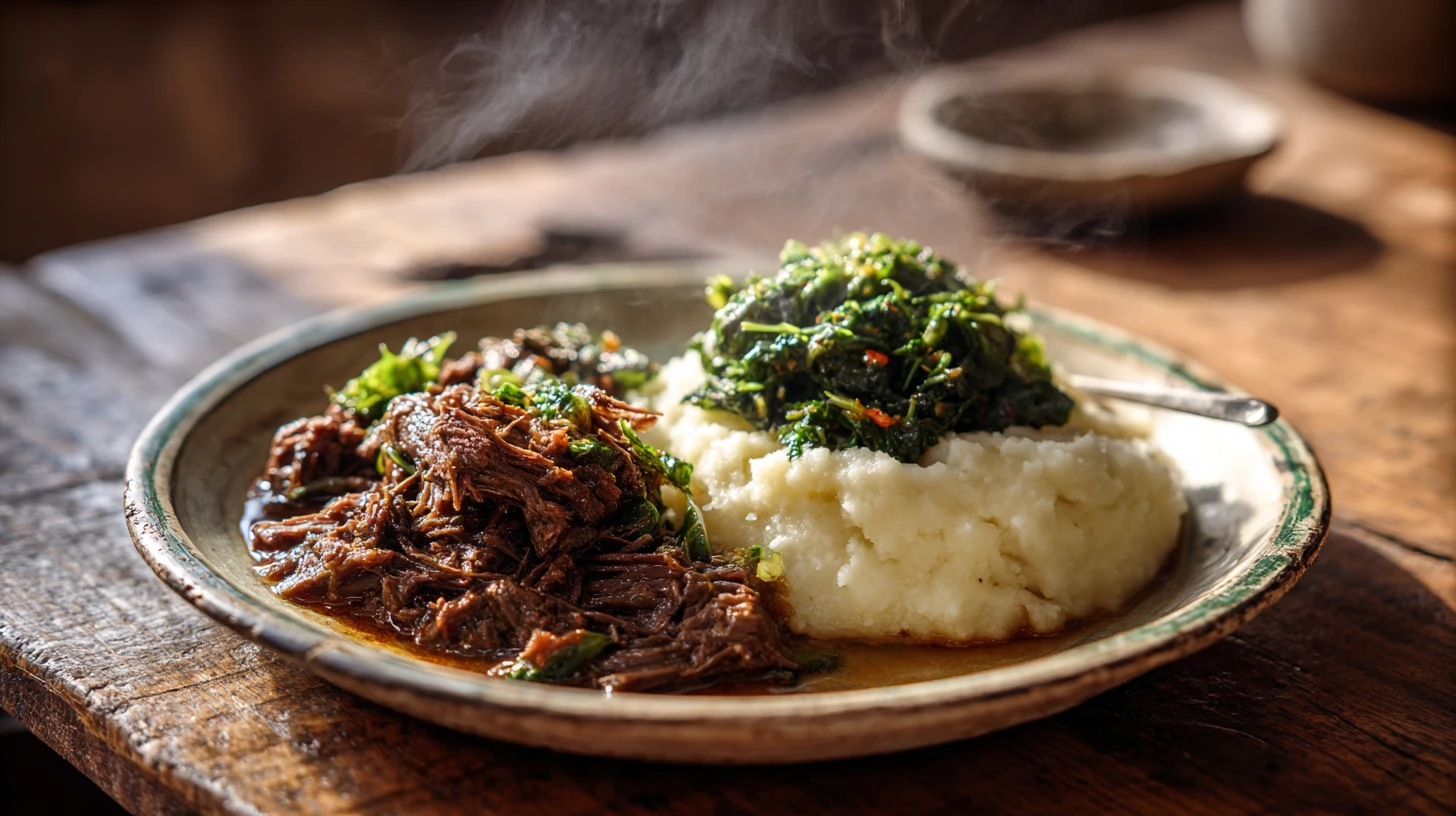
The national dish: beef (or goat) slow-boiled with salt and pounded. Usually allergen-light in itself — the risk is the shared pot and the groundnut relish served with it, not the meat.
BOGOBE / PAP
Sorghum or maize porridge
The staple starch (also phaleche). Maize = corn for the corn-sensitive; sorghum (mabele) is gluten-free. Usually plain, but watch what is spooned over it.
MADILA
Soured milk ⚠
Fermented/soured milk poured over bogobe or eaten with porridge. A structural dairy source that reads as ‘traditional food,’ not ‘milk.’ Name milk explicitly.
MABELE
Sorghum
Sorghum, the gluten-free staple grain (ting is its fermented porridge). Mostly safe for wheat-allergic travelers, but imported/milled products can carry wheat cross-contact — check the label.
DINAWA
Beans / legumes
Beans, including dikgobe (samp-and-beans, maize hominy with legumes). Relevant for legume-allergic travelers; frequently cooked in the same pot as groundnut relish.
LEROTSE
Melon
Native melon cooked into bogobe jwa lerotse — a slightly sour sorghum porridge. A fruit/vegetable vehicle in an otherwise starch-named dish.
SEGWAPA
Biltong / dried meat ⚠
Air-dried, cured, spiced meat (biltong). Carries a spice-and-cure layer: sulfites, coriander, and chilli are common. Read the cure, not just the meat.
NAMA YA NAGA
Game meat
Game (kudu, springbok, ostrich, guinea fowl). Relevant for animal-protein and alpha-gal–sensitive travelers; common on safari-camp menus framed as ‘local’ rather than by species.
DIJO / ALLERGENS
On imported packaging
Botswana has thin domestic allergen-labeling law; most packaged food is imported from South Africa and carries SA-format labels in English/Afrikaans. Read the English ingredient list — the local term you scan menus for won’t appear on a tin.
How allergens appear in Botswana: packaged food — Botswana-made or South African imports alike — must carry a mandatory ingredient list in English or Setswana (Food Control Act, Cap 65:05), so allergens present as ingredients are on the label; read the ‘Ingredients’ list. The gap is unpackaged and informal food (street phane, market morogo, home relishes) and restaurants — no label, no disclosure duty — where the spoken card does the work.
The two terms that hide:Ditloo (groundnut) is stirred into morogo, relishes, and stews unpredictably — a dish named for greens or beans can carry peanut with no warning. And phane (mopane worm; also madora) is a protein staple in a country with no coastline — the one place a shellfish-allergic traveler stops watching, yet the shared tropomyosin makes it a plausible cross-reaction. Ask both questions every time: ‘A go na le ditloo?’ (is there groundnut?) and ‘A go na le phane?’ (is there mopane worm?) — including whether they shared a pot or oil.
Dish Map
Dish Allergen Map — 12 Botswana Dishes
Botswana’s traditional plate is meat-and-starch simple, which makes the hidden layers easy to miss. The groundnut lives in the relish, not the headline dish; the mopane worm is a protein, not a seafood; the cure on the biltong carries the sulfites. Read the relish and the side, not just the centre of the plate. STRUCTURAL means essential to the dish; INCIDENTAL means common but cook-dependent; CROSS-CONTACT means shared pot, oil, or grill.
The national dish and usually the safest traditional order: meat, salt, water. The risk is what it's served with — the morogo relish and the shared three-legged pot — not the meat itself.
The page's primary hidden vehicle. Cooked spinach-style with onion and tomato — and, often, groundnut, with no warning. A dish named for greens that quietly carries peanut. Never assume groundnut-free; ask every time.
MODERATE
Sorghum or maize porridgeBogobe / Pap / Phaleche · Nationwide
CORN (maize) — STRUCTURALMODIFIABLE — SAFE PATH AVAILABLE
The staple starch, eaten with every meal. Plain in itself; the allergen question is always what's spooned over it. Maize-allergic travelers should note pap is maize; sorghum bogobe (mabele) is the gluten-free, corn-free alternative.
LOW
Mopane wormsPhane (madora) · Nationwide; northern & eastern mopane belt
The marquee secondary risk. Dried or stewed in tomato-onion relish, a seasonal protein delicacy. Not seafood — but shares tropomyosin with shrimp and crab, so it is a documented cross-reaction risk (including anaphylaxis) for the shellfish-allergic. Sold openly at markets and looks nothing like seafood, so the guard drops. Treat as a precaution, not a certainty; avoid if shellfish-allergic.
HIGH
Sorghum porridge with melonBogobe jwa lerotse · Nationwide
Slightly sour sorghum porridge cooked with native lerotse melon. A fruit/vegetable vehicle in a starch-named dish; soured milk (madila) is sometimes stirred in.
Maize hominy cooked with legumes, sometimes with groundnut. Both maize and beans are structural; a legume-allergic traveler should treat this as off-limits.
Air-dried, salted, spiced meat. Read the cure, not just the meat: sulfites, coriander, and chilli are common, and home-cured biltong carries no label.
MODERATE
Soured milkMadila · Nationwide
MILK/DAIRY (madila) — STRUCTURAL
Fermented/soured milk eaten with porridge or stirred into bogobe. Reads as 'traditional food,' not 'milk' — a structural dairy source a milk-allergic traveler can miss.
MODERATE
Fat cakesMagwinya (fat cakes) · Nationwide; street food
Deep-fried dough sold everywhere as a snack. Wheat-structural; the bigger trap is the shared frying oil, which may also fry groundnut-coated items at a market stall.
The everyday plate: meat stew, pap, and a morogo relish. The meat is rarely the problem — the relish beside it is where groundnut hides.
MODERATE
Fermented sorghum porridgeTing · Nationwide
FUNGAL/YEAST (fermented) — INCIDENTALMODIFIABLE — SAFE PATH AVAILABLE
Sour fermented sorghum porridge. Gluten-free and groundnut-free as a base; relevant mainly to yeast/mould-sensitive travelers because of the fermentation.
LOW
Cleanest Botswana options depend on your trigger. Plain seswaa (confirm the pot wasn’t shared), plain bogobe/pap, grilled meat without sauce, and fresh fruit are the simplest safe orders. Self-catering from a Gaborone, Maun, or Kasane supermarket — where imported South African labels carry English allergen lines — is the most controllable approach off the camp circuit.
Shellfish-allergic: skip phane entirely. Mopane worm is a documented cross-reaction risk via tropomyosin, sold openly at markets and stewed in relish. It will not read as a seafood risk to anyone around you, so you have to flag it yourself: ‘A go na le phane?’, and ask about the shared pot or oil.
Never infer that morogo is groundnut-free. Groundnut (ditloo) goes into the greens and relishes cook-by-cook with no declaration. A dish named for vegetables can carry peanut — ask about the relish specifically, not just the main dish.
Where to Eat
Venue Safety Profile
Botswana’s venues invert the usual safety ladder. The fly-in safari camp — the signature experience — is the safest place to eat if you brief it at booking: full-board, one chef, total control of the kitchen, fluent English. The catch is location, not cooking: an in-camp reaction means hours to a hospital by air. Lodges and hotel restaurants in Gaborone, Maun, and Kasane run international menus with written cards and English staff. Town diners and braais are where groundnut hides in the relish with no one to flag it, and street food and open-air markets are where mopane worm (phane) and shared frying oil make the highest-risk eating — precisely the casual settings a traveler relaxes in. Supermarkets are low-risk because the imported South African labels are in English.
Higher Risk
Most Reliable
🏕️Fly-in safari camp (full-board, single chef)
The high-value, low-volume operators that define Botswana tourism plate every meal from one kitchen for a small number of guests. Briefed in advance, a camp chef will build your meals around an allergy as a matter of course — this is genuinely the most controlled eating in the country. The risk is not the food; it is the distance. Camps sit hours from a hospital, reached only by light aircraft, so a mistake costs more here than anywhere else.
Disclose at BOOKING, not on arrival — the camp orders supplies days ahead by air. Re-confirm with the chef on day one, name ditloo and phane, and ask the camp manager about the nearest airstrip and their medical-evacuation arrangement.
BEST
🏨Lodge & hotel restaurant
Gaborone, Maun, Kasane, and Francistown hotels and lodges run international menus, often with written allergen awareness and English-fluent staff. Buffets are the weak point — shared serving spoons across dishes, and relishes whose groundnut content isn’t posted.
Hand the card before ordering; at buffets, ask the kitchen to plate your portion separately rather than serving yourself from shared dishes.
LOWER
🍽️Town diner & traditional eatery
The everyday sit-down meal: seswaa, pap/bogobe, morogo, beef or chicken stew, often served buffet-style at lunch. Setswana is the working language and written allergen information is rare. Groundnut (ditloo) turns up in the greens and relishes on a cook-by-cook basis with no warning.
Hand the Setswana card; ask ‘A go na le ditloo mo?’ (is there groundnut in this?) about the morogo and any relish specifically, not just the main dish.
MOD
🔥Braai & communal gathering
Grilled meat is the social centre of Botswana eating, as across Southern Africa. The grill is communal, the marinades, rubs, basting sauces, and relishes are unlabeled. Shared tongs and a shared grill surface carry cross-contact.
Bring your own clearly-labeled portion if invited to a private braai, or ask which sauces and rubs were used. Plain salted seswaa is usually the safest item, but confirm the pot wasn’t shared.
MOD
🐛Street food & open-air market
Markets and roadside stalls sell phane (mopane worm) dried or stewed, magwinya (fat cakes) from shared oil, grilled meat, and groundnut snacks — no labels, no allergen information, and heavy cross-contact in shared frying oil. For shellfish-allergic travelers this is the single highest-risk setting, because phane is sold openly and looks nothing like seafood.
Shellfish-allergic travelers should treat phane as a cross-reaction risk and avoid it, and ask ‘A go na le phane mo?’ Watch the shared oil: magwinya and savoury fritters may fry where groundnut-coated items did.
HIGH
🛒Supermarket & self-catering
Chains such as Choppies, Spar, and Pick n Pay stock largely South African imports with R146-format English/Afrikaans labels, including a ‘Contains’ allergen line — the most readable allergen information available in Botswana. Self-catering on a lodge or mobile safari sidesteps the local-eatery language gap entirely.
Read the English ingredient list and ‘Contains’ line on packaged goods. Fresh, single-ingredient items (fruit, plain meat, rice) are the safest base for self-catering.
LOWER
The safari-camp booking pattern: The camp’s ability to keep you safe is decided weeks before you arrive, not at dinner. Tell the booking agent and the camp your allergy in writing, name ditloo and phane, and get written confirmation the chef can accommodate it. On arrival, speak to the chef directly and confirm the nearest airstrip and the camp’s medical-evacuation plan before you sit down to the first meal.
The market phane pattern (shellfish allergy): A shellfish-allergic traveler arrives in a landlocked country and stops scanning for seafood — then meets phane (mopane worm) dried in bags at every market and stewed in relish. It is an insect, not seafood, but it shares tropomyosin with shrimp and crab and has caused documented reactions, including anaphylaxis. Treat it as a real cross-reaction risk: avoid it, and ask about the shared pot or oil.
The self-catering advantage: Mobile and self-catered safaris let you control the kitchen completely — the single most reliable way to eat safely off the camp circuit. Stock up at a Gaborone, Maun, or Kasane supermarket where imported South African labels carry English allergen lines, and build meals from fresh single-ingredient foods.
The Signature Experience
The Fly-In Safari Camp — fixed menus, remote kitchens, and the distance that defines the risk
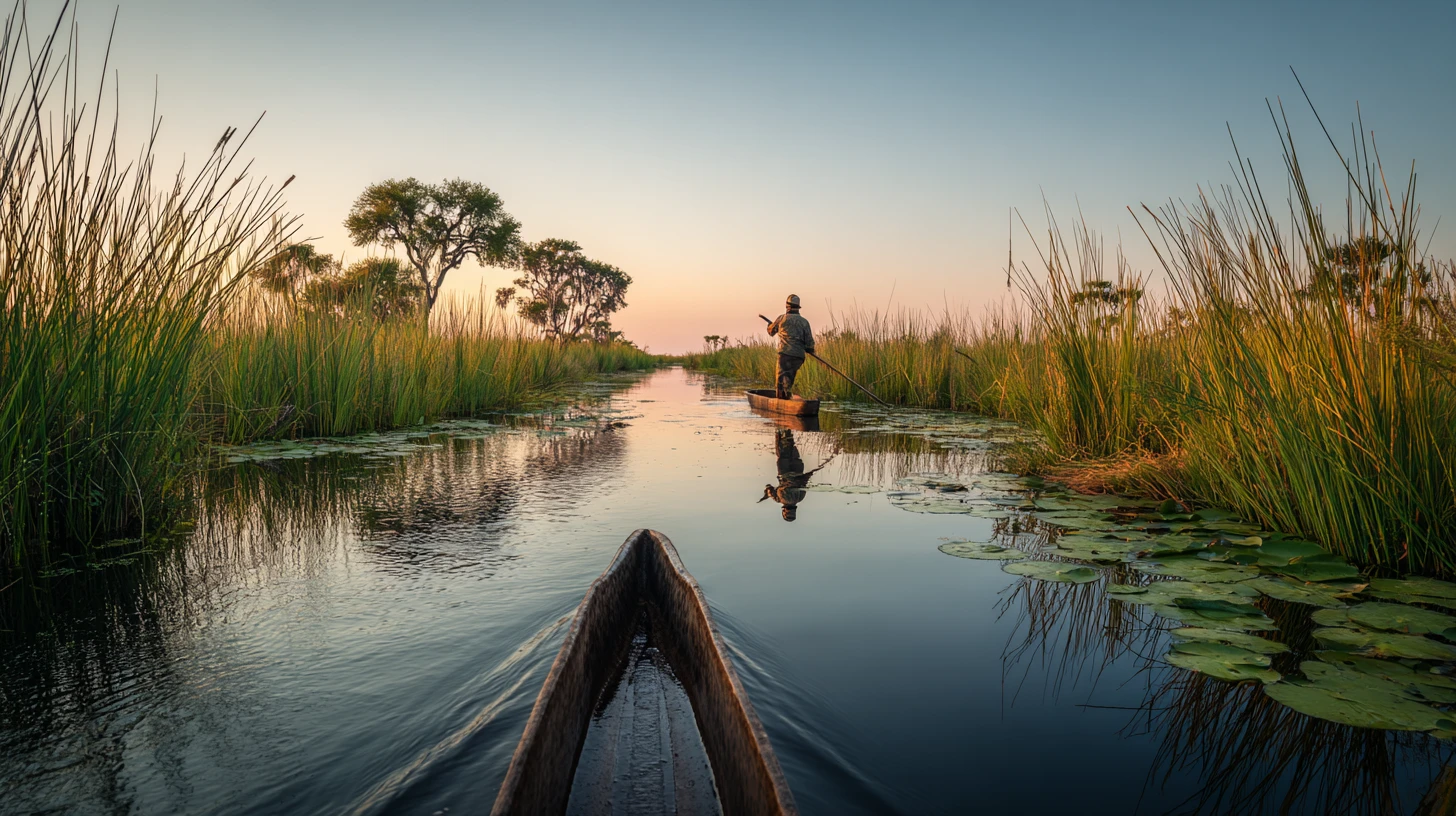
Botswana’s signature experience isn’t a dish or a landmark — it’s the fly-in safari camp, and it flips the usual safety logic. The full-board, single-chef, English-speaking camp kitchen is the most controllable eating in the country, safer than any local restaurant once you’ve briefed it at booking. The danger isn’t the cooking; it’s the location. A camp in the Okavango, Central Kalahari, or Makgadikgadi is hours from a hospital by light aircraft, so the same reaction that’s a bad afternoon in Gaborone is a chartered-evacuation emergency here. Brief the camp, then plan the distance.
Dinner on the Makgadikgadi pans — the fly-in camp’s fixed, single-chef table is the most controlled eating in Botswana, and also the farthest from a hospital.
🛩️
The one rule that governs every camp meal
Your safety on safari is decided at booking, not at dinner. The camp orders supplies by air days ahead, so an allergy briefed in writing at booking is one the chef can build around; an allergy mentioned on arrival often can’t change the menu in time. Then confirm two things on day one — the chef’s plan for your meals, and the camp’s medical-evacuation arrangement — before you sit down.
🛩️
Brief the camp at booking — the kitchen runs on aircraft
A remote camp’s entire larder arrives by light aircraft on a schedule set days ahead. The chef can build every meal around your allergy — but only if it’s known before the supply flight, not when you sit down. Tell the booking agent and the camp in writing, name ditloo (groundnut) and phane (mopane worm), and get written confirmation they can accommodate it.
The rule: Disclose in writing at booking. On-arrival disclosure is often too late to change the menu.
Allergen pattern: groundnut in relishes and sauces is the layer a camp must plan around; name it specifically.
🍳
One chef, full control — the upside of a fixed menu
Unlike an a-la-carte restaurant, a camp plates the same set menu for a small group from one kitchen. Briefed, this is the safest eating in the country: no hidden line cooks, no language gap, total ingredient control. Re-confirm with the chef on day one and ask to see how your meals will differ from the group’s.
The rule: Speak to the chef directly on arrival. Name ditloo and phane; ask what your version of each meal will be.
Allergen pattern: the camp kitchen is controllable; the risk moves to anything eaten away from it.
🐛
The bush-meal & village-visit exception
The camp’s clean kitchen doesn’t travel. Bush breakfasts, sundowner snacks, a San-guided foraging walk, or a village/cultural meal arranged by the camp can bring in groundnut relishes, foraged plants, or phane — exactly the settings where a shellfish-allergic traveler stops watching. Confirm these excursions are covered by the same allergen brief.
The rule: Ask whether off-camp meals and cultural visits follow the same allergen plan. Carry the card on every excursion.
Allergen pattern: phane (shellfish cross-react) and foraged bush foods surface here, not in the main dining tent.
🚁
The distance is the real risk — plan the evacuation
Even a perfectly run camp cannot shorten the flight to a hospital. An in-camp anaphylaxis is managed by camp staff and then by chartered air evacuation to Maun or Gaborone — hours, not minutes. Confirm the nearest airstrip, the camp’s evacuation arrangement, and travel insurance that explicitly covers aeromedical evacuation. Carry two in-date auto-injectors on your person.
The rule: Confirm airstrip + evacuation plan + aeromedical insurance before the first meal. Two injectors, always.
Allergen pattern: this card is about consequence, not ingredient — remoteness multiplies every other risk.
Communication norms
Dining Etiquette & Cultural Norms
Batswana hospitality is warm and communal, and food is shared generously — which is exactly why the allergy-critical moments are the ones that happen before the plate. In a camp, it’s the booking and the chef conversation; at a local or community meal, it’s the shared pot you’re served from. Raise allergies directly and in writing, flag before communal dishes are served, and learn to decline a delicacy graciously — phane in particular is offered as a treat. Tipping is light and not a tool for attention.
A Gaborone waiter brings the everyday plate — seswaa, pap, and a morogo relish. In towns the service is in English; the card does its work in the local eatery where it isn’t.
💬
How to raise an allergy in Botswana
Direct, warm, and written. In camps, hotels, and Gaborone restaurants, English works and staff treat a severe allergy as a professional concern. In local eateries and markets, hand the Setswana card and name ditloo (groundnut) and, if shellfish-allergic, phane (mopane worm). Don’t soften it — ‘a little allergic’ reads as ‘they can eat around it.’
📝
Written beats verbal — especially in Setswana kitchens
Even where English reaches the front of house, the cook in a local eatery works in Setswana and keeps no written allergen information. A card on the table naming the local terms is visible to whoever actually prepares the food, and it survives the language gap that a spoken sentence doesn’t.
🍲
Communal pots & shared meals — flag before serving
At a braai, a village meal, or a family table, food is served from shared pots and a common grill, and sauces and relishes are unlabeled. Say what you can’t eat before the meal is dished up — asking for a separate portion mid-meal is awkward; flagging at the start is normal and welcomed.
🐛
Declining phane (and other delicacies) graciously
Phane is offered as a delicacy and an act of hospitality, so a flat refusal can read as distaste. Decline on health grounds — a food allergy is well understood — with thanks: a shellfish-allergic traveler genuinely should not eat it. The same warmth applies to home-brewed drinks and offered tastes; a clear health reason is always respected.
Tipping in Botswana: roughly 10% in restaurants is generous; rounding up is common. Safari camps usually pool gratuities and provide guideline amounts for staff and guides. Tipping is courtesy, not leverage — it neither secures allergy attention beforehand nor fixes a problem after.
Communication
Essential Safety Phrases
Six scenarios cover the working Setswana an allergic traveler needs; the card carries the formal declaration and these handle the spoken follow-up. The two load-bearing questions are ‘A go na le ditloo?’ (is there groundnut?) and ‘A go na le phane?’ (is there mopane worm?) — drill both, plus the shared-pot follow-up. In safari camps, hotels, and clinics, English works; these Setswana lines are for the local eatery and the market.
Scenario 01
Declaring your allergy
TN
Ke na le aleji e e masisi ya dijo. Karata ya me ke eno.
Ke na le a-LÉ-ji e e ma-SÍ-si ya DÍ-jo. Ka-RÁ-ta ya me ke É-no.
I have a severe food allergy. Here is my card.
TN
Ke na le aleji ya ditloo (manoko).
Ke na le a-LÉ-ji ya di-TLÓ-o (ma-NÓ-ko).
I am allergic to groundnuts (peanuts).
Scenario 02
Asking about groundnut & mopane worm
TN
A go na le ditloo mo?
A go na le di-TLÓ-o mo?
Does this contain groundnut?
TN
A morogo o apeilwe ka ditloo?
A mo-RÓ-go o a-pé-il-we ka di-TLÓ-o?
Is the morogo (greens) cooked with groundnut?
TN
A go na le phane mo?
A go na le PHÁ-ne mo?
Does this contain mopane worm?
Scenario 03
Confirming the kitchen understood
TN
A moapei o badile karata ya me?
A mo-a-PÉ-i o ba-DÍ-le ka-RÁ-ta ya me?
Did the cook read my card?
TN
Ka kopo, ntle le [ditloo / phane].
Ka KÓ-po, N-tle le [di-TLÓ-o / PHÁ-ne].
Without [groundnut / mopane worm], please.
Scenario 04
Asking about cross-contact
TN
A dijo tse di apeilwe mo pitseng e e tshwanang le phane?
A DÍ-jo tse di a-pé-il-we mo pi-TSÉNG e e tshwa-NÁNG le PHÁ-ne?
Were these cooked in the same pot as mopane worm?
TN
A lo dirisa leokwane le le tshwanang go gadika phane kgotsa ditloo le dijo tse?
A lo di-RÍ-sa le-o-KWÁ-ne le le tshwa-NÁNG go ga-DÍ-ka PHÁ-ne kgo-tsa di-TLÓ-o le DÍ-jo tse?
Do you use the same oil to fry mopane worm or groundnut and this food?
Scenario 05
Replacing an auto-injector
TN
Ke tlhoka ente ya adrenaline (auto-injector). Ke na le lengwalo la ngaka.
Ke TLHÓ-ka ÉN-te ya a-dre-na-LÍ-ne. Ke na le len-GWÁ-lo la NGÁ-ka.
I need an adrenaline auto-injector. I have a doctor's prescription.
Scenario 06
Emergency
TN
Anaphylaxis! Ke dirisitse adrenaline ya me. Letsang 997.
A-na-fi-LÁK-sis! Ke di-ri-SÍ-tse a-dre-na-LÍ-ne ya me. LÉ-tsang 997.
Anaphylaxis! I have used my adrenaline. Call 997.
TN
Ke tlhoka ambulense.
Ke TLHÓ-ka am-bu-LÉN-se.
I need an ambulance.
Why a card matters in Botswana: there is no government-issued allergy communication tool, and local eateries keep no written allergen information. A Setswana card that names ditloo and phane fills that gap; English on the same card covers the camp, the hotel, and the clinic.
Confidence: Setswana wording is provisional. The Setswana phrasing above is a working draft pending native-speaker and clinical review (some travelers and clinics use the English loanword ‘aleji’ for allergy). The English on the card is authoritative; treat the Setswana as a spoken aid to be confirmed at the Stage 2 review.
Pre-Trip Preparation
Allergy-Specific Packing List for Botswana
A standard severe-allergy kit with Botswana-specific weight on three things: redundancy (two auto-injectors, because local replacement is not reliable and you may be hours from a pharmacy or hospital), documentation (a doctor’s letter for the BoMRA/customs declaration on arrival), and a bilingual card naming ditloo and phane. If you’re visiting the north (Okavango, Chobe), add malaria prophylaxis to the conversation with your doctor.
💊 Medical essentials
✓
Two adrenaline auto-injectors (carry on-person, not in checked baggage) — Auto-injectors are not reliably stocked in Botswana and you may be hours from care on safari — same-day replacement cannot be assumed. Two devices is the minimum.
✓
Doctor's letter on letterhead: medication generic name, dosage, diagnosis, personal-use statement — Required for the medicine declaration to Botswana Customs (BURS) on arrival and any BoMRA query; keep meds in original pharmacy-labeled packaging.
✓
Copy of the prescription — Supports the customs declaration and any pharmacy interaction in Gaborone or Maun.
✓
Antihistamines (cetirizine / loratadine) — Bring your own to avoid brand confusion; useful for mild reactions, never a substitute for adrenaline.
✓
Travel insurance documents — explicitly covering aeromedical evacuation — The single most important non-drug item for safari. Remote-camp emergencies are resolved by chartered air evacuation, which is expensive without cover.
✓
Malaria prophylaxis (if visiting the north) and any asthma inhaler — The Okavango and Chobe are malaria zones in the wet season; discuss prophylaxis and its interactions with your doctor before travel.
🗂️ Communication tools
✓
Bilingual allergy card naming ditloo (groundnut) and phane (mopane worm) explicitly — The most useful prep item. Setswana for the local eatery and market, English for the camp, hotel, and clinic.
✓
Card image saved to phone lockscreen — For market stalls and street food where you can't pull out a paper card fast enough.
✓
Audio file of your allergy declaration — For noisy markets and braais; play once, then hand the card.
✓
Printed pocket guide with hospital addresses (Gaborone, Maun, Kasane) and camp evacuation contacts — Offline reference — mobile signal disappears across most of the safari circuit.
🎯 At-destination habits
✓
Disclose your allergy at BOOKING for every safari camp — in writing — The camp orders and plans supplies days ahead by air. On-arrival disclosure is often too late to change the menu safely.
✓
On arrival at camp, speak to the chef directly and confirm the evacuation plan — Name ditloo and phane to the chef; ask the manager about the nearest airstrip and medical-evacuation arrangement before the first meal.
✓
At markets and street food, ask about phane and groundnut before tasting — Phane is sold openly and looks nothing like seafood; shared frying oil carries groundnut cross-contact.
✓
Declare your medication to Customs (BURS) on arrival — Carry the doctor's letter and original packaging; declaration is required for prescribed personal-use medication entering Botswana.
Emergency
Emergency Infrastructure
Botswana’s emergency answer is defined by distance. In Gaborone and Francistown, public referral and private hospitals provide a workable urban standard of care. But the safari circuit — the reason most allergic travelers come — is deliberately remote: an in-camp anaphylaxis is managed first by camp staff, then by chartered fixed-wing or helicopter evacuation to Maun or Gaborone, which means hours, not minutes. The national ambulance line is 997 (112 from a mobile), but on safari your real lifeline is the camp’s evacuation arrangement and your own travel insurance. Carry two adrenaline auto-injectors and confirm aeromedical-evacuation cover before you travel.
997
National ambulance (toll-free); dial 112 from a mobile phone
997 reaches government Emergency Medical Services; 112 works from any mobile. State ‘anaphylaxis’ and your location. Short-code routing can vary, so confirm the local emergency number with your camp or hotel on arrival. Toll-free numbers require a local SIM — on safari, you will more often rely on the camp’s radio/satellite link to a private medical-evacuation service than on a public ambulance.
Emergency numbers: Ambulance 997 · Police 999 · Fire 998 · from a mobile 112. Private medical rescue: MedRescue 911; Medical Air Rescue 390 1601; Emergency Assist 991. Toll-free numbers generally require a local SIM card, and national short-code routing has known inconsistencies — dialling 112 from a mobile reaches emergency services, and your camp or hotel can confirm the correct local number.
On safari, you are hours from a hospital. The remote camps in the Okavango, Central Kalahari, and Makgadikgadi have no road ambulance — first response is camp staff, then chartered air evacuation to Maun or Gaborone. Confirm two things before you go: (1) your camp’s specific medical-evacuation arrangement and nearest airstrip, and (2) travel insurance that explicitly covers aeromedical evacuation. Services such as Okavango Air Rescue (helicopter, Maun-based, membership payable by visitors) operate in the Delta. Carry two in-date auto-injectors on your person, not in a bag.
Chobe / Kasane note: Kasane (the Chobe gateway) has local stabilisation capacity, but serious cases require insurer- or camp-directed transfer to the appropriate receiving hospital in Botswana or the region — confirm the route before travel. The Chobe corner sits where Botswana meets Namibia, Zambia, and Zimbabwe.
Camp evacuation checklist — confirm before you book: nearest airstrip; which air-evacuation provider the camp uses (e.g. Okavango Air Rescue, MedRescue) and whether membership/coverage applies to you; your insurer’s pre-authorisation process; the likely receiving hospital; satellite/radio contact at camp; and whether night evacuation is possible from that airstrip.
Princess Marina Hospital
Cnr North Ring Road & Notwane Road, Gaborone
Botswana's largest public referral hospital (~530 beds), 24-hour emergency department; the national tertiary receiving centre.
Gaborone (public referral)
Bokamoso Private Hospital
Mmopane, ~15 km west of Gaborone
Modern accredited private hospital (Lenmed group); English-speaking; 24-hour emergency, ICU, and pharmacy on site; faster than public for acute private care.
Gaborone (private)
Life Gaborone Private Hospital
Segoditshane Way, Broadhurst, Gaborone
Established private hospital with 24-hour casualty and ICU; English-fluent staff; common choice for travelers with insurance.
Gaborone (private)
Nyangabgwe Referral Hospital
Francistown, North-East District
Main public referral hospital for northern Botswana; full emergency department and the regional tertiary receiving centre for the north.
Francistown (north)
Letsholathebe II Memorial Hospital
Maun, Ngamiland (North-West District)
District/referral hospital in the Okavango gateway town; emergency and trauma care (including wildlife injuries) and the first stop / air-evacuation hub for Delta camps. Assume resource constraints and onward transfer to Gaborone for serious cases.
Maun (Okavango gateway)
Regulation
Allergen Labeling Law & EpiPen Rules
Botswana requires mandatory ingredient labelling on all prepackaged food in English or Setswana under the Food Control Act (Cap 65:05) and its Labelling of Prepackaged Foods Regulations, so allergens present as ingredients are declared on packaged goods. What it lacks is an EU FIC-style allergen-emphasis rule and any restaurant or unpackaged-food disclosure requirement — the real gap is markets, street food, relishes, and restaurants. Auto-injectors and prescription medicine are regulated by BoMRA (MRSA 2013); personal-use import is allowed with a doctor’s letter and original packaging. Devices are not reliably stocked locally — carry two, especially given the 2025 medical-supply emergency.
Food Control Act (Cap 65:05) · Labelling of Prepackaged Foods Regulations (2003) — all prepackaged food imported into, sold, or manufactured in Botswana must carry mandatory label information, including a full list of ingredients in descending order of mass, with that information in English or Setswana (a supplementary label is required where the original is in neither). The framework follows the Codex model, so allergens present as ingredients are declared in the ingredient list. What Botswana does not have is an EU FIC-style rule that emphasises a fixed set of allergens, nor any requirement that restaurants or unpackaged food disclose allergens.2
So the written safety net is real for packaged food and absent for everything else. A supermarket tin — whether a South African import or Botswana-made — carries a readable English/Setswana ingredient list, which is why self-catering is the most controllable way to eat here. The gap is unpackaged and informal food: market phane, home-style morogo, street fritters, braai relishes, and restaurant dishes carry no label and trigger no disclosure duty. There, the spoken, handed card does the work, and the two terms to insist on are ditloo (groundnut) and phane (mopane worm). Note too that ingredient lists name a substance, not an allergen warning — groundnut added to a relish is only as visible as the cook’s own list, which for unpackaged food does not exist.
The unlabeled-relish gap: the ingredient-labelling rule covers packaged goods only. Groundnut (ditloo) added to morogo and relishes in a kitchen or at a stall is declared nowhere. Never infer a dish is groundnut-free from its name or appearance — ask, every time, and name several peanut terms (ditloo, manoko, and English “peanut / peanut butter”), since one Setswana word may not capture every preparation.
Bringing adrenaline auto-injectors & prescription medication into Botswana
Medicine import is regulated by the Botswana Medicines Regulatory Authority (BoMRA) under the Medicines and Related Substances Act (MRSA) 2013. Personal-use prescription medication is generally permitted with the right documentation; the steps below are the practical checklist.1
01 📝
Carry a signed, dated letter from your prescribing doctor stating the medication’s generic name, dosage, your diagnosis, and that it is for personal use, plus the original prescription.
02 💊
Keep every device and medication in its original pharmacy-labeled packaging. Carry auto-injectors on your person in carry-on, never in checked baggage.
03 🛂
Be prepared to declare prescribed medication on arrival, and check with BoMRA, BURS (customs), or a Botswana mission before travel whether an import permit is required for your specific medication — a hard customs-declaration requirement is not clearly published for routine personal-use prescriptions, so plan for it rather than assume it.
04 🏥
Do not count on local replacement. Adrenaline auto-injectors are not reliably stocked in Botswana; bring two in-date devices. If you need a replacement mid-trip, a Gaborone hospital or pharmacy is the realistic route, and supply is not guaranteed.
05 📦
Botswana declared a national public-health emergency in August 2025 after its central medical-supply chain failed, with shortages of essential medicines (asthma drugs, dressings, sutures) and military-led distribution; recovery continued into 2026. Treat local resupply of any allergy medication as unreliable, especially outside Gaborone, and carry your full trip supply.
Auto-injector availability: adrenaline auto-injectors are not reliably stocked in Botswana, and across much of the region epinephrine devices depend on importation or named-patient supply rather than routine pharmacy stock. In neighbouring South Africa (the usual supply source) auto-injectors are prescription-only and subject to recurring shortages. Treat your own two devices as your only dependable supply.7
Confidence: MEDIUM. Verify the current BoMRA personal-import and customs-declaration position, permit requirements for your specific medication, and local availability with BoMRA or a Gaborone hospital pharmacy before travel. Rules and stock change, and the 2025–2026 supply situation adds uncertainty.
Regulatory authorities:BoMRA (medicines and devices, imports); food labelling falls under the Food Control Act (Cap 65:05) and its Labelling of Prepackaged Foods Regulations, with BOBS setting product standards. Customs is administered by BURS at ports of entry.
Traveler Reports
Traveler Voices — Community Reports
Illustrative composite scenarios drawn from common Prepared Travel intake patterns and public traveler reports. Initials and locations are stylized; quotes are composite, not first-person verbatim. Replace with verified community testimony once intake-ID-tagged quotes are available.
The morogo looked like plain creamed spinach, so I didn’t think twice. It had groundnut in it. Now I ask ‘A go na le ditloo?’ about the relish at every meal, not just the main dish — in Botswana the peanut is in the side, never on the menu.
Hannah M. · Maun, Okavango · 2025 · Peanut
I’m severely allergic to shellfish, so I relaxed completely — it’s a landlocked country, no seafood anywhere. Then a guide offered me phane as a treat. I had no idea mopane worms could cross-react with shrimp. I declined, looked it up, and was very glad I did.
David O. · Kasane, Chobe · 2024 · Shellfish
I emailed my tree-nut allergy when I booked the Kalahari camp and the chef had a whole separate plan by the time I arrived — genuinely the easiest eating of the trip. What I hadn’t thought about was how far we were from a hospital. I made sure my insurance covered the air evacuation before I went.
Priya N. · Central Kalahari · 2025 · Tree Nuts
References & Transparency
Sources, Citations & Data Confidence
View source citations
▼
1
Botswana Medicines Regulatory Authority (BoMRA). “Imports & Exports / Licensing & Enforcement; Medicines and Related Substances Act (MRSA) 2013.” 2024. bomra.co.bw — National medicines regulator; governs personal-import of prescription medicines and auto-injectors. HIGH confidence.
2
Government of Botswana. “Food Control Act (Cap 65:05); Labelling of Prepackaged Foods Regulations (2003) — mandatory ingredient labelling in English or Setswana.” botswanalaws.com — Primary food-labelling law; allergens declared as ingredients but no EU-style allergen-emphasis or restaurant-disclosure rule. BOBS sets related product standards. HIGH confidence.
3
Ministry of Health, Republic of Botswana. “Emergency Medical Services (Ambulance Services) — 997; service coverage incl. Gaborone, Maun, Kasane, Francistown.” 2025. gov.bw — Government emergency medical services. HIGH confidence.
4
Okezie OA, Kgomotso KK, Letswiti MM. “Mopane worm allergy in a 36-year-old woman: a case report.” Journal of Medical Case Reports, 2010;4:42. ncbi.nlm.nih.gov — Peer-reviewed Botswana case of ingestion allergy to mopane worm. HIGH confidence (single case report).
5
Kung S-J, et al. “Anaphylaxis to Mopane worms (Imbrasia belina).” Annals of Allergy, Asthma & Immunology, 2011. annallergy.org — Documented anaphylaxis to mopane worm; tropomyosin / dust-mite cross-reactivity context. HIGH confidence.
6
Ndlovu V, Chimbari M, Ndarukwa P, Sibanda E. “Sensitisation to Imbrasia belina (mopane worm) and other local allergens in rural Gwanda district of Zimbabwe.” Allergy, Asthma & Clinical Immunology, 2022;18(1):33. ncbi.nlm.nih.gov — Population sensitisation study confirming tropomyosin in mopane worm; cross-reactivity with house dust mite/crustacean. HIGH confidence.
7
Tanno LK, et al. “Global disparities in availability of epinephrine auto-injectors.” World Allergy Organization survey, 2023. sciencedirect.com — Context for limited national EAI availability across Africa; reliance on importation/named-patient supply. MEDIUM-HIGH confidence.
8
Okavango Air Rescue / regional medical-evacuation operators. “Helicopter and fixed-wing aeromedical evacuation, Maun and the Okavango Delta.” 2024. okavangorescue.com — Private aeromedical evacuation serving the safari circuit. MEDIUM confidence (operator information; verify membership terms).
9
U.S. Department of Commerce. “Botswana Country Commercial Guide — Labeling and Marking Requirements (BOBS pre-packaged-goods standard).” 2024. trade.gov — Independent summary of Botswana labelling enforcement. MEDIUM confidence.
10
Prepared Travel community reports. “Botswana safari-camp and Gaborone traveler intake notes, 2024–2026.” 2026. prepared.travel/community — Aggregated allergic-traveler experience on camp briefing, market phane exposure, and card uptake. MEDIUM confidence.
11
Kung S-J, et al. “Food allergy in Africa / Allergy in Botswana — allergy-clinic case data.” Clin Rev Allergy Immunol, 2014 (and EAACI 2012 lecture, “Unusual food allergens from Southern Africa”). link.springer.com — Clinic-based data identifying peanut and egg as common and mopane worm as a novel/local allergen; not national prevalence. MEDIUM-HIGH confidence.
12
Al Jazeera / BMJ. “Botswana declares public health emergency over medicine shortage.” 25–27 August 2025. aljazeera.com — National medical-supply-chain failure; basis for not relying on local medication resupply. HIGH confidence.
Data confidence ratings
▼
Data point
Confidence
Notes
Emergency number (997 ambulance / 112 mobile)
● MEDIUM
MoH supports 997; national short-code routing has known inconsistencies — confirm locally
This page is a living document. Labeling laws change, hospitals change ownership, and the 2025–2026 medical-supply situation is still evolving. Setswana phrasing is provisional pending native-speaker review. Last verified June 2026.
You've done the research. Now build your Botswana allergy card.
The Okavango is waiting. Go prepared.
Generate your Botswana food allergy card in Setswana, with English included — naming ditloo (groundnut) and phane (mopane worm) directly, the two terms a kitchen recognises faster than any English category, and the ones a remote camp needs to hear before you arrive. Your Botswana allergy translation card is ready in two minutes.