Germany scores 4 out of 10 on the Prepared Travel difficulty scale — moderate, in the EU-FIC protected band alongside Portugal, Italy, and Croatia — because EU Regulation 1169/2011 is transposed into German law via the Lebensmittelinformations-Durchführungsverordnung (LMIDV), the 14 mandatory EU allergens are declared on packaged food, printed menus often carry numbered allergen legends, and Berlin, Munich, and Hamburg restaurants handle allergies well in English with some of Europe's strongest gluten-free and vegan scenes. The structural friction is category, not infrastructure: Wurst is filed in the German kitchen mind as ‘Fleisch’ (meat), not dairy — yet emulsified sausage (Brühwurst) is often bound, depending on recipe, with milk protein and milk powder, so a milk-allergic traveler reading Fleischwurst, Currywurst, or Leberkäse has no warning. Mustard (Senf) is common in sauces, dressings, and the Weißwurst ritual — not a condiment a cook flags. And marzipan and tree nuts (Schalenfrüchte) are common in German baking. A German card naming Milcheiweiß, Senf, and Schalenfrüchte/Marzipan directly is the single highest-leverage prep step.
🇩🇪 Food & Culture
Germany's food identity is the Wurst — more than 1,500 named sausage varieties, governed by a craft tradition as exacting as the 1516 Reinheitsgebot that still shapes German beer. Emulsified Brühwurst — the smooth, pale sausages sliced cold as Aufschnitt or simmered as Bockwurst — are often bound for texture with milk protein or milk powder — depending on the recipe — and the dairy can be invisible to the eater and unremarkable to the cook. Alongside the Wurst sits Senf: Germany is a mustard culture, with sweet Bavarian süßer Senf for Weißwurst, sharp mittelscharfer for everything else, and mustard worked into many sauces, Remoulade, and dressings as a base flavor (recipe-dependent in dishes like Klopse), not a garnish. The third inheritance is marzipan — Lübeck has made it since the Middle Ages — and the broader tradition of nut-built Christmas baking (Stollen, Lebkuchen, gebrannte Mandeln). Together they make Germany a country where the most beloved everyday foods carry allergens hidden not by language but by familiarity.
Core Safety Metrics — hover each for full explanation
Overall Allergy Travel Difficulty
4/10
Moderate — strong EU-FIC law vs. milk-in-Wurst and mustard blind spots
Germany sits in the EU-FIC protected band alongside Portugal, Italy, and Croatia. The 14 EU allergens are declared on packaged goods, printed menus often carry numbered allergen legends, and Berlin, Munich, and Hamburg staff handle allergies well in English — Germany also has one of Europe's strongest gluten-free and vegan infrastructures. The deduction comes from category blindness: emulsified Wurst is filed as meat but may be bound with milk protein, mustard is common in sauces, and tree nuts and marzipan are common in baking. Rural Bavaria and the eastern Länder are the harder zones — lower English, traditional menus.
Allergen Labeling Law Strength
9/10
EU 1169/2011 transposed via the LMIDV — full force, with menu legends
Germany operates under EU Regulation 1169/2011 (FIC), transposed via the Lebensmittelinformations-Durchführungsverordnung (LMIDV). All 14 mandatory EU allergens must be declared on packaged food, distinguished in the Zutaten (ingredients) list, and non-prepackaged food (restaurants, bakeries, butcher counters) must disclose on request. Many German printed menus carry numbered or lettered legends mapping dishes to the 14 allergens; if a legend is not shown, ask for the Allergenkennzeichnung. Enforcement is by the Länder food-control authorities under the federal BVL.12
Kitchen Awareness
7/10
High in cities and for gluten-free; blind to milk-in-Wurst and mustard
Awareness is bimodal and uneven by allergen. Gluten-free and vegan literacy is strong — the DZG (German Coeliac Society) maintains restaurant lists, and Berlin's vegan scene can help dairy/egg-allergic travelers (still verify soy, nuts, sesame, gluten, and cross-contact). But the milk-protein binder in emulsified Wurst is a common blind spot: a cook hears 'dairy allergy' and pictures cheese and cream, not the Milcheiweiß in the Fleischwurst. Senf (mustard) is treated as a basic condiment, not an allergen. Rural Bavaria, Swabian villages, and the East run on tradition with thinner English.5
Hidden Allergen Vehicle Density
6/10
Elevated — milk in Wurst, mustard in sauces, nuts in baking
Milk protein and milk powder can bind emulsified sausages (Fleischwurst, Lyoner, Bockwurst, Leberkäse, Currywurst) that read as pure meat — recipe-dependent, so check the Zutaten. Senf (mustard) is common in Remoulade, dressings, and many sauces (recipe-dependent in Königsberger Klopse), and is the standard partner to Weißwurst and Bratwurst. Tree nuts and marzipan are common in Stollen, Lebkuchen, Bienenstich, and gebrannte Mandeln (Baumkuchen may also contain nuts). Wheat is pervasive (bread, Spätzle, Knödel, breaded Schnitzel). Density is mid-band: lower than Japan (dashi) or Italy (pinoli), higher than the Nordics.8
Emergency Response Quality
9/10
Excellent — fast 112/Notarzt response; ERs equipped for anaphylaxis
The Rettungsdienst dispatches via 112 nationwide, with a Notarzt (emergency physician) sent to serious cases — a well-resourced emergency system. German emergency services and hospital emergency departments are equipped to treat anaphylaxis; call 112 immediately. University hospitals in Berlin (Charite Allergie-Centrum), Munich, Hamburg, Frankfurt, and Cologne have allergy and intensive-care capacity. EU travelers are covered via EHIC/GHIC; non-EU travelers pay and reclaim.7
Difficulty in context — how Germany compares globally4 / 10 Moderate
🇩🇰 Denmark 2🇦🇺 Australia 3🇩🇪 Germany 4🇯🇵 Japan 7🇮🇳 India 9
🇩🇪
On the Ground
Germany feels easy in Berlin, Munich, and Hamburg because menus carry allergen legends, gluten-free and vegan options are everywhere, and most front-of-house staff speak English. It gets harder the moment the risk lives inside a word the kitchen files under something else — above all Wurst, which a cook thinks of as meat, not as the milk-protein carrier it often is. A traveler who hands a German card naming Milcheiweiß, Senf, and Schalenfrüchte/Marzipan gets the seriousness the request deserves. The same traveler saying 'I'm allergic to dairy' at an Imbiss will get a nod and a Currywurst whose binder no one thought to mention. The gap is not goodwill; it is category.
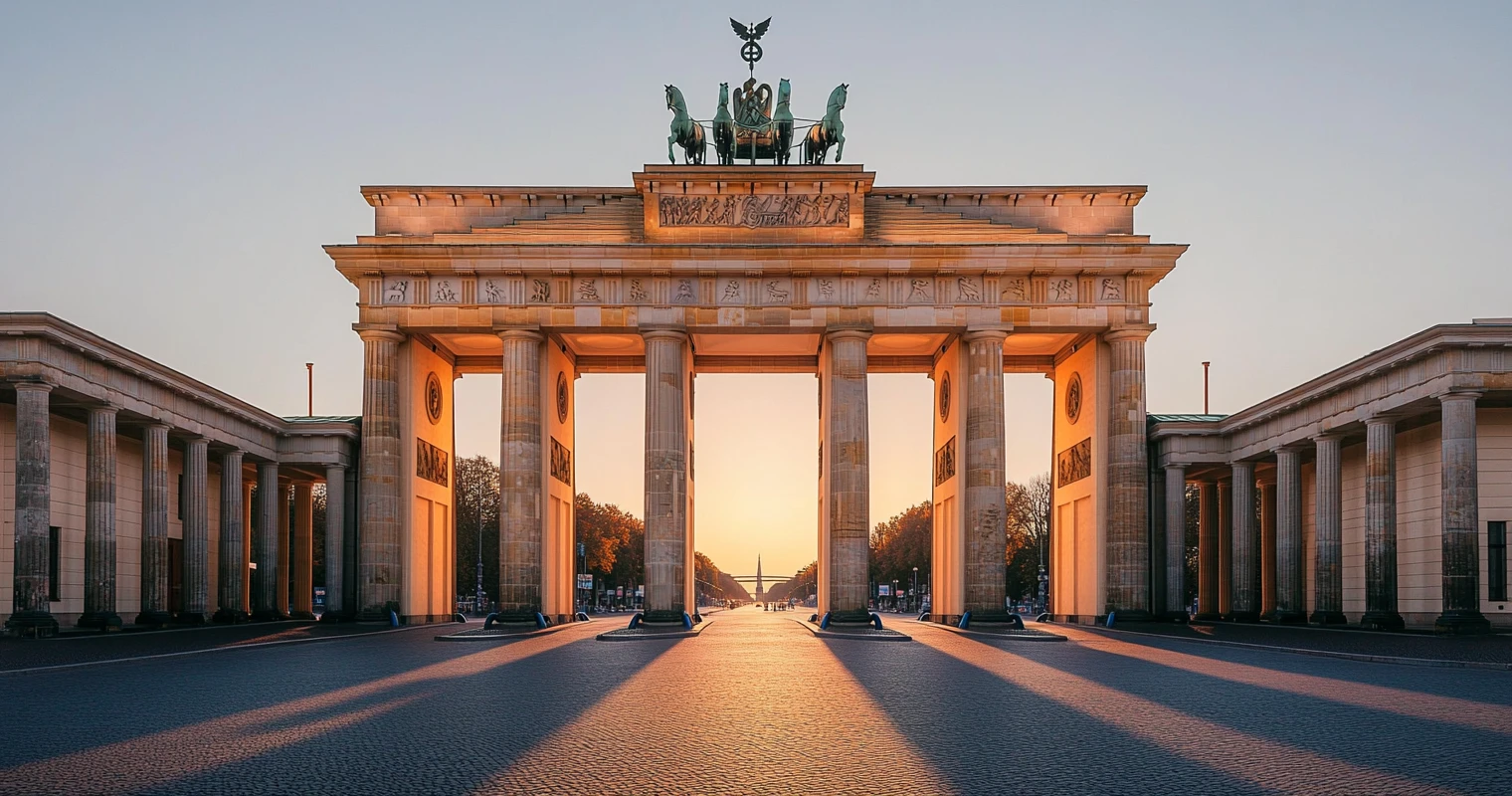
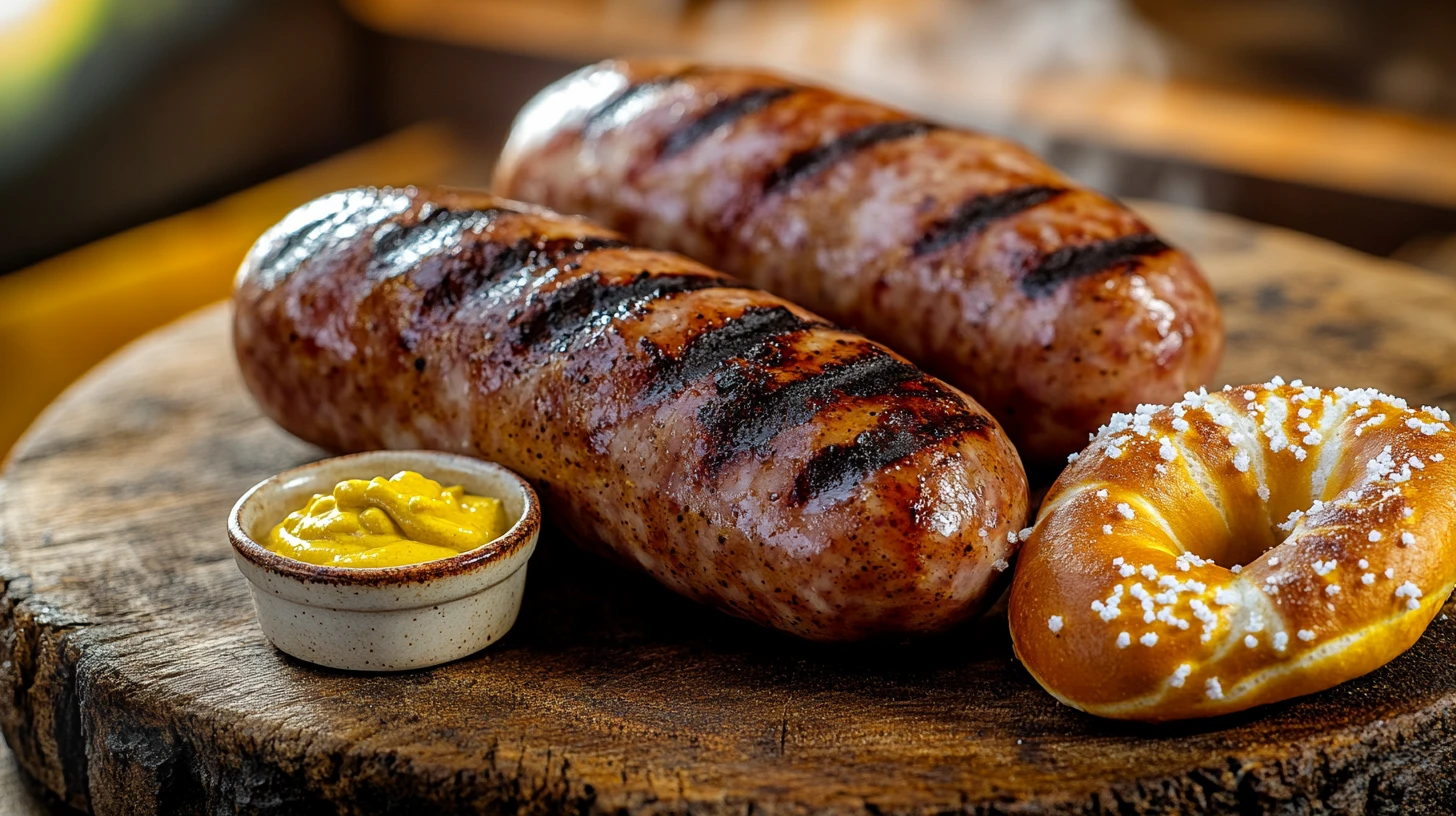
🏛️ Brandenburg Gate · Tap to read🌭 Bratwurst & sweet mustard · Tap to read🌲 The Black Forest · Tap to read
Geography
Regional Allergen Risk Map
Germany's allergy map splits less by ingredient than by tradition and tourism fluency: cosmopolitan Berlin with Europe-leading vegan and free-from infrastructure, the Bavarian beer-hall heartland of Wurst and sweet mustard, Swabia's egg-and-wheat noodle kitchens, the Hanseatic North of fish and Lübeck marzipan, the Rhineland's Lebkuchen-thickened gravies and Currywurst, and the eastern Länder with thinner English and the Dresden Stollen tradition. The constant across all of them is the emulsified Wurst that reads as meat but may carry milk protein, and the mustard worked into many sauces. Standard German is the single kitchen language nationwide; the variance is dialect, recipe, and how much English reaches the cook.
Loading region map…
↑ Hover a region for detail
🍺
Bavaria (Bayern) · Bayern
MODERATE
The beer-hall heartland and the signature experience. Munich Wirtshäuser and Biergarten run on Wurst (Weißwurst, Bratwurst, Leberkäse), Brezn, Schweinshaxe, and sweet mustard, with Oktoberfest as the apex. Sweet mustard is structural to the Weißwurst ritual; the emulsified sausages may carry a milk-protein binder. English is good in Munich and the Alpine resorts, thinner in rural Franconia and the Bavarian Forest. Brezn and Schnitzel make wheat near-unavoidable.
The easiest region. Berlin has a very strong vegan and free-from food scene, widespread English in hospitality, and allergen-literate kitchens. Currywurst was born here — the milk-protein-and-mustard Imbiss trap is the local exception in an otherwise comparatively easy city. Döner culture is everywhere (sesame bread, garlic-yogurt sauce). For milk- and egg-allergic travelers, Berlin's plant-based scene is a helpful fallback for the Wurst problem (still verify soy, nuts, sesame, gluten, and cross-contact).
Noodle country. Swabian cooking centers on egg-and-wheat Spätzle, Käsespätzle, and Maultaschen — wheat and egg are structural at near-daily density, and the cheese-and-onion versions add dairy and allium. Maultaschen broth is often celery-based. Stuttgart and university towns (Freiburg, Tübingen, Heidelberg) carry good English and modern dining; rural Swabian villages run traditional. For wheat- or egg-allergic travelers, this is the region where the staple itself is the allergen.
Hanseatic North (Hamburg, Bremen, the coast) · Norddeutschland
MODERATE
Fish and marzipan country. The North Sea and Baltic coasts raise fish and shellfish risk — Fischbrötchen, Matjes, Rollmops, Labskaus, Nordsee-Krabben (brown shrimp) — while Lübeck is the historic capital of marzipan, threading tree nuts through the region's baking and Hamburg's Franzbrötchen pastry culture. Hamburg has strong English and modern dining; smaller coastal towns are more traditional. Remoulade (egg + mustard) dresses most fish rolls.
↑ ['fish' (Matjes, Fischbrötchen), 'tree_nuts' (Lübecker Marzipan), 'egg + seeds_spices' (Remoulade on fish rolls)]
🍻
Rhineland (Cologne, Düsseldorf, NRW) · Rheinland
MODERATE
Sauce-and-sausage country. Rhenish Sauerbraten is the regional signature — its gravy classically thickened with crushed Lebkuchen or Aachener Printen, a hidden tree-nut-and-wheat source that reads as 'gravy.' Currywurst is heavy in the Ruhr; Himmel un Ääd pairs blood sausage with apple and potato; Reibekuchen are fried potato cakes (shared oil). Cologne and Düsseldorf have good English and Brauhaus culture (Kölsch, Alt). Mustard and the Lebkuchen-gravy are the regional traps.
Hardest region for the allergic traveler outside the big cities. The eastern Länder (Saxony, Thuringia, Saxony-Anhalt) run on tradition with lower English fluency outside Dresden, Leipzig, and university towns. Thuringian Bratwurst, Eierschecke (egg-and-quark cake), and above all the Dresden Stollen tradition concentrate the nut-and-marzipan through-line; Christmas markets (Dresden Striezelmarkt) are dense with gebrannte Mandeln, Lebkuchen, and sulfited Glühwein. Carry the German card; expect to use it.
The German allergen landscape is wheat-dense, milk-dense, and mustard-dense, with three cultural through-lines that punch above their statistical weight: milk protein (Milcheiweiß) that may be bound invisibly into emulsified Wurst the kitchen treats as meat; mustard (Senf) worked into sauces, dressings, and many dishes as a base flavor rather than a condiment; and marzipan and tree nuts common across German baking and Christmas markets. Wheat is everywhere — bread, Brötchen, Spätzle, Knödel, breaded Schnitzel, and beer. Egg binds Spätzle, Maultaschen, and Frikadellen. Fish concentrates on the northern coast. The rows below order by structural supply prevalence across German regional cuisines.
Clinical allergen prevalence in Germany: German prevalence broadly tracks EU averages — cow's milk and egg dominate pediatric food allergy; tree nuts, peanut, and (clinically notable in central Europe) mustard and celery feature in adult presentations. The DAAB (Deutscher Allergie- und Asthmabund) is the national patient organisation, and the European Anaphylaxis Registry, coordinated in part from Germany, documents triggers. Mustard and celery allergy are more clinically visible in German-speaking and central-European populations than many travelers expect.58
Why these allergens matter in Germany specifically: The EU FIC 14 is the legal floor, and German menus often surpass it with numbered allergen legends. The friction is category framing: a milk declaration covers cheese and cream in the cook's mind but not the Milcheiweiß binding the Fleischwurst; a mustard allergy is heard as a preference, not a severe risk, because Senf is a table staple. The three rows to watch most closely for a Germany trip are milk (Milcheiweiß in emulsified Wurst), seeds_spices (Senf and Sellerie hidden in sauces and stock), and tree_nuts (marzipan and almonds common in baking).
Regional variance within Germany: These scores reflect national averages. A Bavarian Wirtshaus concentrates Wurst, Brezn, and sweet mustard; a Swabian kitchen runs egg-and-wheat Spätzle and Maultaschen at near-daily density; a Hanseatic North menu raises fish and Lübeck marzipan; a Saxon Christmas market collapses tree nuts, marzipan, and sulfited Glühwein into one stall. The six regions below surface these gradients.
What's safer than expected in Germany:Gluten-free infrastructure is strong — the DZG maintains restaurant lists and 'glutenfrei' is widely understood. Vegan dining, especially in Berlin, can help dairy- and egg-allergic travelers by removing the milk-in-Wurst and egg problems — but still verify soy, nuts, sesame, gluten, and cross-contact. Peanut is less structural in traditional German cuisine than in Asian or American contexts, though not absent — it appears in packaged snacks, Asian/Turkish and modern venues, and cross-contact settings. A plain roasted single protein (Schweinshaxe, Hendl) with potatoes, ordered without sauce, is among the cleanest traditional choices once gravy and breading are removed.
Languages
Languages Spoken
Germany is structurally simple for card strategy: Standard German (Hochdeutsch) is the single written and kitchen language nationwide. Dialects — Bavarian, Swabian, Low German (Plattdeutsch), Saxon — shape how a dish is said, not how an allergen sheet is written; a single Hochdeutsch card works from Flensburg to Garmisch. The card must name Milcheiweiß, Senf, and Schalenfrüchte/Marzipan by specific German term — a generic Milch or Nüsse declaration is legally accurate but operationally weaker, because the milk binder in Wurst and the marzipan in baking are not what a cook pictures from a vague category. One card, one language.
~100% — Standard German is the written and kitchen language of every German region, understood in every regulated written context. All written kitchen output — menus, the legally required Allergen-Kennzeichnung sheet, packaging labels (Zutaten), regulatory notices — is in Hochdeutsch. Regional dialects are spoken, not written into allergen documentation, so a single Hochdeutsch card is fully sufficient. ~76M speakers.
Nationwide — the kitchen and label language of every German region, including Bavaria, Swabia, and the East
~45% front-of-house in cities — a majority of Germans report some English ability, concentrated among younger and urban staff. English reliably reaches front-of-house in Berlin, Munich, Hamburg, Cologne, and Frankfurt, and chef-driven and hotel kitchens. It thins quickly in rural Bavaria, Swabian villages, and the eastern Länder, where older staff default to German only. English reaches the server who takes the order, not always the cook who builds the plate. ~47M speakers (L2).
Berlin, Munich, Hamburg, Cologne, Frankfurt tourist and hospitality corridors; chef-driven and hotel kitchens nationwide
~5% (Imbiss & bakery niche) — Germany’s largest minority language, central to the Imbiss economy: Döner, Lahmacün, and Turkish-German bakery culture across Berlin, the Ruhr, Cologne, and Hamburg. Useful for ingredient nuance at Turkish-German venues (sesame on bread, garlic-yogurt sauces, nut-laden sweets) but not a substitute for the German card. ~1.5M speakers.
Berlin (Kreuzberg, Neukölln), the Ruhr, Cologne, Hamburg — Imbiss and bakery networks
~1% written — recognized regional language of the northern coast and Lower Saxony, spoken not written; Hochdeutsch is the written kitchen and label language even where Platt is spoken at home. A Hochdeutsch card covers every Platt-speaking region. ~2M speakers.
~1% written — the spoken language of the beer-hall heartland (Weißwurst, Brezn, and Obatzda are Bavarian-dialect terms), but menus and the Allergen-Kennzeichnung sheet are written in Hochdeutsch. Bavarian shapes how a dish is said, not how it is documented. ~12M speakers.
Bavaria (Bayern), especially Munich and the Alpine south
~1%
One language, every kitchen: Generate one Standard German (Hochdeutsch) card — it is the card strategy for the whole country, dialect regions included. Name Milcheiweiß (milk protein) and Milchpulver (milk powder) specifically, not just Milch, so the binder in emulsified Wurst is caught. Name Senf (mustard) on its own line — it is EU FIC #10 and hides inside the word Soße (sauce). For tree-nut and marzipan avoidance, name Schalenfrüchte (the FIC term) and Marzipan separately; the colloquial Nüsse is narrower than a cook needs.
Reading Labels
German Label & Menu Guide
Germany uses the Latin alphabet, so the challenge is not script — it is category. A milk-allergic traveler who reads 'Fleischwurst' sees meat and misses the Milcheiweiß binding it. A mustard-allergic traveler who reads 'Soße' has no warning that Senf is inside. The cards below give the specific German terms for each allergen and exactly where they hide on packaging and menus.
German labeling follows EU Regulation 1169/2011 (transposed via the Lebensmittelinformations-Durchführungsverordnung, LMIDV): the 14 mandatory allergens must be declared in the ‘Zutaten:’ (ingredients) list, distinguished by bold, capitalization, or another emphasis. Restaurants must disclose on request, and most printed German menus carry small superscript numbers mapping each dish to a footnote allergen legend — better default visibility than many EU peers. The trap is not the alphabet (German is Latin script) but the category: a milk-allergic traveler who reads ‘Fleischwurst’ sees meat, not the Milcheiweiß binding it. The cards below give the German term for each allergen and where it appears on packaging and menus.
WURST
Sausage ⚠
Not an allergen category to a German cook — but emulsified Brühwurst (Fleischwurst, Lyoner, Bockwurst, Leberkäse, Currywurst) may be bound with milk protein or milk powder depending on recipe, and may carry mustard. Treated as 'Fleisch.' Name the allergen, ask about the binder.
MILCH · MILCHEIWEISS
Milk / milk protein ⚠
Milch = milk; Milcheiweiß = milk protein; Milchpulver/Magermilchpulver = milk powder; Sahne = cream; Quark, Butter. List Milcheiweiß AND Milchpulver on the card to catch the dairy binder hidden in sausage and cold cuts.
SENF
Mustard (FIC) ⚠
EU FIC #10. Structural in Königsberger Klopse, Remoulade, dressings, marinades, and the standard partner to Weißwurst and Bratwurst. Hides inside the word 'Soße' (sauce). Name it separately — Germans treat it as a condiment, not an allergen.
SCHALENFRÜCHTE
Tree nuts (FIC) ⚠
The EU FIC term for tree nuts. Specific terms: Mandel (almond), Haselnuss (hazelnut), Walnuss (walnut), Pistazie, Cashew, Pekannuss. 'Nüsse' colloquially is narrower. Structural in German cakes and Christmas baking.
MARZIPAN
Almond paste ⚠
Ground almond and sugar — structural in Stollen, Mozartkugeln, Lübecker Marzipan, and festive sweets. Reads as a sweet, not as a tree nut. Almond-allergic travelers must name Marzipan as well as Schalenfrüchte.
GLUTEN · WEIZEN
Gluten / wheat ⚠
'Gluten' is the FIC category; Weizen (wheat), Roggen (rye), Gerste (barley), Hafer (oats), Dinkel (spelt) are the cereals. Pervasive — Brot, Brötchen, Brezn, Spätzle, Knödel, paniertes Schnitzel, and beer. The DZG maintains gluten-free venue lists.
EI
Egg ⚠
Ei = egg. Structural in Spätzle, Maultaschen, Frikadellen/Bouletten (binder), nearly all Kuchen, Eierschecke, and the Remoulade/mayo on a Fischbrötchen. 'Ohne Ei' for egg-free.
FISCH
Fish (FIC) ⚠
Fisch = fish; concentrated on the northern coast — Matjes (herring), Backfisch, Forelle, Labskaus, the Fischbrötchen. Rollmops and Bismarckhering are pickled herring. Less central inland than in coastal cuisines.
KRUSTEN- · WEICHTIERE
Crustaceans / molluscs ⚠
Krustentiere = crustaceans (Garnelen/shrimp, Krebs/crab); Weichtiere = molluscs (Muscheln/mussels, Tintenfisch/squid). Two separate EU FIC categories. North-coast and modern menus; Nordsee-Krabben (brown shrimp) is a regional specialty.
SOJA
Soy ⚠
EU FIC mandatory. Appears in packaged sauces, processed meats, and — prominently — Germany's large vegan scene (Tofu, Soja-based Wurst alternatives). Read labels on plant-based 'Wurst' if soy-allergic.
SESAM
Sesame (FIC) ⚠
EU FIC mandatory. On Brötchen and burger buns, and central to Turkish-German bakery and Döner bread (Sesam topping). An easy miss on the otherwise simple bread roll.
SULFITE
Sulfites · SO₂
Required on labels if >10mg/kg. 'Enthält Sulfite' on Wein, Sekt, Glühwein, dried fruit, and some Sauerkraut and processed potato. Look for 'Schwefeldioxid' or 'SO₂' on wine labels.
How allergens appear on German packaging: The 14 EU FIC allergens appear in the ‘Zutaten:’ list, emphasised in bold or capitals. ‘Kann Spuren von ... enthalten’ = ‘may contain traces of ...’ is voluntary precautionary labeling, common but not legally required. Milk protein may appear as Milcheiweiß, Magermilchpulver, Molkeneiweiß (whey protein), or Kasein — all dairy.
How milk hides in German Wurst: Emulsified sausage (Brühwurst) is frequently bound with milk protein or milk powder for texture and water-binding. If a dish name contains Wurst, Fleischwurst, Lyoner, Bockwurst, Leberkäse, Currywurst, Mortadella — it may carry dairy regardless of whether the word ‘Milch’ appears on the menu. Ask ‘Enthält die Wurst Milcheiweiß?’ and check the packaged label’s Zutaten list. The word that reads as ‘meat’ is the one to question.
Cuisine
Dish Allergen Map — 12 German Dishes
German dishes sort into three structural profiles — Wurst-built (emulsified sausage that reads as meat but carries milk protein and pairs with mustard), wheat-and-egg-built (Schnitzel breading, Spätzle, Maultaschen, the bread-and-Knödel base), and nut-and-marzipan baking (Stollen, Lebkuchen, the Konditorei tradition). Every dish below is classified STRUCTURAL (the allergen defines the dish) or INCIDENTAL (it arrives via binder, sauce, or variant and may be confirmed or mitigated). The STRUCTURAL distinction matters because German kitchens defend canonical recipes — you cannot order a Wiener Schnitzel without its egg-and-breadcrumb coat, and the sweet mustard is the Weißwurst service.
Germany's signature street food. The sausage is emulsified Brühwurst — a milk-protein binder is common, INCIDENTAL because it varies by maker. The curry-ketchup sauce can contain mustard. Pommes share a fryer. The dish reads as 'sausage and sauce'; the dairy and mustard are invisible. Ask 'Enthält die Wurst Milcheiweiß?' and 'Ist Senf in der Soße?'
The Munich morning ritual — eaten before noon with sweet mustard (süßer Senf) and a Brezn. The sweet mustard is not a side; it is the defining accompaniment, STRUCTURAL to the experience and a clear risk for mustard-allergic travelers. The sausage may carry a milk-protein binder. The Brezn is structural wheat. Order without the mustard and Brezn to strip the avoidable allergens.
The breaded cutlet is flour, egg wash, and breadcrumb — wheat and egg are both STRUCTURAL and cannot be removed without it ceasing to be a Schnitzel. Some kitchens fry Backfisch in the same oil. A wheat- or egg-allergic traveler should order a plain grilled cutlet (Naturschnitzel) instead, confirming no flour dusting.
HIGH
Meatloaf 'cheese'Leberkäse / Fleischkäse · Bavaria / South
PORK/BEEF — STRUCTURALMILK (protein binder) — INCIDENTALWHEAT (in a Semmel) — STRUCTURAL
Despite the name, contains neither liver nor cheese in most recipes — it is finely emulsified meat baked as a loaf, sliced into a Semmel (wheat roll). The emulsification may use milk protein, INCIDENTAL and recipe-dependent — many recipes use ice/water, phosphate, or starch instead. Reads as pure meat. Milk-allergic travelers should ask about the binder; wheat-allergic travelers should skip the Semmel.
Swabian egg-noodle dish layered with grated cheese and crowned with fried onions — wheat, egg, dairy, and allium are all STRUCTURAL. No version-without-egg of traditional Spätzle exists. Plain Spätzle (no cheese) removes the dairy but keeps wheat and egg. Not modifiable for wheat- or egg-allergic travelers.
Large wheat-and-egg pasta pockets filled with meat, spinach, and bread — wheat and egg are STRUCTURAL to the dough. Often served in a Sellerie- (celery-) based broth, an INCIDENTAL seeds_spices risk worth confirming. Not modifiable for wheat- or egg-allergic travelers.
HIGH
Meatballs in caper-cream sauceKönigsberger Klopse · Nationwide (East Prussian)
The clearest example of Germany's mustard-in-sauce pattern: poached meatballs in a white caper-and-cream sauce; mustard is common in the sauce but recipe-dependent — confirm it. The defining allergens are the cream (dairy) and the flour roux (wheat); the meatballs use breadcrumb and often egg, and capers are characteristic. A multi-allergen dish that reads as 'meatballs.' Treat as not modifiable for dairy- or wheat-allergic travelers, and confirm mustard if you are mustard-allergic.
HIGH
Marinated pot roastSauerbraten · Rhineland
BEEF — STRUCTURALTREE NUTS (gravy thickener) — INCIDENTALWHEAT (gravy) — INCIDENTALSULFITES (marinade) — INCIDENTALConfirm how the gravy is thickened
Wine-and-vinegar-marinated beef whose Rhineland gravy is classically thickened with crushed Lebkuchen, Aachener Printen, raisins, or pumpernickel — a hidden source of wheat and spices, with tree nuts possible if the Lebkuchen/Printen contains nuts or almond (not guaranteed), all reading simply as 'gravy.' The marinade carries sulfites. The beef itself is clean; the gravy is the risk. Ask how the Soße is thickened; some kitchens use only flour or cornstarch.
Lye-dipped wheat pretzel — wheat is STRUCTURAL and unavoidable. Mostly a single-allergen item, transparent and easy to identify, which makes it low-risk for everyone except wheat-allergic travelers (for whom it is a hard no). The Butterbrezn (split and buttered) adds dairy. No egg, no nuts in a plain Brezn.
The Christmas-market showcase for the marzipan/nut through-line: Many Stollen contain almonds and dried fruit; a marzipan core specifically defines Marzipanstollen, not every Christstollen. Lebkuchen is typically nut-and-spice-built. Wheat and butter (dairy) are STRUCTURAL and almonds/tree nuts are often structural; marzipan and egg are recipe-dependent. For a nut-allergic traveler there is no reliable traditional version — a dedicated free-from bakery is the only path.
HIGH
Herring rollFischbrötchen / Matjes · Hanseatic North
FISH (herring) — STRUCTURALWHEAT (bun) — STRUCTURALEGG (Remoulade) — INCIDENTALMUSTARD (Remoulade) — INCIDENTALAsk for 'ohne Remoulade' to remove egg + mustard
North-coast staple — pickled or raw herring in a wheat roll, usually dressed with Remoulade (egg + mustard). Fish and wheat are STRUCTURAL; the Remoulade adds egg and mustard, INCIDENTAL because it can be left off. Ask 'ohne Remoulade' to strip the egg and mustard. A clearly named fish dish — the trap is the sauce, not the fish.
HIGH
Roast pork knuckleSchweinshaxe / Eisbein · Bavaria / Berlin
Among the cleanest traditional German signatures: a single roasted protein with crackling, no breading, no emulsified binder. The risk shifts to the sides — the dark gravy is usually a flour roux, and the Knödel dumpling carries wheat/egg/sometimes milk. Order the Haxe without gravy and substitute a plain potato; the meat itself carries no breading or emulsified binder beyond pork — but confirm the rub, glaze, gravy, sides, and any shared grill before relying on it.
LOW
Cleanest Germany options depend on your trigger.Milk-allergic travelers: avoid emulsified Wurst entirely (the binder is invisible) and lean on plain roasted proteins (Haxe, Hendl) without gravy, or Berlin's vegan scene. Mustard-allergic travelers: avoid Klopse, Remoulade, dressings, and the Weißwurst ritual; ask 'ohne Senf' and confirm the Soße. Nut-allergic travelers: treat all traditional Konditorei and Christmas-market baking as unsafe and find a dedicated free-from bakery. Wheat-allergic travelers: the DZG restaurant lists and 'glutenfrei' menus are the reliable route around bread, Spätzle, and breading.
The Wurst category trap: Emulsified Brühwurst — Fleischwurst, Lyoner, Bockwurst, Wiener Würstchen, Leberkäse, Mortadella, Currywurst — may be bound with milk protein and milk powder — often enough that neither the eater nor the cook registers the sausage as a dairy risk, and recipes vary, so verify the Zutaten/Allergeninformation every time. A milk-allergic traveler must name Milcheiweiß specifically and ask about the sausage; a verbal 'no dairy' may not reach the binder, because the kitchen files Wurst under meat.
The Christmas-market pattern: From late November, German Weihnachtsmärkte concentrate the nut-and-marzipan risk: gebrannte Mandeln (candied almonds), Lebkuchen, Stollen, Marzipankartoffeln, and Schokofrüchte share open stalls, and Glühwein carries sulfites. Nut-allergic travelers should treat the whole market as airborne-and-surface nut exposure and plan sealed alternatives.
Where to Eat
Venue Safety Profile
German venues sort along the Biergarten-Wirtshaus-Imbiss spine. Festival tents and Biergärten (Oktoberfest, Volksfeste) are communal, fast, and loud — shared Brotzeit boards, Brezn, Wurst, and roast Hendl. Allergen information can be hard to obtain in the crush, but sellers are still legally obliged to provide it on request. Imbiss stands (Currywurst, Döner) are the German fast-food default — sausage with hidden milk protein, sauces built on mustard and curry ketchup, shared fryers. Traditional Wirtshäuser/Gasthäuser carry the legal Allergen-Kennzeichnung sheet but bury it; Wurst, breaded Schnitzel, Knödel, and gravy-thickened roasts are dense. Bäckerei/Konditorei are nut- and marzipan-saturated. Modern city restaurants in Berlin, Munich, and Hamburg handle allergies well, with English-fluent staff and strong vegan/gluten-free menus. Chef-driven and Michelin-tier venues route disclosure through the reservation.
Higher Risk
Most Reliable
🍺Oktoberfest tent / Volksfest / Biergarten
The signature experience and the hardest venue. Communal benches, liter Maße of beer, shared Brotzeit boards (Brezn, Obatzda, Wurst, Radi), roast Hendl, and Steckerlfisch — fast, loud, cash-paced. Allergen information is legally required but hard to obtain at festival speed. Brezn are structural wheat; Obatzda is dairy; Hendl and Steckerlfisch share grills and brushes. Beer is usually barley-based, sometimes wheat (Weizenbier) — gluten either way.
Bring sealed safe food, and order a single item only if you can confirm its seasoning and handling — a plain roast Hendl quarter is potentially simpler, not guaranteed safe. The larger Oktoberfest tents have a service desk that can answer in English; ask before the table fills.
HIGH
🌭Imbiss — Currywurst & Döner stand
The German street-food default. Currywurst is emulsified sausage (possible milk protein) sliced into curry ketchup; the Brötchen or Pommes share a fryer and counter. Döner is Turkish-German — sesame-topped flatbread, garlic-yogurt sauce (dairy), and shared blades. Written allergen sheets exist on paper at registered stands but are rarely offered; the operator works fast.
Ask for the Allergenliste — by law the stand must have one. Name Milcheiweiß and Senf specifically; 'kein Milchprodukt' (no dairy product) may not flag the milk binder inside the sausage. For Döner, sesame on the bread is the easy miss.
HIGH
🍽️Wirtshaus / Gasthaus (traditional tavern)
The default sit-down meal — hearty, regional, Wurst-and-Knödel territory. By LMIDV the venue must hold the 14-allergen Kennzeichnung and disclose on request, but it is usually a back-of-menu legend or a separate sheet, not printed per dish. Breaded Schnitzel is structural wheat + egg; gravies are flour-thickened and sometimes mustard-spiked; Wurst hides milk protein.
Hand the German card before ordering and ask for the Allergenkennzeichnung. Wirtshaus service is fast once the kitchen is busy — verbal disclosure mid-meal is unreliable. 'Ist in der Soße Senf?' is the working sentence for mustard-allergic travelers.
MOD
🥐Bäckerei / Konditorei (bakery & cake shop)
On every block. Tree nuts and marzipan are common, often structural — Nusskuchen, Bienenstich (almond), Stollen, Lebkuchen, gebrannte Mandeln (Baumkuchen may also contain nuts depending on recipe). Shared trays, shared slicing blades, flour dust everywhere. Butter and milk are common in many cakes; egg in many. Seasonal Christmas-market baking concentrates the nut/marzipan risk further.
Nut- and marzipan-allergic travelers should treat traditional Konditorei output as unsafe by default and identify dedicated allergen-aware or vegan bakeries (common in Berlin, Munich, Hamburg) in advance. Ask 'Sind hier Schalenfrüchte oder Marzipan drin?' before any cake.
MOD
🥗Modern city restaurant (Berlin / Munich / Hamburg)
Germany's metropolitan dining is allergy-literate: written menus with allergen legends, English-fluent staff, and some of Europe's strongest vegan and gluten-free scenes (Berlin especially). Plant-based and free-from menus sidestep the Wurst-milk and dairy problems entirely. Cross-contact still needs flagging once dishes are shared at the table.
Ask for the allergen legend (most printed German menus carry numbered footnotes mapping to the 14 allergens). Berlin's vegan scene is a helpful fallback for milk- and egg-allergic travelers (still verify soy, nuts, sesame, gluten, and cross-contact).
LOWER
⭐Chef-driven & Michelin tier
The 2025 Michelin Guide lists over 300 starred restaurants in Germany — among the most in Europe. These kitchens route allergy notes through the reservation system and a pre-service briefing, which makes them safer than walk-in Wirtshäuser despite more elaborate menus. Most take advance disclosure 48 hours ahead and will rebuild a tasting menu around a card.
Email allergens 48 hours before. Tasting-menu kitchens treat the card as professional input and will design around it; the request is routine, not a complaint.
BEST
The hotel-breakfast buffet pattern: German hotel breakfasts (Frühstücksbuffet) are Wurst-and-cheese-and-bread heavy, with sliced Aufschnitt (cold cuts, milk-protein binder), Brötchen, Nuss-Müsli, and shared tongs across open platters. For milk-, nut-, and wheat-allergic travelers, request a plated breakfast or ask the kitchen to prepare items separately. Boiled eggs, plain fruit, and named single-ingredient items are the reliable buffet picks.
How German restaurants disclose allergens: Many printed German menus carry small superscript numbers or letters mapping each dish to a footnote legend for the 14 EU allergens (often alongside additive codes). If you do not see a legend, ask: 'Haben Sie eine Allergenkennzeichnung?' By LMIDV the venue must be able to provide the information.
The contextual section
Rhine River Cruise — the captive galley and the wine-village table
For many visitors Germany’s signature trip is not a city — it is the Rhine: a multi-day cruise through the castle-and-vineyard gorge, eaten almost entirely aboard. That turns the river into a closed dining system, where the dietary form filed before you sail and the card in the maître d’s hand on day one matter far more than anything you can negotiate mid-meal. Ashore, the wine villages put you back among set Flammkuchen-and-Riesling tables and the Rhenish sweet-sour gravy where the milk-protein-in-Wurst and Senf through-line resurfaces. The skill is working the captive table to your advantage — and not losing the safety net the moment you step off the ship.
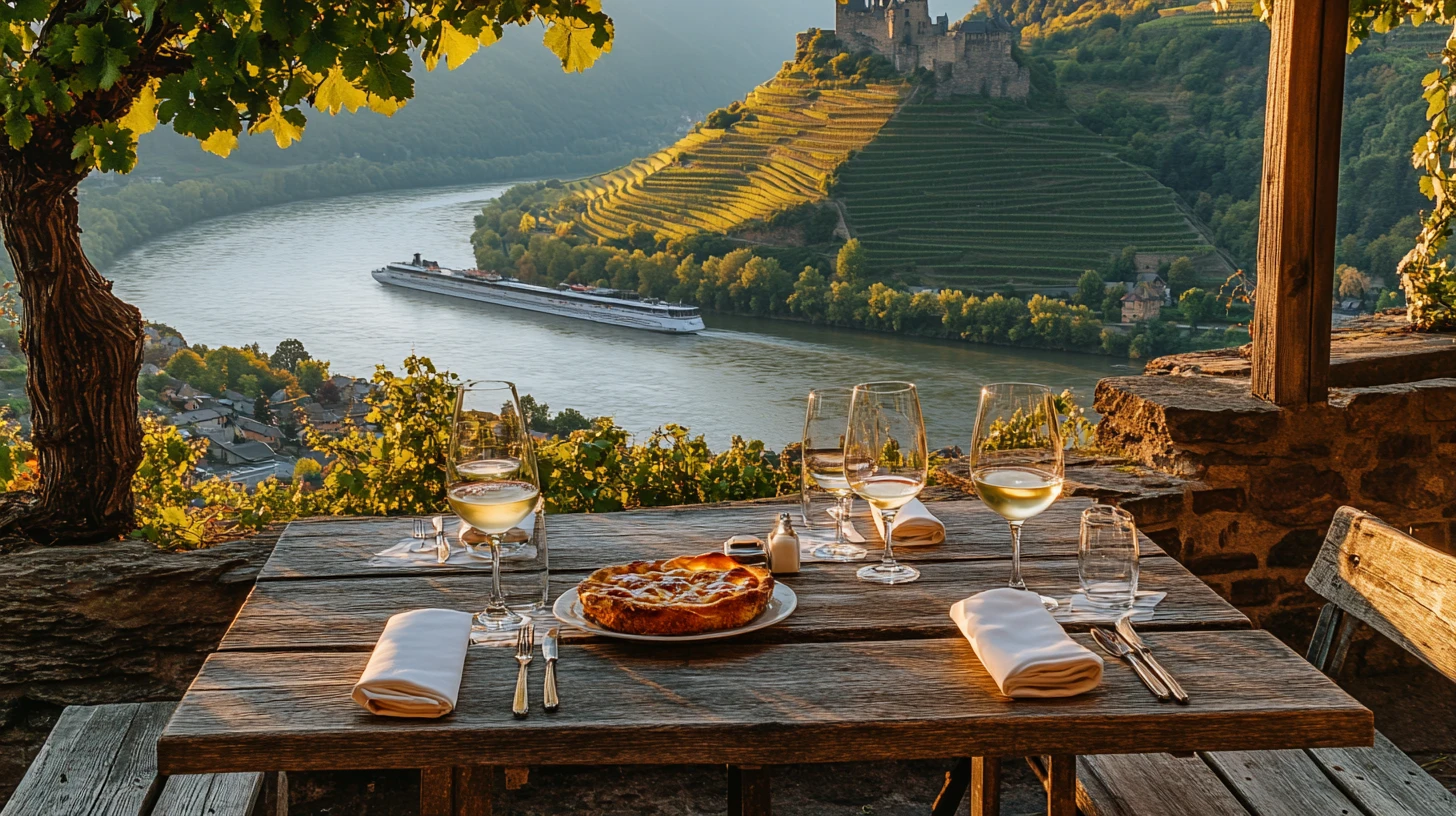
Life along the Rhine — the wine-terrace-and-river-cruise rhythm a Rhine itinerary is built around: vineyards, castles, and the boat between the wine villages.
🚢
The one rule that governs every meal
On a river cruise you are a captive diner — you cannot walk out and find another kitchen, so the decisive move happens before the trip, not at the table. File the dietary notice when you book, put the card in the maître d’s hand on embarkation day, and name the binder, not the category: a note that says ‘keine Milchprodukte’ will not reach the Milcheiweiß in a Fleischwurst unless you name it. Settle it once with the galley and it holds for the whole sailing; leave it to each meal and you are renegotiating in a room you can’t leave.
🚢
The captive galley — settle it before you sail
River-cruise dining is set menus, half-board, and buffets, eaten aboard for days at a time. That is the allergic traveler’s leverage, not their trap: a single conversation with the maître d’ on day one becomes a standing brief the galley keeps all week, and the multilingual crew works from the card. The default menus lean on wheat, dairy, and egg — breaded mains, cream sauces, pastries — so the plated alternative is what you arrange up front.
The rule: Submit the cruise line’s dietary form at booking, confirm with the maître d’ on embarkation, and hand the card. Ask for the next day’s menu the night before so substitutions are ready.
Allergen pattern: Set-menu wheat, dairy, and egg defaults; the buffet adds cross-contact.
🍷
The wine-village table — Riesling, Flammkuchen, Zwiebelkuchen
The gorge’s wine villages — Rüdesheim, Bacharach, Boppard — and their riverside Weinstuben and seasonal Straußwirtschaften are the classic shore stop. Riesling is the regional wine (sulfites). The plates are tarts: Flammkuchen on a thin wheat base with crème fraîche (dairy) and Speck (bacon), and Zwiebelkuchen, an onion tart of wheat, egg, dairy, and onion. Easy to read as ‘just a snack,’ structurally a multi-allergen plate.
The rule: Name Sulfite for the wine; for the tarts confirm the base and topping. The card carrying Weizen, Milch, Ei, and Zwiebel does the work faster than a conversation.
Allergen pattern: Wheat, dairy, egg, and onion in the tarts; sulfites in the Riesling.
🍲
The Rhenish table — Sauerbraten and the hidden gravy
The Rhineland’s signature dish is Rheinischer Sauerbraten, and its sweet-sour gravy is classically thickened with crushed Lebkuchen, Aachener Printen, or raisins — wheat and spice, with tree nuts possible if the Lebkuchen or Printen contains nuts or almond. It reads simply as ‘gravy,’ which is exactly why it is missed. The milk-protein-in-Wurst and Senf-in-sauces through-line follows you onto the river.
The rule: Ask how the Soße is thickened. The card naming Weizen, Schalenfrüchte, and Senf covers the three ways this plate hides an allergen.
Allergen pattern: Wheat and spice in the gravy, tree nuts possible; milk-in-Wurst and mustard persist.
🏰
Shore excursions — leaving the ship's safety net
On excursion days you eat ashore in small towns where English thins out and the ship’s careful accommodations don’t follow you. Cruise buffets, meanwhile, are cross-contact by design — shared serving spoons, crowded lines, dishes refilled from the kitchen. The two soft spots of an otherwise controllable trip are the buffet aboard and the unscripted lunch in town.
The rule: Pre-order a plated galley lunch for excursion days, carry sealed backup food, and hand the card in town. Treat the buffet as cross-contact unless a crew member plates you from the back.
Allergen pattern: Cross-contact at the buffet; reduced English and ad-hoc kitchens ashore.
Communication norms
Dining Etiquette & Cultural Norms
Germans value directness, so an allergy stated plainly and in writing is received as a normal, professional request — not a fuss. The allergy-critical moment is the order handoff: at a Wirtshaus or Imbiss the kitchen moves fast, and once a Wurst plate or breaded Schnitzel is in motion, the milk-protein binder and breading are already committed. The cultural norm is to ask for the Allergenkennzeichnung and hand the card at the start, not to negotiate mid-meal. Tipping is modest (round up, ~5–10%) and is not a lever for attention. Communal Biergarten and Brotzeit sharing assumes everyone eats from the board — flag cross-contact before the plates arrive.
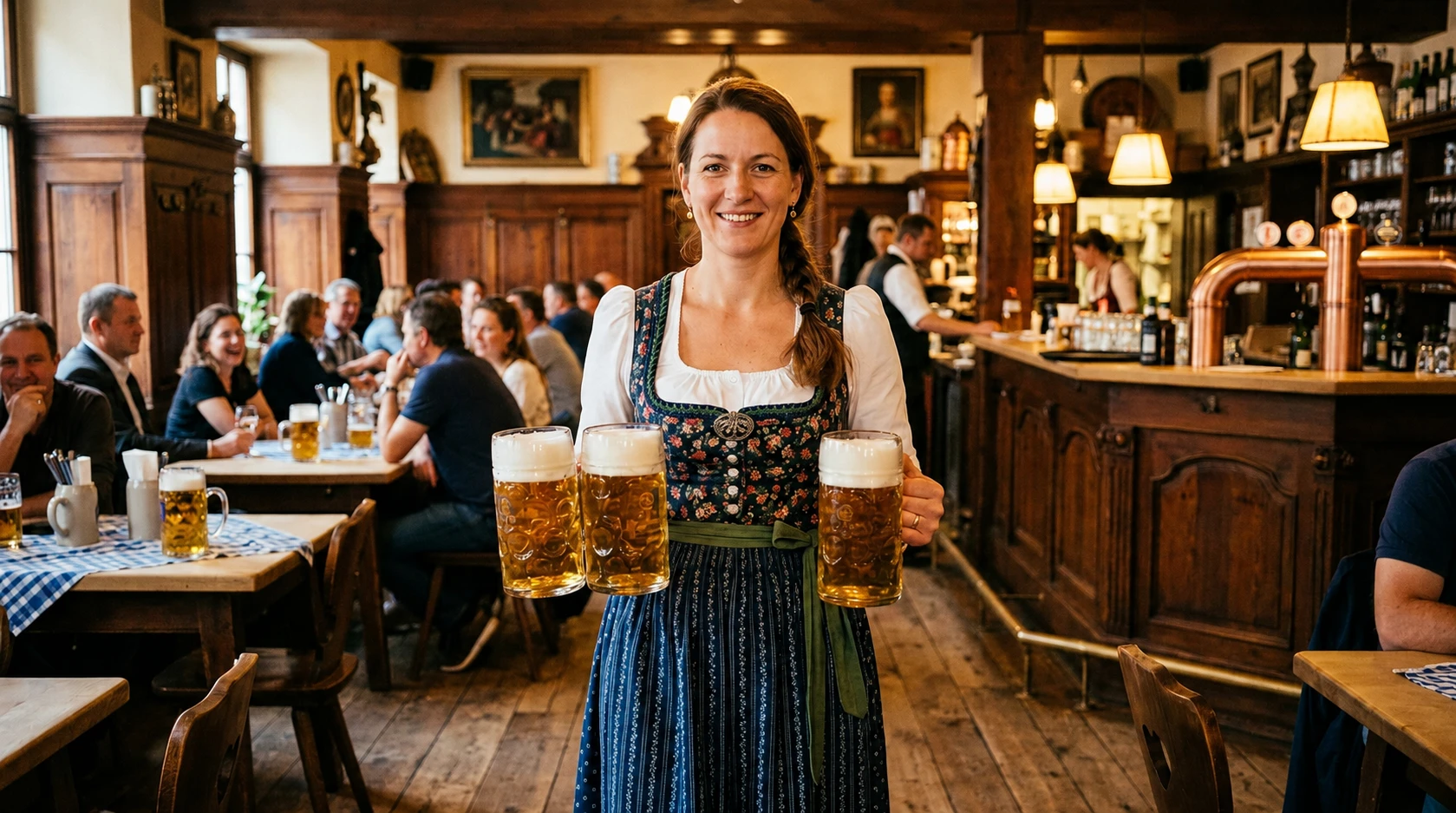
The Kellnerin who carries the room — in a German Wirtshaus, service is fast, direct, and physical, which is why the written card and the up-front question beat a mid-meal conversation.
💬
How to raise an allergy in German culture
Direct and written. Hand the card and say ‘schwere Lebensmittelallergie’ (severe food allergy). German service culture treats this as a professional matter, not a personal preference, and will not press you. The cultural mistake is to soften it — downplaying (‘a little allergic’) reads as ‘can probably eat around it.’ The second mistake for milk-allergic travelers is naming only ‘Milch’: name ‘Milcheiweiß’ and ask about the Wurst, because the cook does not classify sausage as dairy.
📝
Written beats verbal — and ask for the legend
Even in English-fluent Berlin and Munich, a written card plus the menu's allergen legend outperforms a verbal disclosure. German service is fast, the line speaks German, and the dish passes through several hands. Most printed menus carry numbered allergen footnotes; if you do not see them, ask ‘Haben Sie eine Allergenkennzeichnung?’ By LMIDV the venue must be able to provide it.
🍺
Communal sharing — flag before the board arrives
Biergarten Brotzeit and festival tables assume the whole bench shares. If cross-contact rules out the shared board, say so at order time, before the kitchen plates it — and remember the Biergarten tradition lets you bring your own food and buy only the drink, which is the cleanest route around a shared board.
📞
Advance notice — when it helps and when it doesn't
Imbiss and festival stands: not possible, walk up and ask for the Allergenliste. Wirtshäuser and sit-down restaurants: helpful, mention at booking. Chef-driven and Michelin venues: standard, 48 hours ahead. A call ‘telefonisch anmelden’ mentioning a severe allergy signals you take the kitchen seriously and lets them prepare.
Tipping in Germany: Rounding up or ~5–10% is standard, stated to the server when you pay (‘stimmt so’ or naming the total). Tipping is not a tool for allergy attention — it neither helps before the meal nor remedies a problem after. The written card and the up-front question do the work.
Communication
Essential Safety Phrases
Six scenarios cover the working German an allergic traveler needs. The card carries the formal declaration; these phrases handle the follow-up. The Milcheiweiß-in-Wurst and Senf-in-Soße distinctions are the ones to drill — they are where the kitchen's category blindness lives.
Scenario 01
Declaring your allergy
DE
Ich habe eine schwere Lebensmittelallergie. Hier ist meine Karte.
Ish hábe áine schwére Lébensmittel-allergie. Hier ist máine Kárte.
I have a severe food allergy. Here is my card.
DE
Ich bin allergisch gegen Milch — auch das Milcheiweiß in Wurst.
Ish bin allérgish géghen Milsh — auch das Milsh-áiwaiss in Vúrst.
I am allergic to milk — including the milk protein in sausage.
Does this sausage contain milk protein or milk powder?
DE
Ist in der Soße Senf?
Ist in der Sósse Sénf?
Is there mustard in the sauce?
DE
Sind in diesem Gebäck Schalenfrüchte oder Marzipan?
Zint in díezem Gebéck Scháalen-frueshte óder Mártsi-paan?
Are there tree nuts or marzipan in this pastry?
Scenario 03
Confirming the kitchen understood
DE
Hat der Koch meine Karte gelesen?
Hat der Koch máine Kárte geléezen?
Has the chef read my card?
DE
Ohne [Senf / Milch / Nüsse], bitte.
Óne [Sénf / Milsh / Núesse], bítte.
Without [mustard / milk / nuts], please.
Scenario 04
Asking about cross-contact
DE
Wird die Fritteuse auch für Paniertes oder Fisch benutzt?
Virt die Frittöze auch für Paníertes óder Fish benútzt?
Is the fryer also used for breaded food or fish?
DE
Wird das Brot im selben Ofen wie Nussgebäck gebacken?
Virt das Broot im sélben Ófen vie Núss-gebeck gebácken?
Is the bread baked in the same oven as nut pastries?
Scenario 05
Replacing an auto-injector
DE
Ich brauche einen Adrenalin-Autoinjektor. Ich habe ein Rezept dabei.
Ish bráuche áinen Adrenalíin-Áuto-injéktor. Ish hábe áin Retsépt.
I need an adrenaline auto-injector. I have a prescription.
Scenario 06
Emergency
DE
Anaphylaxie! Ich habe mein Adrenalin benutzt. Rufen Sie 112.
Anafylaxíe! Ish hábe máin Adrenalíin benútzt. Rúfen Zie áins-áins-tswái.
Anaphylaxis! I have used my adrenaline. Call 112.
DE
Ich brauche einen Krankenwagen.
Ish bráuche áinen Kránken-váaghen.
I need an ambulance.
Why a card matters in Germany: Germany has no single government allergy-communication template comparable to Japan's CAA sheet. The LMIDV gives legal backing for on-request restaurant disclosure, and printed menus often carry numbered allergen legends, but there is no public-facing card. A well-written Hochdeutsch card that names Milcheiweiß, Senf, and Schalenfrüchte/Marzipan fills the gap the legend's broad categories leave open.
Pre-Trip Preparation
Allergy-Specific Packing List for Germany
Standard EU packing list with three Germany-specific additions: a Hochdeutsch card naming Milcheiweiß (the milk binder in Wurst) and Senf specifically; the card image on your phone lockscreen for Imbiss and festival moments where a paper card is too slow; and a pharmacy plan for Apotheken (including the Notdienst rotation) in your travel cities.
💊 Medical essentials
✓
Two adrenaline auto-injectors (carry on-person, not in checked bag) — Adrenaline auto-injectors are prescription medicines in Germany; brand and strength availability varies by pharmacy and over time, so same-day replacement of your exact device is not guaranteed.
✓
Antihistamines (cetirizine, loratadine, diphenhydramine) — Available over the counter at any Apotheke, but bringing your own avoids brand confusion and after-hours Notdienst hunts.
✓
Doctor's letter on letterhead naming medications, dosages, and diagnosis — Rarely needed at the border, but required for a mid-trip Apotheke refill or a hospital visit.
✓
Prescription copy, English plus a German translation — Larger city Apotheken may dispense against a translated foreign Rx; smaller ones will not.
✓
Asthma inhaler if relevant — Pollen can be a strong trigger in spring and summer; smoke and crowding at festival tents can also affect reactive airways.
🗂️ Communication tools
✓
Hochdeutsch allergy card naming Milcheiweiß, Senf, and Schalenfrüchte/Marzipan explicitly — The single most useful prep item. Closes the category gap between the German kitchen's 'Wurst = meat' reflex and the milk protein actually in it.
✓
Card image saved to phone lockscreen — For Currywurst and Döner Imbiss counters and festival stands where you cannot pull a paper card out fast enough.
✓
Audio file of your German allergy declaration — For loud Biergarten and Oktoberfest tents; play once, then hand the card.
✓
Printed pocket guide for the cities you'll visit — Offline reference for hospital addresses, Apotheke Notdienst, and an allergen-aware restaurant shortlist.
🎯 At-destination habits
✓
Ask for the Allergenkennzeichnung at every sit-down venue, before ordering — By LMIDV the venue must have it; printed menus often hide it in numbered footnotes.
✓
At Imbiss stands, name Milcheiweiß and Senf — not just 'no dairy' — The milk binder in the sausage and the mustard in the sauce do not surface from a vague verbal request.
✓
Treat Konditorei and Christmas-market sweets as nut/marzipan by default — Marzipan and tree nuts are structural in German baking; assume presence unless told otherwise.
✓
For Oktoberfest or a Volksfest, plan a verified single item and bring sealed backup food — Allergen information is hard to obtain at festival speed and shared boards make cross-contact likely; a verified single item plus sealed backup food is the safer plan.
Emergency
Emergency Infrastructure
Germany has a well-resourced emergency system. 112 is the EU-universal number and reaches the Rettungsdienst (ambulance) and fire service nationwide, with a Notarzt (emergency physician) dispatched to serious cases; 110 is police. German emergency services and hospital emergency departments are equipped to treat anaphylaxis — call 112 immediately. University hospitals in the major cities have allergy and intensive-care capacity.
112
EU Universal Emergency (Rettungsdienst / Notarzt / Feuerwehr)
Free from any phone, no area code, multilingual dispatch in cities. State you have anaphylaxis ('Anaphylaxie') and whether you have used adrenaline. For police only, dial 110.
Other useful numbers: Police (110): non-medical emergencies. Aerztlicher Bereitschaftsdienst (116117): nationwide non-emergency medical on-call service (after-hours GP advice). Giftnotruf (regional poison-control lines, e.g. Berlin 030 19240): for ingestion/poisoning questions.
How the German system works: Emergency care is provided to all. EU travelers with EHIC/GHIC are covered through the statutory insurance (GKV); non-EU travelers should expect to pay and reclaim via travel insurance. The Notaufnahme handles acute care; for non-urgent follow-up, an Apotheke (pharmacy) and the 116117 service are the right channels. Epinephrine is available in every emergency department.
Charite – Universitätsmedizin Berlin (Campus Mitte)
Chariteplatz 1, 10117 Berlin
Operates the Allergie-Centrum-Charite, one of Europe's leading allergy units; full emergency department and intensive care.
Berlin
LMU Klinikum (Klinikum der Universität München, Campus Großhadern)
Marchioninistraße 15, 81377 München
Major university hospital with allergy/dermatology and emergency departments; primary receiving for the Munich/Bavaria region.
Munich
Universitätsklinikum Hamburg-Eppendorf (UKE)
Martinistraße 52, 20246 Hamburg
Tertiary university hospital, full emergency and intensive care; primary receiving for the Hanseatic North.
Hamburg
Universitätsklinikum Frankfurt
Theodor-Stern-Kai 7, 60590 Frankfurt am Main
University hospital with allergology and emergency medicine; central Rhine-Main receiving hospital, close to Frankfurt Airport.
Frankfurt
Universitätsklinikum Köln
Kerpener Straße 62, 50937 Köln
University hospital serving the Rhineland; full emergency department and specialist allergy/dermatology.
Cologne
Regulation
Allergen Labeling Law
Germany implements EU Regulation 1169/2011 (Food Information to Consumers) through the Lebensmittelinformations-Durchführungsverordnung (LMIDV). 14 mandatory allergens on packaged-food labels, distinguished in the Zutaten list; most printed menus also carry numbered allergen legends, and restaurants must disclose on request. The law's category labels are broad: 'Milch' covers the milk protein that binds Wurst, but the cook does not picture sausage when asked about dairy. This is the legal-versus-practical gap your card has to close.
Verordnung (EU) Nr. 1169/2011 / Lebensmittelinformations-Durchführungsverordnung (LMIDV) — transposing EU Regulation 1169/2011 (Food Information to Consumers) into German law. Restaurant disclosure required: EU FIC Article 44 requires non-prepackaged food (restaurants, bakeries, butcher counters) to disclose the 14 allergens. Disclosure on the menu itself is not mandatory, but most German menus carry numbered allergen legends; on-request disclosure is required. Enforced by the Länder food-control authorities under the federal BVL (Bundesamt für Verbraucherschutz und Lebensmittelsicherheit).
EU FIC Annex II mandatory allergen. Must be declared on all pre-packaged foods and disclosed on request at all food-service venues (Restaurant, Wirtshaus, Imbiss, Bäckerei, Konditorei). Taxonomy mapping: wheat.
02. Crustaceans · Krebstiere (Krustentiere)
EU FIC Annex II mandatory allergen. Must be declared on all pre-packaged foods and disclosed on request at all food-service venues (Restaurant, Wirtshaus, Imbiss, Bäckerei, Konditorei). Taxonomy mapping: shellfish.
03. Eggs · Eier
EU FIC Annex II mandatory allergen. Must be declared on all pre-packaged foods and disclosed on request at all food-service venues (Restaurant, Wirtshaus, Imbiss, Bäckerei, Konditorei). Taxonomy mapping: egg.
04. Fish · Fische
EU FIC Annex II mandatory allergen. Must be declared on all pre-packaged foods and disclosed on request at all food-service venues (Restaurant, Wirtshaus, Imbiss, Bäckerei, Konditorei). Taxonomy mapping: fish.
05. Peanuts · Erdnüsse
EU FIC Annex II mandatory allergen. Must be declared on all pre-packaged foods and disclosed on request at all food-service venues (Restaurant, Wirtshaus, Imbiss, Bäckerei, Konditorei). Taxonomy mapping: peanut.
06. Soybeans · Sojabohnen
EU FIC Annex II mandatory allergen. Must be declared on all pre-packaged foods and disclosed on request at all food-service venues (Restaurant, Wirtshaus, Imbiss, Bäckerei, Konditorei). Taxonomy mapping: soy.
EU FIC Annex II mandatory allergen. Must be declared on all pre-packaged foods and disclosed on request at all food-service venues (Restaurant, Wirtshaus, Imbiss, Bäckerei, Konditorei). Taxonomy mapping: milk.
EU FIC Annex II mandatory allergen. Must be declared on all pre-packaged foods and disclosed on request at all food-service venues (Restaurant, Wirtshaus, Imbiss, Bäckerei, Konditorei). Taxonomy mapping: tree_nuts.
09. Celery · Sellerie
EU FIC Annex II mandatory allergen. Must be declared on all pre-packaged foods and disclosed on request at all food-service venues (Restaurant, Wirtshaus, Imbiss, Bäckerei, Konditorei). Taxonomy mapping: seeds_spices.
10. Mustard · Senf
EU FIC Annex II mandatory allergen. Must be declared on all pre-packaged foods and disclosed on request at all food-service venues (Restaurant, Wirtshaus, Imbiss, Bäckerei, Konditorei). Taxonomy mapping: seeds_spices.
11. Sesame seeds · Sesamsamen
EU FIC Annex II mandatory allergen. Must be declared on all pre-packaged foods and disclosed on request at all food-service venues (Restaurant, Wirtshaus, Imbiss, Bäckerei, Konditorei). Taxonomy mapping: sesame.
12. Sulphur dioxide and sulphites >10mg/kg · Schwefeldioxid und Sulfite
EU FIC Annex II mandatory allergen. Must be declared on all pre-packaged foods and disclosed on request at all food-service venues (Restaurant, Wirtshaus, Imbiss, Bäckerei, Konditorei). Taxonomy mapping: sulfites.
13. Lupin · Lupinen
EU FIC Annex II mandatory allergen. Must be declared on all pre-packaged foods and disclosed on request at all food-service venues (Restaurant, Wirtshaus, Imbiss, Bäckerei, Konditorei). Taxonomy mapping: legumes.
14. Molluscs · Weichtiere (Mollusken)
EU FIC Annex II mandatory allergen. Must be declared on all pre-packaged foods and disclosed on request at all food-service venues (Restaurant, Wirtshaus, Imbiss, Bäckerei, Konditorei). Taxonomy mapping: shellfish.
Milk protein is a hidden one: Emulsified Wurst (Brühwurst) may contain milk protein (Milcheiweiß) or milk powder, depending on recipe (some use ice/water, phosphate, or starch instead). On packaging it appears in the Zutaten list as Milcheiweiß, Magermilchpulver, Molkeneiweiß, or Kasein. In a restaurant it falls under allergen category milk — ask specifically about the sausage, since the cook does not classify Wurst as a dairy product.
Mustard (Senf) and celery (Sellerie) are quiet sauce allergens: Both are separate EU FIC allergens that hide inside the word ‘Soße’ (sauce), in Brühe (stock), and in dressings. Senf is common in Remoulade, dressings, and many sauces (recipe-dependent in Königsberger Klopse); Sellerie is common in Suppengrün, stocks, and soups. Ask specifically and name them on the card.
Numbered menu legends: Most printed German menus mark allergens with small superscript letters or numbers mapped to a footnote key (e.g. the additive/allergen Kennzeichnung). If you do not see it, ask ‘Haben Sie eine Allergenkennzeichnung?’ By LMIDV the venue must be able to provide it.
Medication
EpiPen Import & Local Availability
Adrenaline auto-injectors are personal-use prescription medicines; travelers may carry them into Germany with a prescription and a doctor’s letter. BfArM (Bundesinstitut für Arzneimittel und Medizinprodukte) is the national medicines authority; EpiPen, Jext, and Emerade has marketed brands including EpiPen, Jext, and Emerade, but availability and strength vary by pharmacy and over time — verify current local stock before travel.
Personal-use medicine: Travelers may carry adrenaline auto-injectors into Germany as personal-use prescription medicine. Carry the device in its original pharmacy packaging with a doctor’s letter naming the medication, your diagnosis, and dosage.
01 📋
Carry both auto-injectors (recommended: two devices) in carry-on, not checked baggage.
02 ✉️
Carry a doctor’s letter on letterhead naming the medication (epinephrine/adrenaline), dosage, your diagnosis, and brand. English is fine; a German translation helps at a pharmacy.
03 🛂
Keep the device in original pharmacy packaging with the prescription label visible.
04 💊
No customs declaration is routinely required for personal-use prescribed medication in EU/Schengen travel. Non-Schengen arrivals carry the documentation in case of inspection.
05 🏥
For mid-trip replacement, a German Apotheke can dispense an auto-injector against a German prescription; the Aerztlicher Bereitschaftsdienst (116117) or a hospital can issue one. Some Apotheken accept a translated foreign Rx; smaller ones will not.
Auto-injector brand landscape in Germany: Adrenaline auto-injectors are prescription medicines in Germany; brands such as EpiPen, Jext, and Emerade have been marketed, but the device and strength on a given shelf vary over time and by pharmacy. Bring two devices; for replacement seek a German prescription via a doctor, 116117, or emergency care. Verify current availability and pricing with BfArM or a major-chain Apotheke in your travel city before departure. Pediatric strengths are stocked at larger pharmacies but not every neighborhood Apotheke.
Confidence: MEDIUM. Verify current device availability and pricing with BfArM or a Berlin/Munich major-chain Apotheke before travel. Brand and stock policies change.
Regulatory authority:BfArM — Bundesinstitut für Arzneimittel und Medizinprodukte is the German regulatory authority for medicines — it authorises and monitors medicinal products and participates in EU/EMA procedures. Traveler-carried auto-injectors fall under personal-use medicine and customs rules, not a separate BfArM import process. Check current marketing authorizations there before you travel.
Traveler Reports
Traveler Voices — Community Reports
Illustrative composite scenarios drawn from common Prepared Travel intake patterns and public traveler reports. Initials and locations are stylized; quotes are composite, not first-person verbatim. Replace with verified community testimony once intake-ID-tagged quotes are available.
I'd ordered Currywurst a dozen times before someone showed me the packaging — the sausage listed Milcheiweiß. I'm dairy-allergic. I'd been treating Wurst as 'just meat' the whole trip. Now the first thing I ask is whether the sausage has a milk-protein binder.
Daniel R. · Berlin · 2024 · Milk (in Wurst)
Königsberger Klopse looked like plain meatballs to me. The white sauce had mustard in it — I reacted before the second bite. I'd never have guessed Senf could turn up in a 'meatball' dish. Now I ask 'ist Senf in der Soße?' every time.
Priya S. · Munich · 2023 · Mustard
The Dresden Christmas market was the hardest hour of the trip with a nut allergy. Gebrannte Mandeln roasting at every stall, Stollen with a marzipan core, Lebkuchen everywhere. The smell alone was almonds. I found one allergen-aware bakery and stuck to it.
Megan K. · Dresden · 2024 · Tree Nuts / Marzipan
References & Transparency
Sources, Citations & Data Confidence
View source citations
▼
1
European Parliament and Council. “Regulation (EU) No 1169/2011 on the provision of food information to consumers (EU FIC).” 2011. eur-lex.europa.eu — Primary regulatory source for the EU 14 allergen labeling regime. HIGH confidence.
2
Bundesministerium der Justiz. “Lebensmittelinformations-Durchführungsverordnung (LMIDV).” 2017. gesetze-im-internet.de — German national implementation of EU FIC, including non-prepackaged (restaurant) disclosure. HIGH confidence.
3
Bundesinstitut für Arzneimittel und Medizinprodukte (BfArM). “Arzneimittel-Informationssystem — adrenaline auto-injector authorisations (EpiPen, Jext, Emerade).” 2025. bfarm.de — German national medicines authority; confirms auto-injector availability and import framework. HIGH confidence.
4
Bundesamt für Verbraucherschutz und Lebensmittelsicherheit (BVL). “Kennzeichnung von Allergenen.” 2025. bvl.bund.de — Federal food-safety authority; provides federal coordination and guidance, while enforcement is primarily by the Länder food-control authorities. HIGH confidence.
5
Deutscher Allergie- und Asthmabund (DAAB). “Nahrungsmittelallergien — Patienteninformationen.” 2025. daab.de — Germany's national allergy and asthma patient organisation; prevalence and label-reading guidance. HIGH confidence.
6
Deutsche Zöliakie-Gesellschaft (DZG). “Glutenfrei unterwegs — Aufzeichnungen und Restaurantliste.” 2025. dzg-online.de — German Coeliac Society; the gluten-free infrastructure behind Germany's strong celiac awareness. MEDIUM-HIGH confidence.
7
Charite – Universitätsmedizin Berlin. “Allergie-Centrum-Charite.” 2025. allergie-centrum.charite.de — Leading German academic allergy centre; clinical reference for anaphylaxis care. HIGH confidence.
8
Worm M. et al. “Food-induced anaphylaxis in Germany — data from the European Anaphylaxis Registry.” Allergo Journal International, 2018-2023. anaphylaxie.net — German/European anaphylaxis registry; triggers and clinical patterns. MEDIUM confidence (epidemiology evolves).
9
Prepared Travel community reports. “Berlin, Munich, Hamburg, and Oktoberfest traveler intake notes 2023–2025.” 2025. prepared.travel/community — Aggregated allergic-traveler experience reports on Wurst milk-protein surprises, mustard-in-sauce reactions, and festival-tent navigation. MEDIUM confidence.
10
Auswärtiges Amt (German Federal Foreign Office). “Reisen mit Medikamenten / traveling with medicinal products — personal-use quantities.” 2025. auswaertiges-amt.de — Basis for the personal-use medicine framing: travelers may carry a personal supply (commonly cited as up to ~3 months) with documentation. MEDIUM confidence (verify current guidance).
11
European Medicines Agency (EMA). “Adrenaline auto-injectors — referral and guidance.” 2025. ema.europa.eu — EU-level guidance confirming AAIs are life-saving and recommending patients carry two devices. HIGH confidence.
Data confidence ratings
▼
Data point
Confidence
Notes
Emergency number (112)
● HIGH
Pan-EU standard — Rettungsdienst / Notarzt dispatch
EU FIC mandatory allergens (14)
● HIGH
Regulation 1169/2011 transposed via the LMIDV — no Germany-specific supplements
Non-prepacked on-request disclosure
● HIGH
FIC Art. 44 + LMIDV — written, electronic, or oral with accessible documentation
Adrenaline auto-injector import (personal use)
● HIGH
EU member state — personal-use prescription medicine; doctor’s letter prudent, not a BfArM import process
Milk-protein-in-Wurst risk pattern
● HIGH
Documented for emulsified Brühwurst; recipe-dependent — verify the Zutaten every time
Difficulty score (4/10)
● MEDIUM
Editorial composite — combines structural-legal protection with cultural-practical intelligence
Hospital addresses & allergy-unit specifics
● MEDIUM
Charité Allergie-Centrum confirmed; reconfirm the others against current hospital directories before publish
Language / English-ability figures
● MEDIUM
Softened to qualitative; source with Eurobarometer/census if re-quantified
AAI brand / strength pharmacy stock
● MEDIUM
EpiPen, Jext, Emerade have been marketed; current shelf stock varies by pharmacy and over time — verify
Traveler voice quotes
● MEDIUM
Illustrative composites drawn from common Prepared Travel intake patterns; not first-person verbatim
This page is a living document. Labeling laws change, hospitals reorganise departments, and kitchen awareness improves over time. Last verified June 2026.
Auto-injector note: Adrenaline auto-injectors are prescription medicines in Germany; brand and strength availability (EpiPen, Jext, and Emerade have been marketed) vary by pharmacy and over time, and traveler-carried devices fall under personal-use medicine/customs rules. Bring two devices and documentation; confirm current local availability with BfArM or a major-chain Apotheke before departure.
You've done the research. Now build your Germany allergy card.
The Rhine is waiting. Go prepared.
Generate your Germany food allergy card in Standard German — naming Milcheiweiß, Senf, and Schalenfrüchte/Marzipan directly, the terms that close the kitchen-category gap English labels leave open. Your Germany allergy translation card is ready in two minutes.